On this page
- 01Key takeaways
- 02Why plan paid and organic together?
- 03Which posts should you put money behind?
- 04What goes in the calendar for an ad?
- 05How do you time ads against the organic plan?
- 06When should you not plan paid social?
- 07What does this look like in practice?
- 08Paid and organic checklist
- 09Next step
- 10Sources and further reading
- 11Frequently asked questions
Key takeaways
A paid and organic content calendar puts ads and normal posts in one view, so offers, ads and posts support each other instead of clashing. Plan ads from organic posts that have already worked, line their dates up with the offers on your calendar, and mark the budget and objective in the row. Small budgets work best behind proven posts.
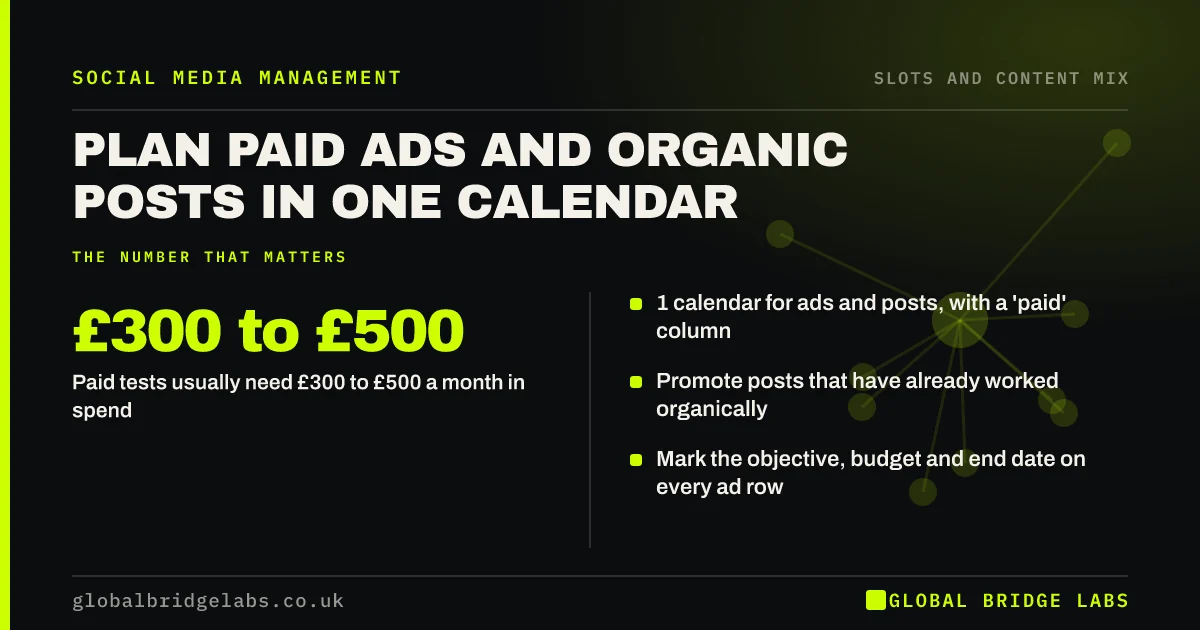
- 1 calendar for ads and posts, with a 'paid' column.
- Promote posts that have already worked organically.
- Paid tests usually need £300 to £500 a month in spend.
- Mark the objective, budget and end date on every ad row.
Want ads planned into next month's calendar? Message us on WhatsApp.
Chat on WhatsApp →Why plan paid and organic together?
Plan them together because they share an audience and a message. An ad for an offer that the organic posts never mention looks out of place, and organic posts that sell the same week as an ad compete for the same people. One calendar shows the whole month, so the offer, the ad and the supporting posts land in the right order.
Which posts should you put money behind?
Put money behind posts that have already done well organically with the right people: those that brought messages, saves or enquiries. A proven post usually performs better as an ad than one written for the ad. Proof posts and clear offers are the usual choices; general brand posts rarely justify the spend for a small business.
What goes in the calendar for an ad?
Mark the ad's start and end date, the objective (messages, bookings, leads or traffic), the budget, the audience in a few words, the post or creative it uses and a tracked link. As an indicative market range, paid social tests for small businesses usually need £300–£500 a month in ad spend to learn anything, and LinkedIn often needs £1,000 or more.
How do you time ads against the organic plan?
Start the organic posts first, then add the ad once the best one is clear, and run it through the offer's main window. Keep the organic posts helpful during the ad, so followers do not see the same sales message twice a day. End the ad on the offer's closing date and mark it in the calendar.
When should you not plan paid social?
Do not plan paid social until the organic posts and the profile are working: a clear bio, a working link and someone replying to messages. Paying to send people to a weak profile wastes the budget. And do not plan ads you cannot track, because you will not know whether they worked.
What does this look like in practice?
A pattern we see: ads planned by one person and posts by another, so an offer ad runs while the page posts something unrelated and nobody is watching the messages. One calendar with a paid column usually fixes the clash and the reply gap together.
Paid and organic checklist
- Add a 'paid' column to your calendar.
- Promote posts that already worked.
- Record objective, budget, audience and end date.
- Use a tracked link on every ad.
- Keep organic posts helpful while ads run.
Next step
Look at last month's best organic post. If it brought messages or enquiries, it is the first candidate for next month's ad.
Message us on WhatsApp and we will discuss your requirements for paid social, or book a 30-minute consultation.
Chat on WhatsApp →Sources and further reading
- Meta Business Help Centre · Meta
- URL builders: collect campaign data with custom URLs · Google Analytics Help
- Recognising ads: brand-owned and paid social media · ASA / CAP
Frequently asked questions
Should ads be in my social media content calendar?
Yes. Putting ads and organic posts in one calendar keeps offers, ads and posts in the right order, avoids two sales messages competing, and shows when someone needs to watch the messages more closely.
Which social media posts should I promote with ads?
Posts that have already performed well organically with the right people, especially proof posts and clear offers that brought messages or enquiries. A proven post usually performs better as an ad than one written specially.
How much should a small business spend on social media ads?
As an indicative market range, paid social tests usually need £300 to £500 a month in ad spend to produce useful results, and LinkedIn often needs £1,000 or more. Start small, track results and increase only what works.
Written by

Global Bridge Labs (GBL) is a UK–Sri Lanka partner for social media, websites and BPO. Everything here comes from client delivery, not theory.