On this page
- 01Key takeaways
- 02What are the five steps of a monthly content calendar?
- 03What does each step produce?
- 04Why does the order matter?
- 05Which step do small businesses skip most?
- 06When should you not follow all five steps?
- 07What does this look like in practice?
- 08Five-step checklist
- 09Next step
- 10Sources and further reading
- 11Frequently asked questions
Key takeaways
The content calendar steps that hold up in a small business are review, map, slot, fill and ship, done in that order once a month. We call it the GBL Five-Step Month. Each step produces one thing the next step needs, so skipping one, usually review or slot, is what makes calendars collapse by week three.
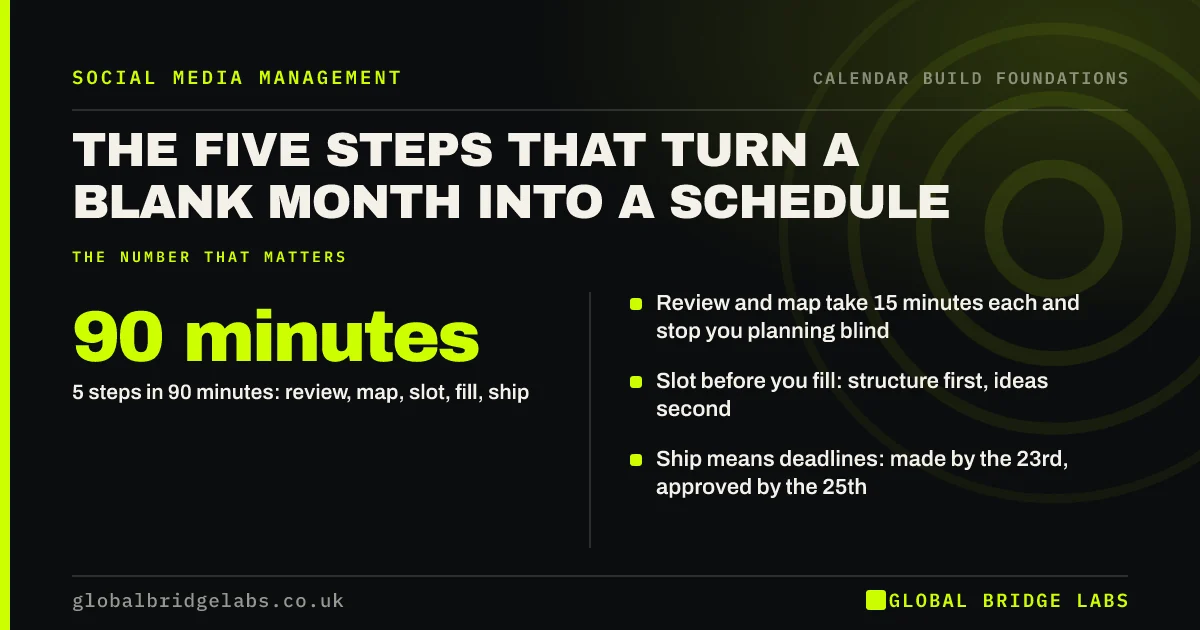
- 5 steps in 90 minutes: review, map, slot, fill, ship.
- Review and map take 15 minutes each and stop you planning blind.
- Slot before you fill: structure first, ideas second.
- Ship means deadlines: made by the 23rd, approved by the 25th.
Want the five steps run with your team once? Message us on WhatsApp.
Chat on WhatsApp →What are the five steps of a monthly content calendar?
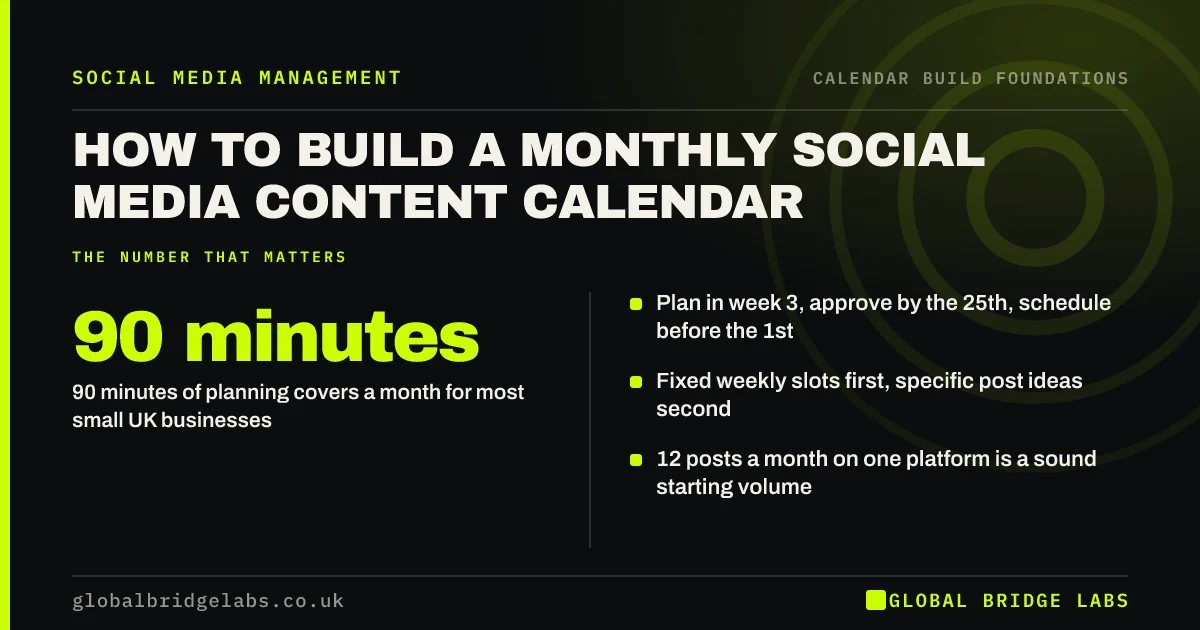
The five steps are review, map, slot, fill and ship. Review looks back at last month. Map marks the dates and goal for next month. Slot sets the repeating weekly pattern. Fill puts a specific post in every slot. Ship turns the plan into finished, approved and scheduled posts. Together they take about 90 minutes of planning.
What does each step produce?
Each step has one output, which is how you know it is finished. If a step has not produced its output, do not move on, because the next step will be guesswork.
- Review: a list of three posts to repeat, three to drop and last month's completion rate.
- Map: next month's dates on a single page and one written goal.
- Slot: a weekly grid of days, platforms, pillars, formats and owners.
- Fill: one specific post and a one-line brief in every slot.
- Ship: deadlines for making, approval and scheduling, with a name against each.
Why does the order matter?
The order matters because each step narrows the choices for the next. Mapping dates before slotting stops you planning a product post on a bank holiday when nobody can reply. Slotting before filling stops the month becoming a pile of good ideas with no rhythm. Most failed calendars start at step 4, with ideas, and never set the structure that would hold them.
Which step do small businesses skip most?
Review is skipped most, because the month has already ended and the next one feels more urgent. Without it, the same weak post types keep coming back and the best ones are forgotten. Fifteen minutes is enough: compare published with planned, note enquiries from social media, and pick the three posts worth repeating.
When should you not follow all five steps?
Shorten the steps when the month is simple. If you post twice a week on one platform with no offers or events, review and map can be five minutes together. Do not shorten slot or ship, because those are what make the posts appear. And if you are building your very first calendar, start with slot, because there is no last month to review.
What does this look like in practice?
A pattern we see: a small team spends an hour every month brainstorming post ideas, ends with a long list, and publishes about half of it. Working through the five steps instead usually produces fewer ideas but a finished month, because every idea lands in a slot with an owner and a deadline.
Five-step checklist
- Review: completion rate, enquiries, three to repeat, three to drop.
- Map: business dates, public dates, dates to avoid, one goal.
- Slot: days, platforms, pillars, formats, owners.
- Fill: a specific post and a one-line brief in every slot.
- Ship: made by the 23rd, approved by the 25th, scheduled before the 1st.
Next step
Write the five step names down the side of a page and, next to each, the output you will have when it is done. Use that page as the agenda for your next planning session.
Message us on WhatsApp for the five-step agenda, or book a 30-minute consultation.
Chat on WhatsApp →Sources and further reading
- Meta Business Help Centre · Meta
- LinkedIn Pages best practices · LinkedIn
Frequently asked questions
What are the steps to create a content calendar?
Review last month, map next month's dates and goal, set the weekly slots, fill each slot with a specific post, then make, approve and schedule the posts. Doing them in that order once a month takes about 90 minutes of planning for one platform.
Which content calendar step takes longest?
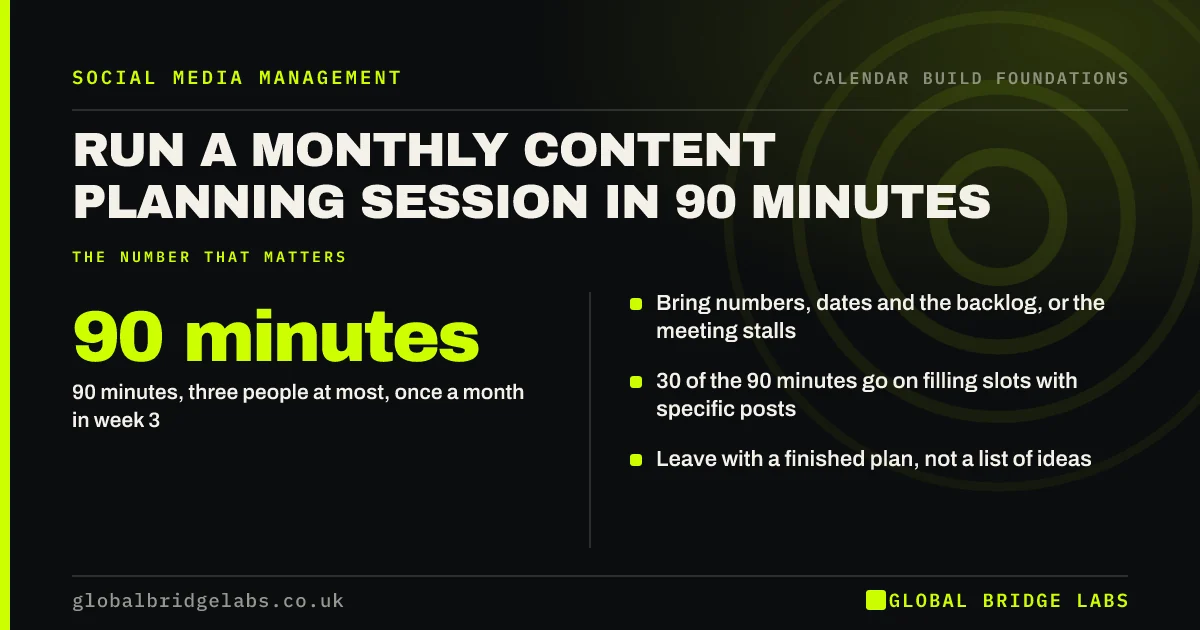
Filling the slots usually takes longest, about 30 minutes of the 90, because each slot needs a specific post and a one-line brief. It gets faster each month if you keep a backlog of ideas and a log of customer questions to draw from.
Can I skip reviewing last month?
You can shorten it but should not skip it. Without a review, weak post types keep coming back and the posts that brought enquiries are not repeated. Fifteen minutes comparing planned with published and noting the three best posts is enough.
Written by

Global Bridge Labs (GBL) is a UK–Sri Lanka partner for social media, websites and BPO. Everything here comes from client delivery, not theory.