On this page
- 01Key takeaways
- 02Which platforms still work without paid support?
- 03What does time buy that money would have?
- 04Where should a first small budget go?
- 05What free things do businesses skip?
- 06What are the limits of a no-budget approach?
- 07What does this look like in practice?
- 08How do you ask for reviews without nagging?
- 09Next step
- 10Sources and further reading
- 11Frequently asked questions
Key takeaways
Organic still works on channels where distribution is not primarily paid: local groups, short-form video, Pinterest and a Google Business Profile. It works poorly on channels where organic page reach has been squeezed. Choose accordingly rather than fighting the economics.
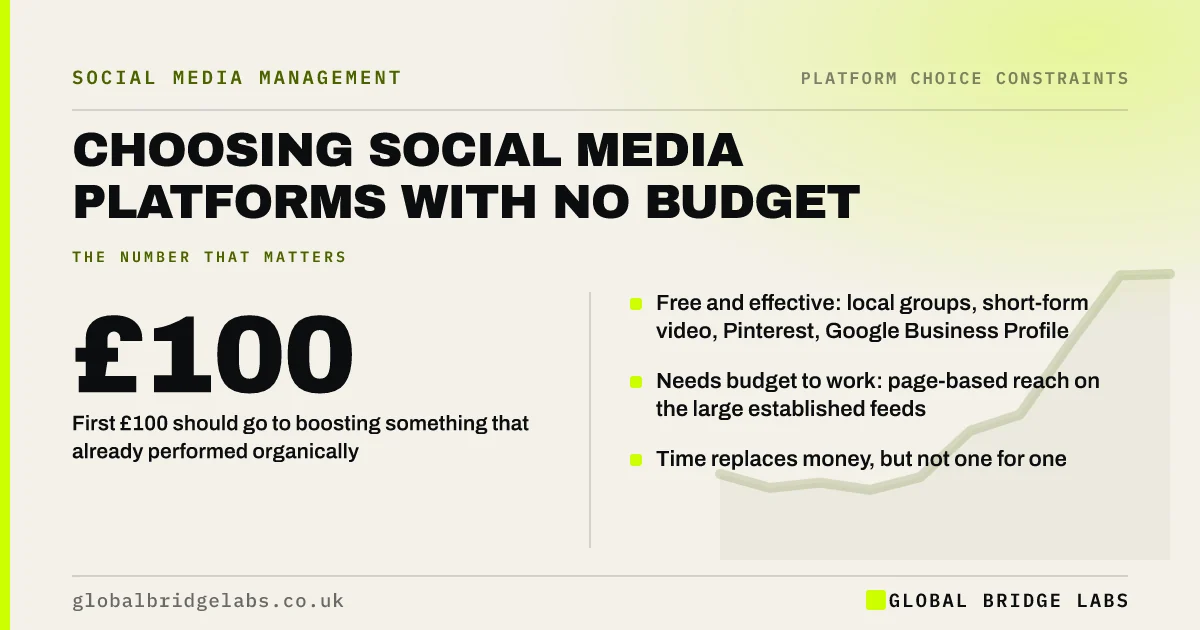
- Free and effective: local groups, short-form video, Pinterest, Google Business Profile.
- Needs budget to work: page-based reach on the large established feeds.
- Time replaces money, but not one for one. Free channels are slower, not easier.
- First £100 should go to boosting something that already performed organically.
- Never buy followers. It is visible in your engagement rate permanently.
No budget and need enquiries? We will find the free channel that fits on WhatsApp.
Chat on WhatsApp →Which platforms still work without paid support?
The ones where distribution is earned rather than bought. Short-form video platforms still show good content to strangers without spend, local community groups are entirely organic, Pinterest behaves like search, and a Google Business Profile is free visibility at the point of intent.
Where organic struggles is page-based reach on the large established feeds, where a business page post reaches a small fraction of its own followers. That is not a content problem to solve, it is the platform's business model.
What does time buy that money would have?
Distribution, slowly, and only in specific places. Five free mechanics that genuinely produce enquiries for UK small businesses.
- Answering questions in local and sector groups. Slow, compounding, free.
- Short-form video, where good content can reach strangers without spend.
- Google reviews, asked for consistently. The highest-return free activity available.
- Pinterest pins, which keep working for months after they are made.
- Partnerships with complementary local businesses, costing only coordination.
Where should a first small budget go?
Behind something that already worked organically, not behind a new idea. If a post produced enquiries without spend, putting £50 behind it to reach more of the same audience is the lowest-risk advertising available.
What wastes a first budget is boosting for reach, running ads to a cold audience with no proof, and paying for followers. All three produce numbers that look like progress and generate nothing.
We will tell you where a first £100 actually works. Message us on WhatsApp.
Chat on WhatsApp →What free things do businesses skip?
The unglamorous ones, which are usually the effective ones. Asking every satisfied customer for a review. Completing every field of a Google Business Profile. Answering the questions on that profile before a customer answers them wrongly. Adding your service area to every post.
None of these feel like marketing, which is why they get left. Together they typically outperform a year of content for a UK local business, and they cost nothing but attention.
What are the limits of a no-budget approach?
Speed and scale. Organic growth is slow and largely local, so a business that needs results this quarter or needs to reach a national audience will struggle without spend.
It also does not work for every sector. Categories where every competitor advertises heavily are difficult to enter organically, and pretending otherwise wastes a year. In those markets, a small consistent budget beats a large occasional one, and no budget at all is a genuine disadvantage worth naming.
What does this look like in practice?
A UK mobile car valeting business started with no budget at all. It spent fifteen minutes a day in four local groups, asked every customer for a Google review, and posted three before-and-after photographs a week with the postcode in each caption.
After four months it had about 60 reviews and appeared in most local recommendation threads. The first advertising spend came in month six, behind a post that had already produced eleven enquiries organically. The sequence mattered more than the money.
How do you ask for reviews without nagging?
Ask once, at the moment the customer is most pleased, and make it one tap. For most UK service businesses that moment is immediately after the job is finished and they have said something positive.
Send the direct review link over WhatsApp or text rather than asking them to find you. The gap between a link and an instruction is the difference between a review and a good intention.
Never incentivise it. UK consumer protection rules require reviews to be genuine, and an offer of a discount for a review is both a legal risk and visible to anyone reading the pattern of your ratings.
Reply to every review you get, including the poor ones. It takes a minute, it is visible to everyone comparing you with two competitors, and recency of activity is itself part of how local ranking works.
Next step
Ask your next ten customers for a Google review and complete every field of your profile this week. That is the highest-return free activity available to a UK local business, and almost nobody does it consistently.
Message us on WhatsApp and we will build a no-budget plan for your first quarter.
Chat on WhatsApp →Sources and further reading
- Tips to improve your local ranking on Google · Google Business Profile Help
- Publishing consumer reviews and complying with consumer protection law · Competition and Markets Authority
Frequently asked questions
Can you market a business on social media with no budget?
Yes, on channels where distribution is earned rather than bought: local community groups, short-form video, Pinterest and a Google Business Profile. Page-based organic reach on the large established feeds is now difficult without spend, whatever the content quality.
What is the highest-return free marketing activity?
Asking every satisfied customer for a Google review and completing every field of your Google Business Profile. Neither feels like marketing, which is why they get skipped, and together they typically outperform a year of content.
Where should a small business spend its first advertising budget?
Behind a post that already produced enquiries organically, because that post is proven. Boosting purely for reach, advertising to a cold audience with nothing proven, and buying followers all reliably waste a first budget and produce numbers that look like progress.
When does a no-budget approach stop working?
When you need results this quarter, when you need reach beyond your local area, or when you are in a category where every competitor advertises heavily. Organic growth is slow and largely local, and in those markets a small consistent budget will beat a large occasional one.
Written by

Global Bridge Labs (GBL) is a UK–Sri Lanka partner for social media, websites and BPO. Everything here comes from client delivery, not theory.