On this page
- 01Key takeaways
- 02What are a small employer's maternity obligations?
- 03What does Statutory Maternity Pay cost the business?
- 04What are the options for maternity cover?
- 05When does outsourcing work for maternity cover?
- 06How do you plan the handover?
- 07How do you plan the return?
- 08What should you avoid?
- 09What does maternity cover cost a small business?
- 10What does this look like in practice?
- 11Maternity cover checklist
- 12Next step
- 13Sources and further reading
- 14Frequently asked questions
Key takeaways
Maternity cover for a small business is manageable with planning. Eligible employees can take up to 52 weeks' leave, and most of the Statutory Maternity Pay you pay can be reclaimed, up to 109% for businesses qualifying for Small Employers' Relief. Cover options are a fixed-term hire, spreading the work, or outsourcing the repeatable part, and many businesses combine them.
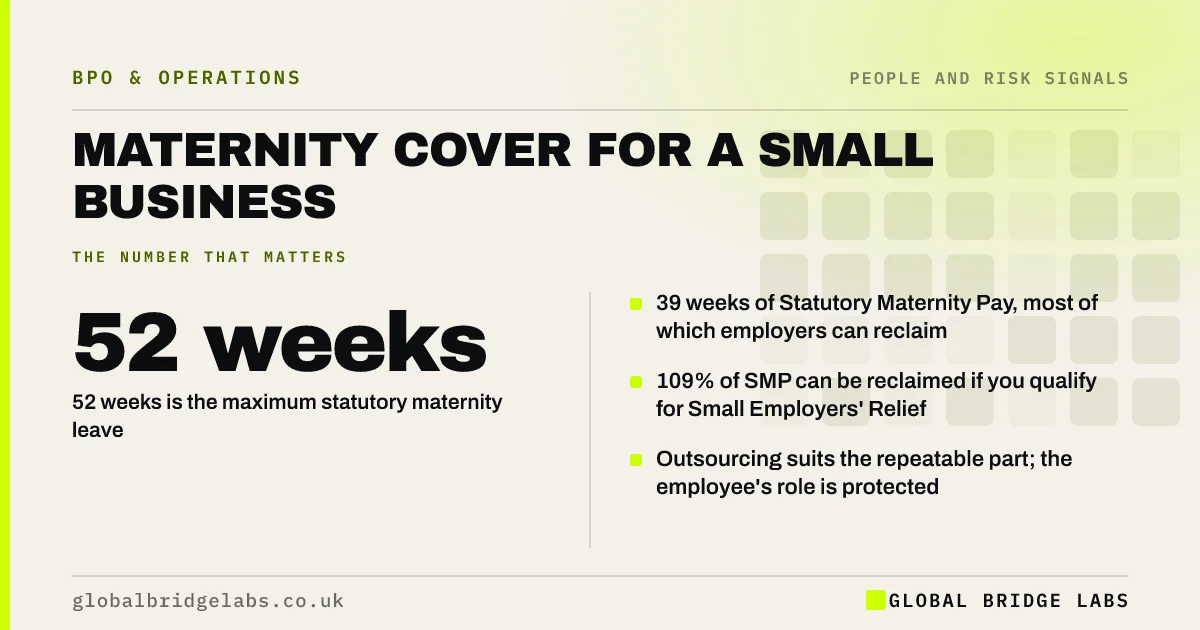
- 52 weeks is the maximum statutory maternity leave.
- 39 weeks of Statutory Maternity Pay, most of which employers can reclaim.
- 109% of SMP can be reclaimed if you qualify for Small Employers' Relief.
- Outsourcing suits the repeatable part; the employee's role is protected.
Planning maternity cover? Message us on WhatsApp with what the role involves.
Chat on WhatsApp →What are a small employer's maternity obligations?
Eligible employees can take up to 52 weeks of maternity leave: 26 weeks of Ordinary Maternity Leave and 26 of Additional Maternity Leave. They have the right to return to their job after Ordinary Maternity Leave, and to the same or a suitable job after Additional Maternity Leave. Cover arrangements must respect that right to return.
What does Statutory Maternity Pay cost the business?
Statutory Maternity Pay is paid for up to 39 weeks: 90% of average weekly earnings for the first 6 weeks, then £194.32 or 90% of average weekly earnings, whichever is lower, for the remaining 33. Employers can usually reclaim 92% of SMP, or 109% if they qualify for Small Employers' Relief. The larger cost is usually covering the work.
What are the options for maternity cover?
Most small businesses use one or more of four options. The right mix depends on how much of the role needs presence and judgement, and how long the leave will be.
- Fixed-term maternity cover hire for the duration of the leave.
- Spreading the work across the team, for short leave or light roles.
- Agency temp, useful for on-site roles and shorter periods.
- Outsourcing the repeatable part to a managed team.
Want help choosing the right mix for your role? Ask us on WhatsApp.
Chat on WhatsApp →When does outsourcing work for maternity cover?
Outsourcing works for the repeatable, remote-friendly part of the role: phones, inbox, booking, data entry or invoicing. It avoids recruiting and training a fixed-term hire for a year, provides holiday and sickness cover during the leave, and can be scaled back when the employee returns. The in-house judgement work can be shared or given to a smaller fixed-term role.
How do you plan the handover?
Start documenting the role with the employee several months before the leave begins. Record recurring tasks, key contacts and how each process works, and run the cover alongside the employee for a few weeks if possible. Agree how and when the employee would like to be contacted, including optional keeping-in-touch days.
How do you plan the return?
Plan it from the start. Decide which work returns to the employee and when, and set notice terms on any outsourced cover so it can be reduced or ended on their return. Some businesses keep part of the outsourced process afterwards, because the returning employee prefers a more focused role, but that should be their choice, not a change imposed on them.
What should you avoid?
Avoid treating the leave as a chance to restructure the employee's job without consultation, and avoid any change that disadvantages them because of pregnancy or maternity leave. That can be unlawful discrimination. Use cover to protect the role, not to replace it, and take advice if you are considering wider changes.
What does maternity cover cost a small business?
The pay itself is largely reclaimable, so the real cost is the cover. A fixed-term hire costs a full salary with on-costs and recruitment, and needs training. Outsourcing the repeatable part costs only the hours needed, at an indicative £9–£18 per hour offshore, and includes holiday and sickness cover during the leave. Compare both against the tasks that actually need covering.
What does this look like in practice?
A pattern we see in UK clinics and small practices: the practice administrator goes on maternity leave for a year. A managed team covers phones and booking, a part-time fixed-term hire covers in-person reception, and the administrator returns to a role with the same responsibilities and better cover in place.
Maternity cover checklist
Use this once leave dates are known.
- Confirm leave dates and statutory entitlements.
- Check whether you qualify for Small Employers' Relief.
- Document the role with the employee.
- Split tasks: in-person, judgement, repeatable.
- Choose cover for each and start before the leave.
- Plan the return, including notice terms on any cover.
Next step
Tell us what the role involves and when the leave starts. We will suggest a cover mix and what the outsourced part would cost.
Message us on WhatsApp about maternity cover, or book a 30-minute consultation.
Chat on WhatsApp →Sources and further reading
- Statutory Maternity Pay and Leave: employer guide · GOV.UK
- Holiday entitlement · GOV.UK
- Agency workers: your rights · GOV.UK
Frequently asked questions
How do small businesses cover maternity leave?
Usually with a fixed-term maternity cover hire, by spreading work across the team, with an agency temp, or by outsourcing the repeatable part of the role. Many combine options. The employee's right to return to their job must be respected throughout.
Can small employers reclaim maternity pay?
Yes. Employers can usually reclaim 92% of Statutory Maternity Pay, or 109% if they qualify for Small Employers' Relief. Check eligibility and the current rules on GOV.UK. The main cost to a small business is usually covering the work rather than the pay itself.
Can I outsource work while an employee is on maternity leave?
Yes, as temporary cover for the repeatable part of the role. It must not be used to disadvantage the employee or change their job because of their leave. Plan the return from the start, with notice terms that let the cover be reduced when they come back.
Written by

Global Bridge Labs (GBL) is a UK–Sri Lanka partner for social media, websites and BPO. Everything here comes from client delivery, not theory.