On this page
- 01Key takeaways
- 02Which produces more local enquiries?
- 03What are the rules on promotion?
- 04How do you earn recommendations rather than post them?
- 05What does Nextdoor do that Facebook cannot?
- 06Where does this approach fail?
- 07What does this look like in practice?
- 08How do you ask customers to recommend you?
- 09Next step
- 10Sources and further reading
- 11Frequently asked questions
Key takeaways
Facebook groups have more people and looser norms. Nextdoor has fewer people, stricter verification and higher trust per recommendation. For most UK local businesses, Facebook groups produce more enquiries and Nextdoor produces better ones.
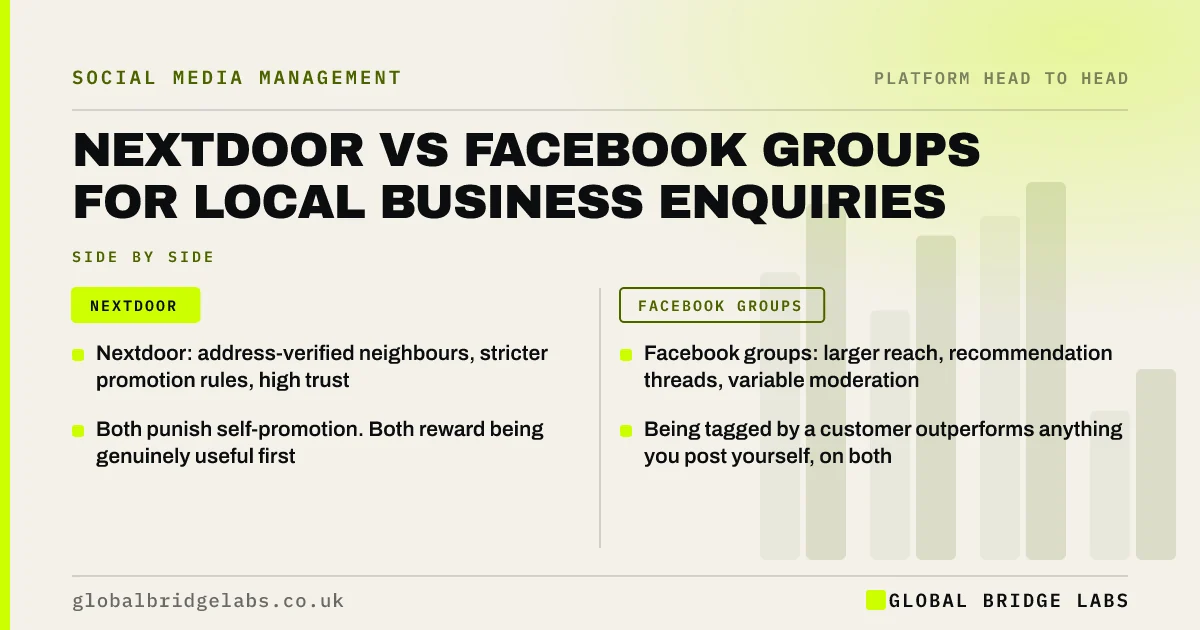
- Nextdoor: address-verified neighbours, stricter promotion rules, high trust.
- Facebook groups: larger reach, recommendation threads, variable moderation.
- Both punish self-promotion. Both reward being genuinely useful first.
- Being tagged by a customer outperforms anything you post yourself, on both.
- Budget 2-4 hours a week across both. It is conversation, not content production.
Want a hyperlocal plan that does not get you removed? Message us on WhatsApp.
Chat on WhatsApp →Which produces more local enquiries?
Facebook groups, on volume, because most UK towns have several large active groups and the recommendation thread is a daily habit in many of them. Nextdoor produces fewer enquiries with a higher conversion rate, because address verification means a recommendation carries more weight.
The honest answer for a small business with limited hours is to start where your town is actually active. In some areas Nextdoor is busy and the Facebook groups are quiet; in others the reverse. Check before you commit.
What are the rules on promotion?
Both restrict it, and being removed from a large local group is a genuine setback that is hard to reverse. Learn the norms before you post.
- Most Facebook groups allow business posts only on a named day, or not at all.
- Nextdoor separates neighbour posts from business accounts and enforces the split.
- Answering a question without linking is allowed almost everywhere.
- Replying to a recommendation request about you is fine. Replying to every request is not.
- Read the pinned rules before your first post. Moderators remember first impressions.
How do you earn recommendations rather than post them?
By being useful in public without selling, consistently, for longer than feels comfortable. The mechanic that works on both platforms is answering questions in your area of expertise where the answer helps even if the person never hires you.
The second mechanic is asking satisfied customers to mention you if they see a request. Most will, and a customer tagging you is worth considerably more than anything you write yourself, because it is the only form of local marketing that carries someone else's reputation.
We will find the active groups in your area and a way in. Ask on WhatsApp.
Chat on WhatsApp →What does Nextdoor do that Facebook cannot?
Verify that people actually live where they say they do. That address verification is the platform's whole proposition and it changes the quality of the conversation, particularly for trades, childcare, pet services and anything where someone is letting a stranger into their home.
It also has narrower geography. A Facebook group may cover a whole city while a Nextdoor neighbourhood covers a few streets, which suits businesses with a small service radius and frustrates those covering a county.
Where does this approach fail?
When your service area is large, when your buyer is a business rather than a household, or when you cannot commit the time. Hyperlocal channels are conversation channels, and a business that drops in once a month to post an offer will be ignored at best and removed at worst.
It also fails when the work is not local at all. A consultancy serving clients nationwide gains nothing from neighbourhood channels, and the hours are better spent where the buyers are.
What does this look like in practice?
A UK mobile dog groomer spent twenty minutes a day in four local Facebook groups and one Nextdoor neighbourhood, answering questions about coat types and grooming intervals and never linking to anything.
Within three months she was the name that appeared whenever someone asked, without having to ask for it. The diary filled from a service radius of about six miles. No content was produced, no budget was spent, and the whole thing cost roughly two hours a week of conversation.
How do you ask customers to recommend you?
Directly, once, at the point they are happiest, and without scripting what they say. Most satisfied UK customers will mention you in a local thread if asked, and almost none think to do it unprompted.
The wording that works is simple: if you ever see someone asking for a recommendation in one of the local groups, we would really appreciate a mention. Never offer anything in return. UK consumer protection rules are clear that reviews and recommendations must be genuine, and an incentivised mention is both a legal risk and obvious to everyone reading.
Ask at the point the job finishes and they have said something positive, not a week later by email. The gap between those two moments is most of the difference between a mention and a good intention.
Next step
Join the three largest groups covering your service area and your Nextdoor neighbourhood, read the pinned rules, and spend two weeks answering questions without mentioning your business. What happens next will tell you whether this channel is worth your hours.
Message us on WhatsApp and we will map the local groups worth joining in your area.
Chat on WhatsApp →Sources and further reading
Frequently asked questions
Is Nextdoor better than Facebook groups for local business?
Facebook groups produce more enquiries because most UK towns have several large ones with daily recommendation threads. Nextdoor produces fewer but better-qualified enquiries because addresses are verified, which matters most for services that involve entering someone's home.
Can businesses post promotions in local Facebook groups?
Usually only on a designated day, and many groups forbid it entirely. Answering questions without linking is allowed almost everywhere. Read the pinned rules first, because removal from a large local group is difficult to reverse.
How long does hyperlocal marketing take to work?
Two to three months of consistent, genuinely useful participation before you become the name people mention. It is conversation rather than content, so budget two to four hours a week and expect nothing in the first month.
Does Nextdoor work for B2B businesses?
Rarely. Neighbourhood channels reach households within a few streets, which suits trades, childcare, tutoring and pet services. A business selling to other businesses, or covering a county rather than a postcode, gains very little from them and should spend the hours elsewhere.
Written by

Global Bridge Labs (GBL) is a UK–Sri Lanka partner for social media, websites and BPO. Everything here comes from client delivery, not theory.