On this page
- 01Key takeaways
- 02How do you estimate website cost?
- 03What base prices should you use?
- 04What should you add for content and features?
- 05How do you add running costs?
- 06When is a quick estimate not enough?
- 07What does this look like in practice?
- 08Estimate checklist
- 09Next step
- 10Sources and further reading
- 11Frequently asked questions
Key takeaways
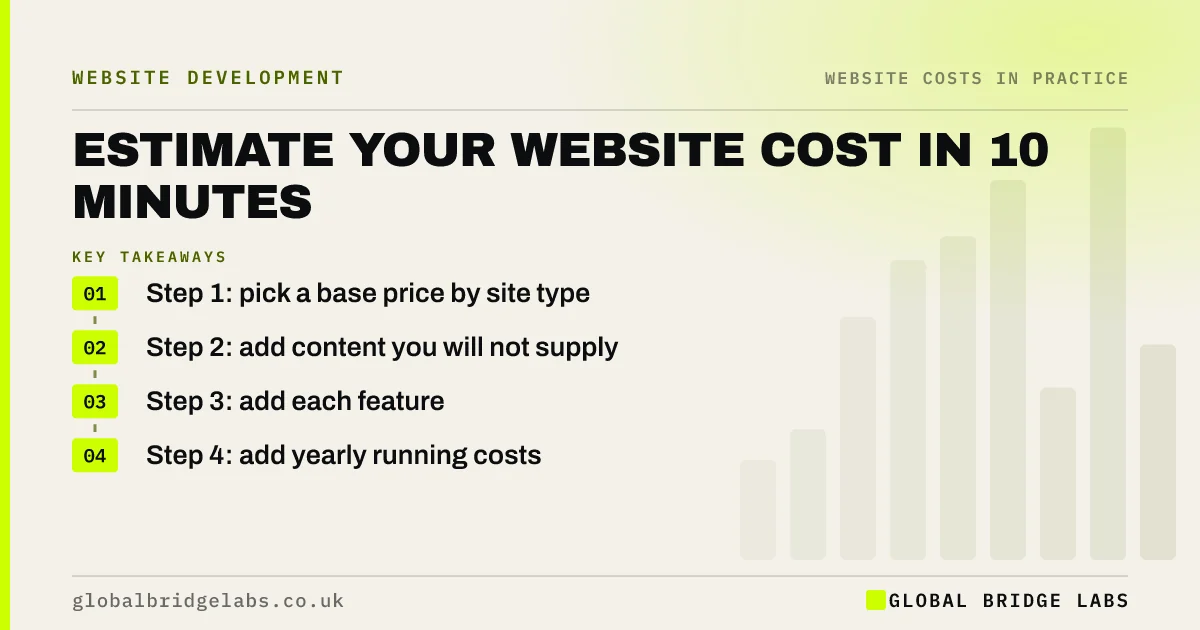
You can estimate website cost in about 10 minutes by choosing a site type base price, adjusting for content and features, then adding running costs. For example, a template service site at £2,500, plus £1,000 for copy and £800 for booking, gives about £4,300 to build, plus monthly running costs. The estimate gives you a realistic range before asking for quotes.
- Step 1: pick a base price by site type.
- Step 2: add content you will not supply.
- Step 3: add each feature.
- Step 4: add yearly running costs.
Want your estimate checked? Message us on WhatsApp.
Chat on WhatsApp →How do you estimate website cost?
Estimate website cost by picking a base price for your type of site, adding content you will not supply yourself, adding each feature you need, then adding running costs. Use market ranges for each step. The result is a range, good enough to set a budget and brief suppliers.
What base prices should you use?
Use indicative UK base prices for the build only, before content and features. These are orientation figures, not a GBL price list.
- Self-built builder site: about £200 to £500 a year.
- Template service site: about £1,500 to £4,000.
- Custom service site: about £5,000 to £15,000.
- Online shop: about £3,000 to £15,000.
Want a base price matched to your site type? Message us on WhatsApp and we will discuss your requirements.
Chat on WhatsApp →What should you add for content and features?
Add copy at about £100 to £400 a page if you will not write it, photography at about £300 to £1,500, booking at about £300 to £1,500 to set up, payments at £0 to £2,000, and CRM links at £0 to £5,000 depending on complexity.
How do you add running costs?
Add hosting, domain, email and licences, typically £200 to £1,500 a year, plus care at about £30 to £200 a month and any growth work. Multiply monthly costs by 12 for a yearly figure and add VAT if you cannot reclaim it.
When is a quick estimate not enough?
A quick estimate is not enough for complex integrations, regulated sectors or large catalogues, where costs vary widely. Use it to set a range, then get quotes or pay for discovery to firm it up.
What does this look like in practice?
At Global Bridge Labs (GBL), a UK dog trainer estimated their site in ten minutes: template site £2,500, copy for five pages £1,000, booking £600, running costs £1,500 a year. Their quotes came back between £3,800 and £4,600 for the build, close to the estimate, which made choosing quick.
Estimate checklist
- Pick a base price for your site type.
- Add content you will not supply.
- Add each feature.
- Add yearly running costs.
- Add VAT if not reclaimable.
- Treat the result as a range.
Next step
Run the four steps now with a pen and paper. Take the range to suppliers and ask what they would deliver within it.
Message us on WhatsApp for a website cost estimate sheet, or book a 30-minute consultation.
Chat on WhatsApp →Sources and further reading
- SEO Starter Guide · Google Search Central
- About key events · Google Analytics Help
- VAT rates · GOV.UK
Frequently asked questions
How can I estimate how much my website will cost?
Choose a base price for your site type, such as £1,500 to £4,000 for a template service site, then add copywriting, photography and features such as booking or payments, and add yearly running costs. The result is a realistic range to share with suppliers.
Are online website cost calculators accurate?
They give a rough range, which is useful for orientation, but they cannot account for your content, integrations, sector rules or supplier differences. Use a calculator or simple estimate to set expectations, then get quotes against a written scope for an accurate figure.
What affects website cost the most?
Design approach, content, integrations and the number of unique page layouts affect cost most. Features such as booking, payments or CRM links add significantly, as does professionally written copy. Page count matters less than people expect when pages share layouts.
Written by

Global Bridge Labs (GBL) is a UK–Sri Lanka partner for social media, websites and BPO. Everything here comes from client delivery, not theory.