On this page
- 01Key takeaways
- 02How do you calculate website break even?
- 03What does a worked example look like?
- 04Why is tracking needed to know?
- 05How long does break even usually take?
- 06When is break even the wrong measure?
- 07What does this look like in practice?
- 08Break-even checklist
- 09Next step
- 10Sources and further reading
- 11Frequently asked questions
Key takeaways
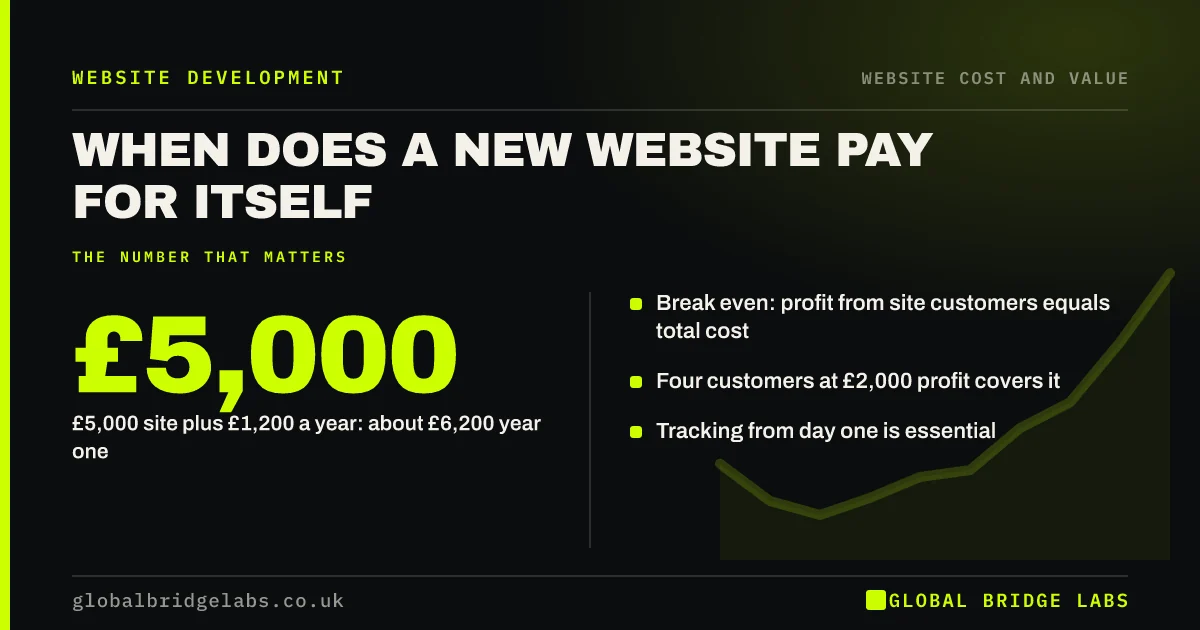
A new website pays for itself when the profit from customers it brings exceeds its build and running costs. For example, a £5,000 site with £100 a month running costs breaks even within a year if it wins four customers worth £2,000 profit each. Track enquiries from launch so you can see the break-even point instead of guessing.
- Break even: profit from site customers equals total cost.
- £5,000 site plus £1,200 a year: about £6,200 year one.
- Four customers at £2,000 profit covers it.
- Tracking from day one is essential.
Want your website break-even point worked out? Message us on WhatsApp.
Chat on WhatsApp →How do you calculate website break even?
Calculate website break even by dividing the site's total cost over a period by the profit from one new customer, giving the number of customers needed. Then estimate how many enquiries that takes, using your conversion rate from enquiry to customer. The result shows how many enquiries the site must bring.
What does a worked example look like?
A worked example: a £5,000 build plus £100 a month running costs is £6,200 in year one. If a new customer brings £2,000 profit, the site needs four customers. If one in four enquiries becomes a customer, it needs 16 enquiries in the year, about one or two a month.
- Total cost: £6,200 in year one.
- Profit per customer: £2,000.
- Customers needed: 4.
- Enquiries needed at 25% conversion: 16.
Want the calculation run with your own numbers? Message us on WhatsApp and we will discuss your requirements.
Chat on WhatsApp →Why is tracking needed to know?
Tracking is needed because without it, you cannot tell which customers came from the website. Set up form submissions and calls as key events in analytics, and ask new customers how they found you. Then break even becomes visible, not guessed.
How long does break even usually take?
For service businesses with valuable customers, break even often comes within the first year. For low-value products or competitive markets, it can take longer, as the site needs more traffic. Search visibility also builds over months, so early months may bring fewer enquiries.
When is break even the wrong measure?
Break even is the wrong measure when the site's role is mainly credibility for referrals or tenders, where it supports sales without creating trackable enquiries. Then judge it by whether prospects mention it and whether it helps you win.
What does this look like in practice?
At Global Bridge Labs (GBL), a UK loft conversion firm built a £6,500 site with call and form tracking. One job was worth about £8,000 profit. The site brought its first tracked job in month three, paying for itself with a single conversion, and later months were measured clearly against cost.
Break-even checklist
- Add up build and year-one running costs.
- Estimate profit per new customer.
- Estimate enquiry to customer conversion.
- Calculate enquiries needed.
- Track forms and calls as key events.
- Review progress monthly.
Next step
Work out the profit from one typical new customer. Divide your website cost by it, and you know how many customers the site must win.
Message us on WhatsApp for a website break-even calculator, or book a 30-minute consultation.
Chat on WhatsApp →Sources and further reading
- About key events · Google Analytics Help
- Business population estimates for the UK and regions 2025 · Department for Business and Trade
- SEO Starter Guide · Google Search Central
Frequently asked questions
How long does it take for a website to pay for itself?
For many service businesses with valuable customers, a well-built website pays for itself within the first year, sometimes within months. It depends on cost, profit per customer, conversion rate and how quickly the site gains visibility. Tracking enquiries from launch shows exactly when it happens.
How do I work out if my website is profitable?
Track enquiries from the website, find out how many become customers, multiply by profit per customer and compare with the site's build and running costs over the same period. If profit exceeds cost, the site is profitable. Ask new customers how they found you to fill gaps.
What if my website never pays for itself?
Check the basics: whether people can find it, whether the offer is clear, whether contact is easy on phones and whether tracking works. Often the fix is clearer copy, better service pages or local search set-up. If the site's role is credibility, judge it differently.
Written by

Global Bridge Labs (GBL) is a UK–Sri Lanka partner for social media, websites and BPO. Everything here comes from client delivery, not theory.