On this page
- 01Key takeaways
- 02What is a captive centre?
- 03What does a captive centre cost to set up and run?
- 04At what scale does a captive centre make sense?
- 05What are the risks of a captive centre?
- 06Is there a route from outsourcing to captive?
- 07What about data protection?
- 08What does a captive centre need before it opens?
- 09What does this look like in practice?
- 10Captive centre checklist
- 11Next step
- 12Sources and further reading
- 13Frequently asked questions
Key takeaways
Captive centre vs outsourcing is mainly a question of scale. A captive centre is your own company abroad, with its own entity, office, payroll and managers. It gives full control but needs dozens of staff to spread the fixed costs. Most UK SMEs get the same cost benefits with less risk through managed outsourcing.
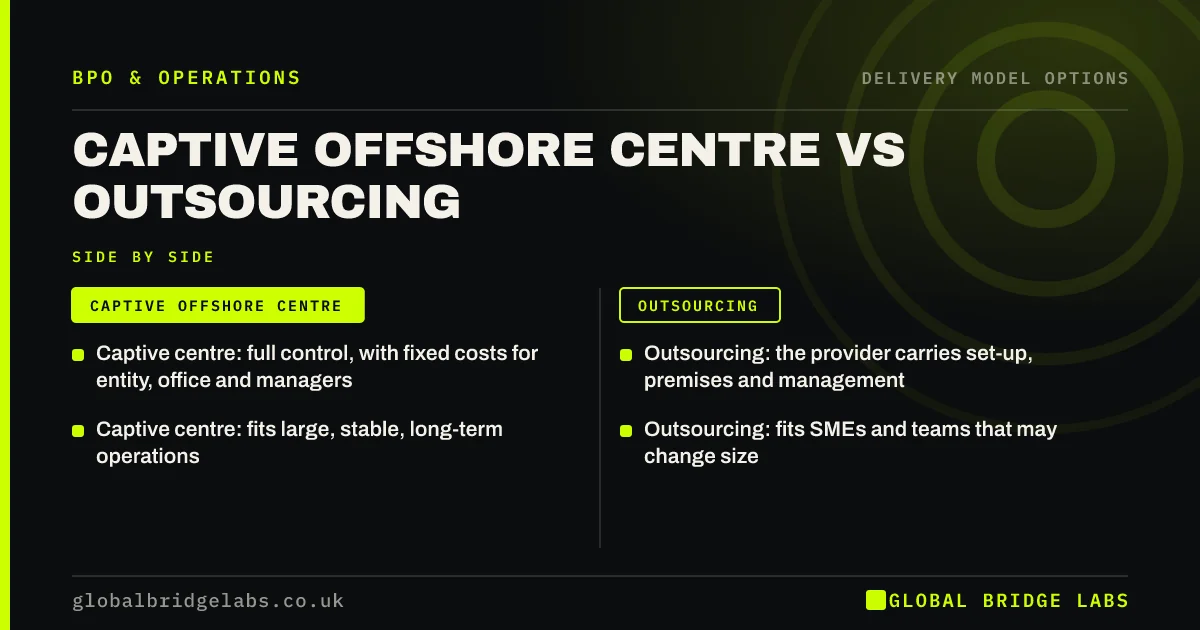
- Captive centre: full control, with fixed costs for entity, office and managers.
- Outsourcing: the provider carries set-up, premises and management.
- Captive centre: fits large, stable, long-term operations.
- Outsourcing: fits SMEs and teams that may change size.
Considering your own offshore office? Message us on WhatsApp to compare it with outsourcing.
Chat on WhatsApp →What is a captive centre?
A captive centre, sometimes called a global capability centre, is an offshore operation owned and run by the business itself rather than a provider. The company sets up a local entity, leases an office, employs staff directly under local law, and appoints local managers. The work is in-house; only the location changes.
What does a captive centre cost to set up and run?
Set-up covers incorporating a local company, legal and tax advice, bank accounts, office fit-out, IT and security, and recruiting a local manager. Running costs include rent, local payroll and statutory contributions, management salaries, accounting and audit, and your own travel. These fixed costs are similar whether the centre has 5 staff or 25.
- Legal entity, tax registration and annual compliance.
- Office lease, fit-out, power backup and connectivity.
- Local HR, payroll and employment law advice.
- A site manager and team leads.
- IT security, devices and licences.
At what scale does a captive centre make sense?
When the operation is large and stable enough that the fixed costs, spread across staff, fall below a provider's margin. That typically means dozens of full-time roles with long-term, predictable work. Below that, the site manager, office and compliance costs make each seat more expensive than a managed provider's rate.
Want the break-even scale worked out for your plans? Send us your headcount on WhatsApp.
Chat on WhatsApp →What are the risks of a captive centre?
You carry local employment law, tax, currency and continuity risk directly. Recruiting and keeping good local managers is hard from a distance. If the business changes direction, closing an overseas entity takes time and cost. A provider absorbs most of these risks inside its rate.
Is there a route from outsourcing to captive?
Yes. Build-operate-transfer lets a provider set up and run the team, then transfer it to your own entity once it reaches scale. It gives an exit to ownership without taking all the start-up risk.
What about data protection?
Moving personal data to your own overseas entity is still an international transfer under UK GDPR, and needs a valid safeguard, just as with a provider. You also become directly responsible for security at the site.
What does a captive centre need before it opens?
More than an office. A captive centre needs a registered local entity, a bank account, tax and employment registrations, an employment contract template under local law, IT and security set-up, and a local manager you trust. Each of these takes time and specialist advice, which is why SMEs usually start with a provider.
What does this look like in practice?
A pattern we see in growing UK SMEs: a director considers opening an office in Sri Lanka for five admin roles. Costed properly, the entity, office and manager make each seat far more expensive than a managed team, so the business outsources first and revisits ownership if the team reaches real scale.
Captive centre checklist
Answer these before setting one up.
- How many full-time roles, for how many years?
- Who will manage the centre locally?
- Have you costed entity, office, compliance and management?
- What is the exit plan if needs change?
- How will data transfers be safeguarded?
Next step
Tell us the roles and timescale you have in mind. We will compare a captive centre, managed outsourcing and build-operate-transfer in a 30-minute call.
Message us on WhatsApp to compare offshore models, or book a 30-minute consultation.
Chat on WhatsApp →Sources and further reading
- International transfers of personal data · Information Commissioner's Office
- The Sourcing and Consultancy Playbooks · Cabinet Office
- Exchange rates · Central Bank of Sri Lanka
Frequently asked questions
What is a captive centre in outsourcing?
A captive centre is an offshore operation owned by the business itself, with its own local entity, office, employees and managers, rather than a provider. The work is in-house; only the location is offshore. Large companies use them for long-term, high-volume functions.
Is a captive centre cheaper than outsourcing?
Only at scale. Entity, office, compliance and management costs are largely fixed, so they are spread thinly only when the centre has many long-term roles. For most SMEs, a managed provider is cheaper per seat and carries local employment and continuity risk for you.
Can I move from outsourcing to my own offshore team later?
Yes. Build-operate-transfer arrangements let a provider build and run the team, then transfer it to your own entity once it reaches scale, with the terms and transfer fee agreed at the start. Many businesses decide at that point that continued outsourcing suits them better.
What are the biggest risks of running a captive centre?
Finding and keeping a strong local manager, complying with local employment and tax law from a distance, currency movements, and the cost of closing the entity if plans change. A provider absorbs most of these risks inside its rate, which is why SMEs rarely go captive.
Written by

Global Bridge Labs (GBL) is a UK–Sri Lanka partner for social media, websites and BPO. Everything here comes from client delivery, not theory.