On this page
- 01Key takeaways
- 02What is build-operate-transfer?
- 03How is BOT priced?
- 04When does BOT make sense?
- 05When is plain outsourcing better?
- 06What should the BOT contract cover?
- 07What are the risks?
- 08How long does each BOT phase take?
- 09What does this look like in practice?
- 10BOT checklist
- 11Next step
- 12Sources and further reading
- 13Frequently asked questions
Key takeaways
The build-operate-transfer (BOT) model lets a provider build and run an offshore team for you, then transfer it into your own entity after an agreed period, often two to three years. It combines the low start-up risk of outsourcing with later ownership. It suits businesses sure they will need a large, long-term team.
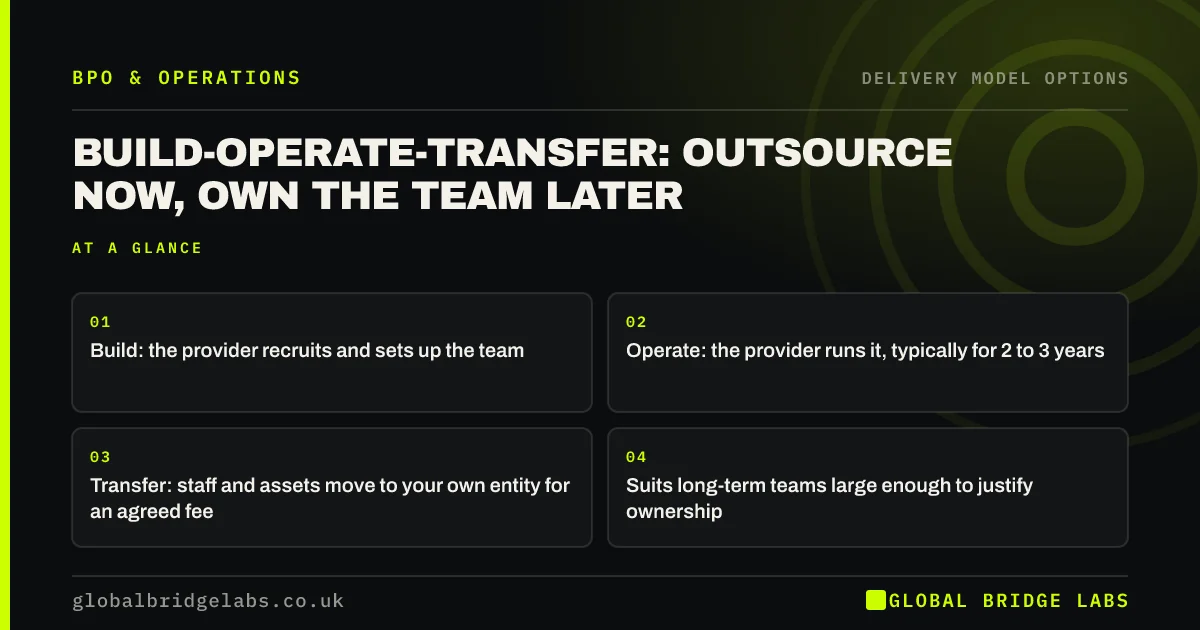
- Build: the provider recruits and sets up the team.
- Operate: the provider runs it, typically for 2 to 3 years.
- Transfer: staff and assets move to your own entity for an agreed fee.
- Suits long-term teams large enough to justify ownership.
Planning a long-term offshore team? Message us on WhatsApp to talk through BOT.
Chat on WhatsApp →What is build-operate-transfer?
Build-operate-transfer is an outsourcing model in three phases. The provider builds the team, recruiting staff and setting up premises; operates it under a service agreement; then transfers the team, and sometimes the premises and equipment, to the client's own entity. The terms of the transfer are agreed at the start.
How is BOT priced?
During the build and operate phases, you pay a service rate similar to managed outsourcing, sometimes with a set-up fee. At transfer, you pay an agreed transfer fee for the team, processes and any assets, and take on the local employment and running costs. Get the transfer fee formula in writing before starting.
Want a BOT option compared with ongoing outsourcing? Send us your plans on WhatsApp.
Chat on WhatsApp →When does BOT make sense?
When you are confident you will need a sizeable offshore team for many years, want to own it eventually, and do not want the risk of setting up alone. It suits businesses planning an offshore capability centre but lacking local knowledge today.
When is plain outsourcing better?
When the team is small, the need may change, or you have no wish to run an overseas entity. For most SMEs, ongoing managed outsourcing gives the cost benefit without the future responsibility for local employment, premises and compliance.
What should the BOT contract cover?
Agree these points at the start, not at transfer.
- Minimum team size and period before transfer.
- The transfer fee formula and what it includes.
- How staff consent and local employment transfer work.
- Ownership of processes, documentation and IP throughout.
- What happens if you decide not to transfer.
What are the risks?
Key staff may not want to move to your entity, local employment law may add costs at transfer, and you take on management that the provider used to carry. Plan the transfer with a local manager in place, and keep documentation current throughout the operate phase.
How long does each BOT phase take?
Timings vary with team size and skills, but a typical pattern is a build phase of a few months to recruit and set up, an operate phase of about two to three years while the team matures, and a transfer phase of a few months to move employment, assets and processes. Agree milestones for each phase in the contract.
What does this look like in practice?
A pattern we see with growing UK technology businesses: they start with a managed team to test the offshore model and only discuss transfer once the team is stable and large. Many find continued managed outsourcing suits them better than owning an entity.
BOT checklist
Answer these before choosing BOT.
- How large will the team be in three years?
- Do you want to run an overseas entity?
- Is the transfer fee formula agreed in writing?
- Who will manage the team after transfer?
- What happens if you do not transfer?
Next step
Tell us your team plans. We will compare build-operate-transfer with ongoing managed outsourcing in a 30-minute call.
Message us on WhatsApp to discuss BOT, or book a 30-minute consultation.
Chat on WhatsApp →Sources and further reading
- The Sourcing and Consultancy Playbooks · Cabinet Office
- International transfers of personal data · Information Commissioner's Office
- Exchange rates · Central Bank of Sri Lanka
Frequently asked questions
What is the build-operate-transfer model?
An outsourcing model where a provider builds and runs a team for you, then transfers it to your own entity after an agreed period, often two to three years, for a transfer fee agreed at the start. It combines outsourcing's low start-up risk with later ownership.
Is BOT suitable for small businesses?
Rarely. It suits businesses sure they will need a sizeable offshore team for many years and want to own it eventually. Smaller teams usually get better value and less risk from ongoing managed outsourcing, which avoids running an overseas entity at all.
What does the BOT transfer fee cover?
Typically the team, processes, documentation and sometimes premises and equipment moving to your entity. Agree the formula and exactly what it includes before starting, along with what happens if you decide not to transfer or the team is smaller than planned.
What happens to staff at transfer?
Staff move from the provider's employment to your local entity under local employment law, usually with their consent and on terms at least as good as before. Plan it early, keep staff informed, and make sure a local manager is in place before the move.
Written by

Global Bridge Labs (GBL) is a UK–Sri Lanka partner for social media, websites and BPO. Everything here comes from client delivery, not theory.