On this page
- 01Key takeaways
- 02Why rotate calls to action?
- 03Which calls to action fit which posts?
- 04How do you plan CTAs in the calendar?
- 05How do you know which CTAs work?
- 06When should you not rotate?
- 07What does this look like in practice?
- 08CTA rotation checklist
- 09Next step
- 10Sources and further reading
- 11Frequently asked questions
Key takeaways
Call to action rotation on social media means planning a different next step for each post across the month, matched to the post: 'save this' on a tip, 'message us for a quote' on proof, 'book now' on an offer, 'tell us in the comments' on a question. Every post asks for something, but only some ask for a sale, so followers are not asked to buy every day.
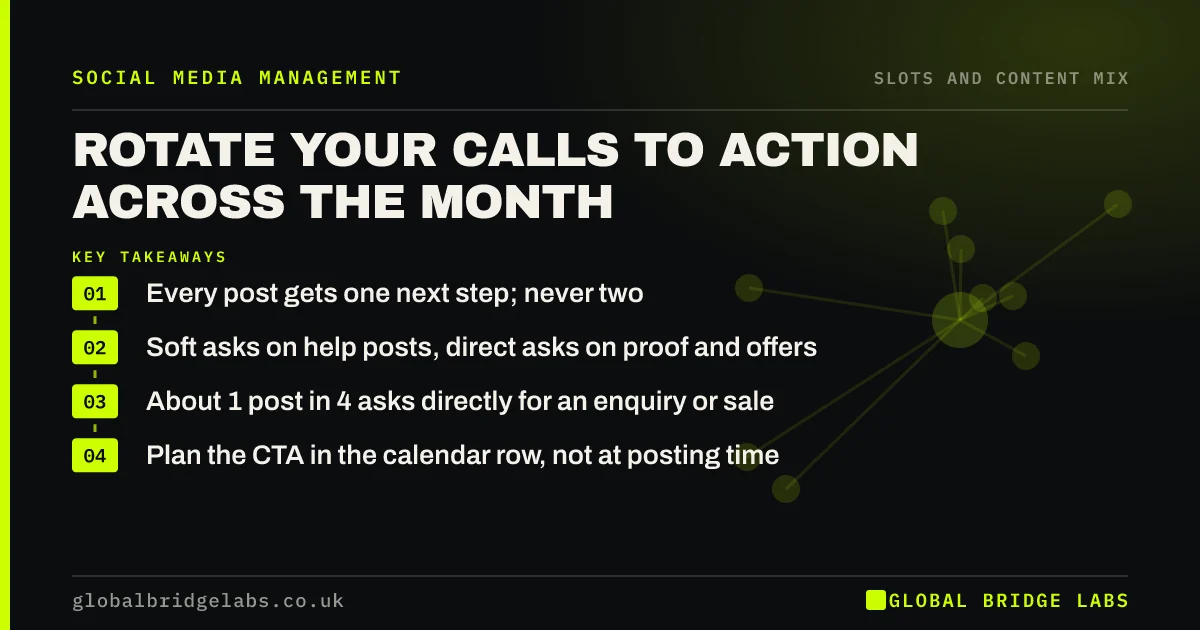
- Every post gets one next step; never two.
- Soft asks on help posts, direct asks on proof and offers.
- About 1 post in 4 asks directly for an enquiry or sale.
- Plan the CTA in the calendar row, not at posting time.
Want a month of calls to action planned? Message us on WhatsApp.
Chat on WhatsApp →Why rotate calls to action?
Rotate them because the same 'call us today' on every post becomes invisible, and asking for a sale every day wears people out. Matching the ask to the post works better: someone reading a tip may save it, while someone looking at a finished job may want a quote. Different asks also show you which posts move people closest to buying.
Which calls to action fit which posts?
A simple match for most small businesses:
- Help posts: save this, share with someone who needs it.
- Proof posts: message us for a quote, see more work on our page.
- People posts: say hello, ask us anything.
- Offer posts: book now, claim by the closing date.
- Interactive posts: vote, answer, tell us in the comments.
How do you plan CTAs in the calendar?
Add a call to action field to each row and fill it when you fill the slot. Over a month of 12 posts, aim for about three direct asks (quote, booking or purchase), with the rest softer. If the month has an offer, the direct asks cluster around its dates.
How do you know which CTAs work?
Track what each ask produces: saves and shares for soft asks, messages and tracked clicks for direct ones. Use a tracked link where the ask sends people to your website, and ask enquirers where they heard about you. After three months you will know which asks bring work.
When should you not rotate?
Do not rotate the main contact method. If messages are how buyers reach you, every direct ask should point to messages, not sometimes the phone, sometimes a form and sometimes email. Rotate what you ask for, not where people go to do it.
What does this look like in practice?
A pattern we see: every post ends with 'DM us for more info', including tips and team photos, and few people do. Matching asks to posts, with direct asks on proof and offers, usually brings more saves on tips and more messages where it counts.
CTA rotation checklist
- Add a CTA field to every calendar row.
- Match the ask to the post type.
- Plan about three direct asks in 12 posts.
- Keep one main contact method.
- Track what each ask produces.
Next step
Look at next month's calendar and write a call to action next to every post. Count the direct asks; if there are more than four in 12, soften some.
Message us on WhatsApp and we will review your calls to action, or book a 30-minute consultation.
Chat on WhatsApp →Sources and further reading
- Meta Business Help Centre · Meta
- URL builders: collect campaign data with custom URLs · Google Analytics Help
Frequently asked questions
Should every social media post have a call to action?
Yes, every post should have one clear next step, but not every step should be a sale. Soft asks such as save or share suit help posts, while direct asks such as message us or book now suit proof and offer posts.
How many posts should ask for a sale?
For most small businesses, about one in four, so around three in a month of 12 posts. More than that tends to wear out followers, especially if the other posts give them nothing useful.
What is the best call to action for social media?
The one that fits the post and makes the next step easy. For many small UK businesses, 'message us for a quote' on proof posts produces the most enquiries, because messaging takes less effort than calling or filling in a form.
Written by

Global Bridge Labs (GBL) is a UK–Sri Lanka partner for social media, websites and BPO. Everything here comes from client delivery, not theory.