On this page
- 01Key takeaways
- 02What is a social media strategy?
- 03How much does a strategy cost?
- 04What should the strategy document contain?
- 05Is strategy included in a monthly retainer?
- 06When should you write it yourself?
- 07What makes a paid strategy poor value?
- 08What happens in a strategy workshop?
- 09What does this look like in practice?
- 10Strategy buying checklist
- 11Next step
- 12Sources and further reading
- 13Frequently asked questions
Key takeaways
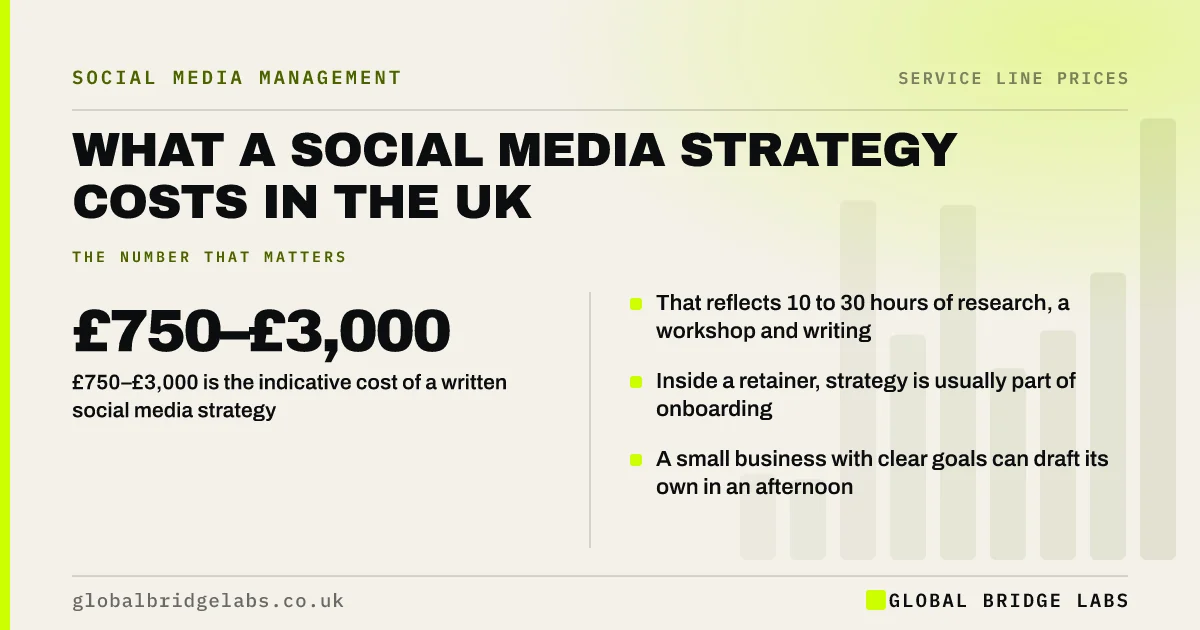
Social media strategy cost in the UK is indicatively £750–£3,000 for a written strategy from an agency or consultant, based on 10 to 30 hours of senior time. The price depends on the research involved and the number of channels. A one-page strategy you use beats a long one you file.
- £750–£3,000 is the indicative cost of a written social media strategy.
- That reflects 10 to 30 hours of research, a workshop and writing.
- Inside a retainer, strategy is usually part of onboarding.
- A small business with clear goals can draft its own in an afternoon.
Want a strategy you will actually use? Message us on WhatsApp.
Chat on WhatsApp →What is a social media strategy?
A social media strategy is a short written plan that states what social media is for in your business, who it must reach, which channels you will use, what you will post, how much you will spend and how you will measure it.
How much does a strategy cost?
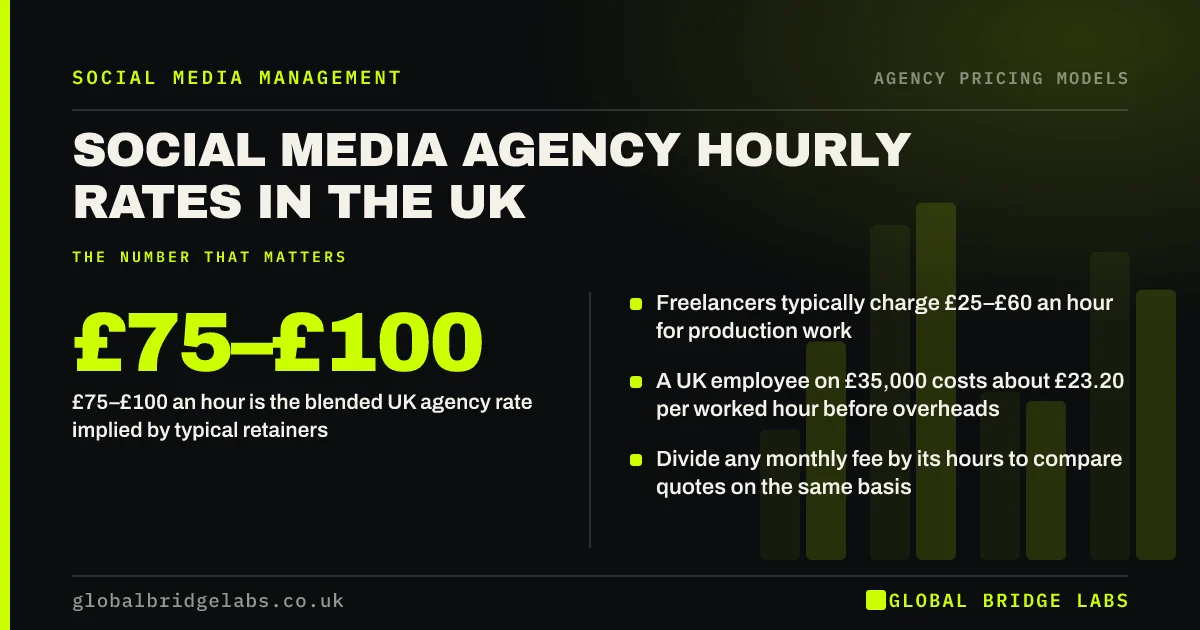
A strategy is priced on senior hours. At the £75–£100 an hour implied by typical UK retainers, 10 hours costs about £750 and 30 hours about £3,000. The lower end is a workshop and a one-page plan. The upper end adds audience research, competitor review and a measurement set-up. These are indicative figures.
- Workshop and one-page plan: indicative £750–£1,200.
- Plan with audience and competitor research: indicative £1,200–£2,000.
- Multi-channel plan with tracking design: indicative £2,000–£3,000.
Want a strategy scoped to your business as a fixed piece of work? Send us your goals on WhatsApp and we will discuss your requirements.
Chat on WhatsApp →What should the strategy document contain?
A usable strategy fits on one or two pages and answers seven questions: the goal, the audience, the channels, the content pillars, the posting rhythm, the budget and the measures. If it cannot be read in five minutes, it will not be used in a busy week.
- One commercial goal and the number that proves it.
- Who you need to reach and where they are.
- One or two channels, with reasons.
- Three or four content pillars.
- A weekly rhythm you can hold.
- Budget, including paid reach.
- What is reported monthly.
Is strategy included in a monthly retainer?
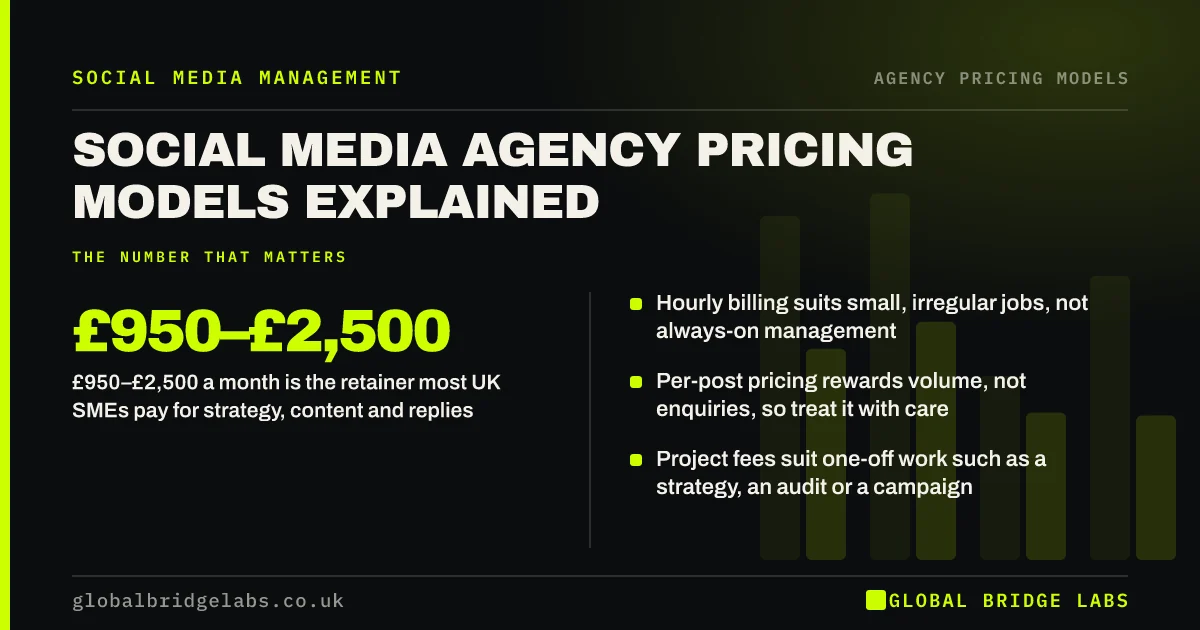
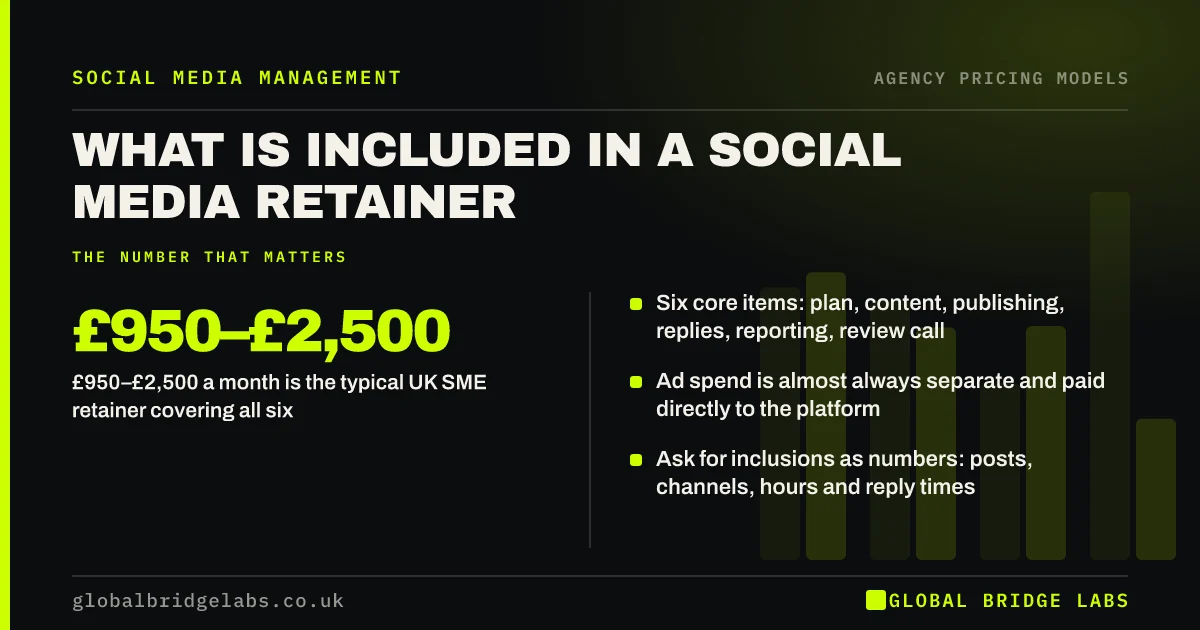
Usually, as part of onboarding. Most retainers in the £950–£2,500 band include a strategy at the start and a review each quarter. Publishing-only packages rarely include one. If you are quoted a separate strategy fee and a set-up fee, check you are not paying twice.
When should you write it yourself?
Write it yourself when the business is simple, you know your customers well and the budget is tight. A template and two focused hours will produce a workable plan. Pay for a strategy when you are entering a new market, choosing between channels with real money, or briefing an agency.
What makes a paid strategy poor value?
A paid strategy is poor value when nobody implements it, when it recommends every channel, or when it has no numbers. A long document of trends and personas with no posting plan or budget is a report, not a strategy.
What happens in a strategy workshop?
A strategy workshop is a two to three hour working session with the people who know your customers. It ends with decisions, not ideas: the goal, the audience, the channels, the content pillars and the measures. The written strategy afterwards records what was decided and who owns each part.
- Before: sales figures, customer questions, current accounts.
- During: goal, audience, channels, pillars, measures.
- After: a one or two page plan and a 90-day calendar.
What does this look like in practice?
A pattern we see with UK owner-managed firms: a short strategy session narrows four channels to two and sets one measure, enquiries. Global Bridge Labs (GBL) offers a 30-minute consultation that gives an honest view of which channels to focus on and what a first 90 days would look like.
Strategy buying checklist
Check these before paying for a strategy.
- Ask to see an example, with client details removed.
- Confirm length: one or two pages for daily use.
- Check it includes budget and measures.
- Agree who implements it afterwards.
- Confirm you own the document.
Next step
Tell us what you want social media to achieve this year. We will tell you whether you need a paid strategy or a template and an hour of advice.
Message us on WhatsApp to talk through your social media strategy, or book a 30-minute consultation.
Chat on WhatsApp →Sources and further reading
- The Long and the Short of It: balancing short and long-term marketing strategies · IPA
- Employee earnings in the UK (Annual Survey of Hours and Earnings) · Office for National Statistics
Frequently asked questions
How much does a social media strategy cost in the UK?
As an indication, £750–£3,000 for a written strategy from an agency or consultant, based on 10 to 30 hours of senior time. A workshop and one-page plan is at the lower end; research across several channels is at the upper end.
Do I need a strategy before hiring a social media agency?
You need clear goals, not a finished strategy. A good agency builds the strategy with you during onboarding. Arriving with a goal, an audience and a budget makes quotes easier to compare. If you have neither, a short paid strategy session before the quotes is money well spent.
Can I write my own social media strategy?
Yes. A small business with clear goals can draft a one-page strategy in an afternoon using a template. Paying for one makes sense when the decisions are expensive, such as new markets or significant paid budgets. Either way, keep it to a page or two so it gets used.
How often should a social media strategy be updated?
Review it every quarter and rewrite it once a year or when the business changes materially, such as a new service, location or audience. Monthly reports should feed small adjustments in between. Change the strategy when the evidence changes, not when a new platform launches.
Written by

Global Bridge Labs (GBL) is a UK–Sri Lanka partner for social media, websites and BPO. Everything here comes from client delivery, not theory.