On this page
- 01Key takeaways
- 02What is a one-page website?
- 03When does a one-page website work?
- 04Why is a one-page site often a mistake?
- 05Is a one-page website bad for SEO?
- 06What are the risks of a multi-page site?
- 07How do you choose?
- 08What does this look like in practice?
- 09One-page vs multi-page checklist
- 10Next step
- 11Sources and further reading
- 12Frequently asked questions
Key takeaways
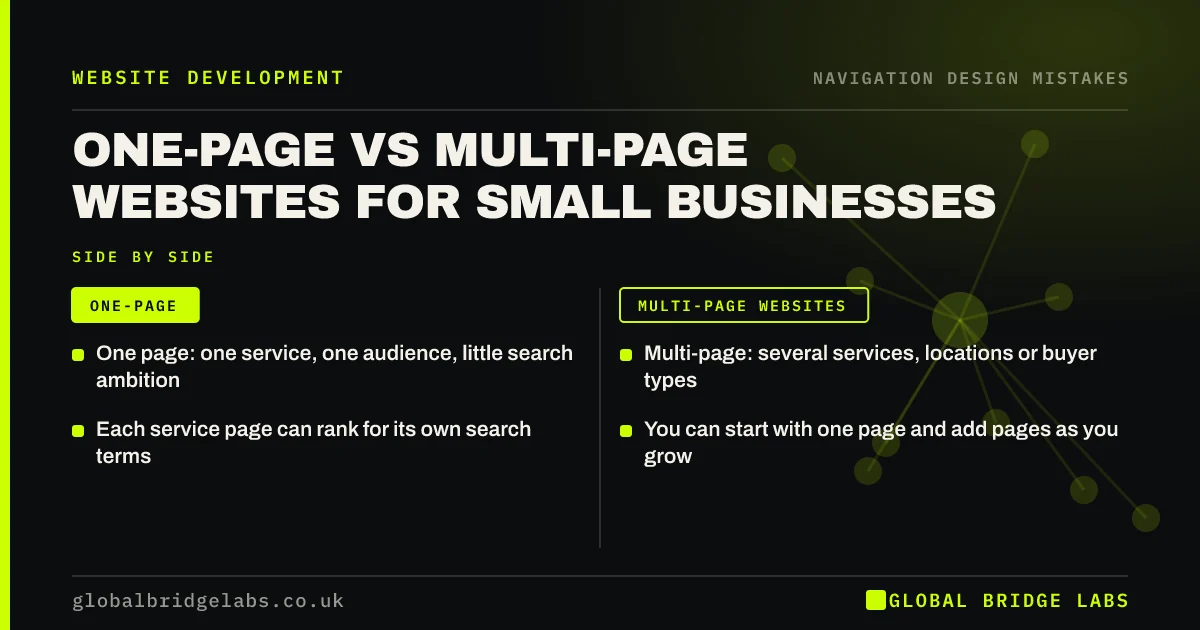
A one-page website suits a business with a single service, a narrow audience and few search terms to target, such as a new sole trader or an event. A multi-page website suits most service businesses, because each service, location and question can have its own page that ranks in search and answers one buyer's need. Choosing one page when you offer several services is a common design mistake.
- One page: one service, one audience, little search ambition.
- Multi-page: several services, locations or buyer types.
- Each service page can rank for its own search terms.
- You can start with one page and add pages as you grow.
Unsure which suits you? Message us on WhatsApp.
Chat on WhatsApp →What is a one-page website?
A one-page website puts all content on a single scrolling page, with menu links that jump to sections such as Services, About and Contact. A multi-page website splits content into separate pages, each with its own address, title and purpose.
When does a one-page website work?
One-page sites work when there is one thing to say and one action to take: a single product launch, an event, a portfolio, or a new business with one service in one area. They are quick and cheap to build, easy to keep current and give visitors a simple, linear story.
Why is a one-page site often a mistake?
For a business with several services, a single page has to rank for everything at once and usually ranks well for nothing. It cannot have a separate title and description for each service, which limits how Google can match it to specific searches. It also becomes long, and visitors interested in one service must scroll past the others.
- One page title and description for every service.
- No dedicated page to link adverts or social posts to.
- Harder to track which service visitors were interested in.
- Long scrolling on phones to find one section.
Is a one-page website bad for SEO?
Not inherently, but it limits you. Google ranks pages, so one page can target one main topic well. A multi-page site can target each service and location with its own page, title and content, which matches how people search. Google's SEO Starter Guide encourages organising content so each page has a clear topic.
Want to know how many pages your site really needs? Message us on WhatsApp and we will discuss your requirements.
Chat on WhatsApp →What are the risks of a multi-page site?
Multi-page sites can sprawl: thin pages with a paragraph each, duplicated content across location pages and a menu that grows too long. The answer is not fewer pages but better ones: each page should answer one buyer's question fully.
How do you choose?
Count the distinct things buyers search for: services, locations, buyer types. If there is one, a one-page site may be enough. If there are several, give each its own page. You can start with a strong homepage and a page for each main service, then add more as you learn what buyers ask.
What does this look like in practice?
A pattern we see: a firm offering four services has a single long page, and a buyer searching for one of those services lands on a section about another. Splitting the services onto their own pages gives each one a clear title, a focused message and a place for adverts to link to.
One-page vs multi-page checklist
- List the services, locations and buyer types you serve.
- Use one page only if there is one of each.
- Give each main service its own page.
- Make every page answer one question fully.
- Avoid thin and duplicated pages.
- Keep the menu to five to seven items.
Next step
Write down the three searches you most want to be found for. If they need different answers, they need different pages.
Message us on WhatsApp to plan your site structure, or book a 30-minute consultation.
Chat on WhatsApp →Sources and further reading
- SEO Starter Guide · Google Search Central
- Influencing your title links in search results · Google Search Central
- Scrolling and attention · Nielsen Norman Group
Frequently asked questions
Is a one-page website good for a small business?
It can be, if you offer one service to one audience and do not need to rank for many different searches. Businesses with several services or locations usually do better with a page for each, which can rank and be linked to separately.
Is a one-page website bad for SEO?
It limits SEO rather than ruining it. One page can rank for one main topic. A multi-page site can give each service and location its own title and content, which matches more of the searches buyers make.
How many pages should a small business website have?
Enough to give each main service, key location and important buyer question its own page, plus home, about and contact. For many service businesses that is somewhere between about six and twenty pages, but quality matters more than count.
Written by

Global Bridge Labs (GBL) is a UK–Sri Lanka partner for social media, websites and BPO. Everything here comes from client delivery, not theory.