On this page
- 01Key takeaways
- 02Why are businesses nervous about free advice?
- 03What should you share freely?
- 04What should you keep for paying clients?
- 05How do you stop attracting people who only want tips?
- 06How do you handle requests for free help in messages?
- 07When does free advice backfire?
- 08What does this look like in practice?
- 09Free advice checklist
- 10Next step
- 11Sources and further reading
- 12Frequently asked questions
Key takeaways
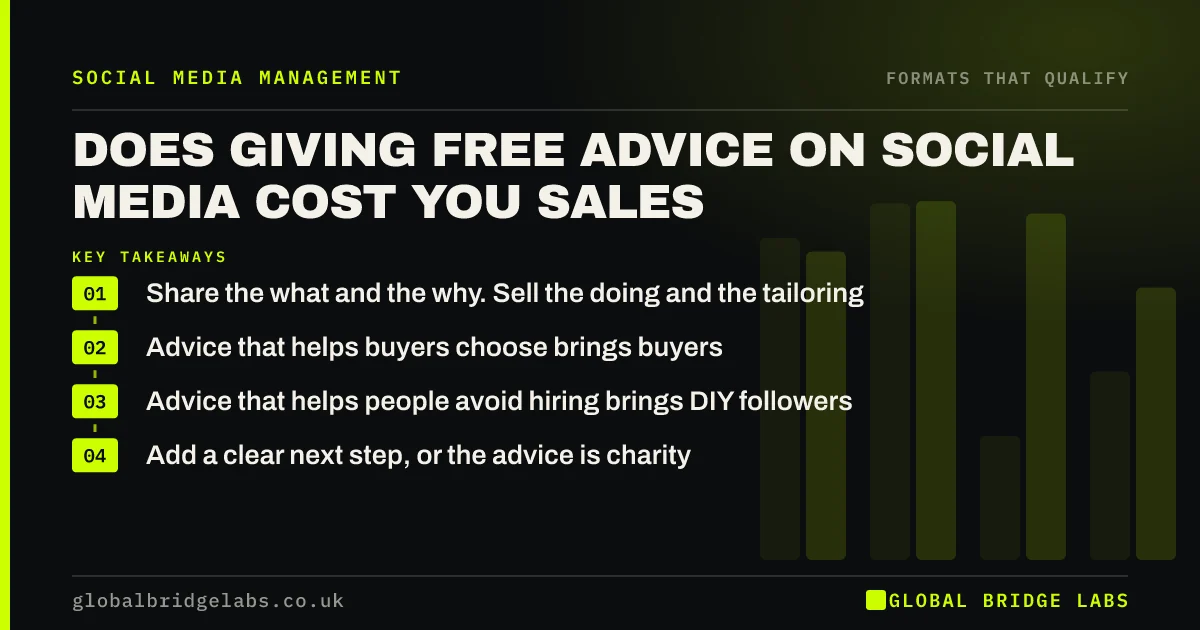
Giving away free advice on social media rarely costs sales, because buyers pay for the work being done for them, not for the knowledge alone. It costs sales only when the advice is aimed at people who want to do it themselves. Explain what and why freely. Keep the tailored how for clients.
- Share the what and the why. Sell the doing and the tailoring.
- Advice that helps buyers choose brings buyers.
- Advice that helps people avoid hiring brings DIY followers.
- Add a clear next step, or the advice is charity.
Unsure what to give away and what to hold back? Message us on WhatsApp.
Chat on WhatsApp →Why are businesses nervous about free advice?
Businesses worry that if they explain how it is done, nobody will need them, or a competitor will copy it. Both fears are overstated. Most customers lack the time, tools or confidence to do the work, and competitors already know the general method.
What should you share freely?
Share what helps a buyer understand their situation and choose well: what the options are, what affects the cost, what good looks like, which mistakes are common and how long things take. This is the knowledge that makes someone trust you enough to enquire.
- What the options are and who each suits.
- What drives cost and timescale.
- How to tell good work from poor.
- Mistakes to avoid when choosing a supplier.
What should you keep for paying clients?
Keep the application: the diagnosis of a specific case, the tailored plan, the templates and the doing. General principles lose nothing by being shared. Advice on an individual's circumstances is the service itself, and in regulated professions it carries liability if given casually.
- Diagnosis of an individual case.
- A tailored plan or specification.
- Your working templates and tools.
- The implementation itself.
Want a line drawn for your service? Message us on WhatsApp and we will discuss your requirements.
Chat on WhatsApp →How do you stop attracting people who only want tips?
Change who the advice is for. 'How to choose an accountant when you outgrow your bookkeeper' attracts a buyer. 'How to do your own VAT return' attracts someone avoiding one. Frame advice around decisions buyers face, and say plainly that you offer the service.
How do you handle requests for free help in messages?
Answer the general question briefly, then explain what a proper answer requires. A reply such as 'In general, yes. To be sure for your property I would need to see it. A survey is £95' is polite, helpful and clear about where free ends.
When does free advice backfire?
Free advice backfires when it is wrong, when it is given on regulated matters without the proper basis, or when it replaces all selling. The Financial Conduct Authority (FCA), for example, treats social media posts that promote financial products as financial promotions. Know where your sector draws the line.
What does this look like in practice?
A pattern we see with UK consultants and professional firms: a large following of students and peers built on how-to threads, and few client enquiries. Keeping the generosity but re-aiming it at the decisions a client faces changes the audience over a few months.
Free advice checklist
Test each advice post.
- It helps a buyer choose, not avoid buying.
- It is accurate and current.
- It stays general, not case-specific.
- It states that you offer the service.
- It has one next step.
- It respects any sector rules.
Next step
Look at your last five advice posts and ask of each: who would find this useful, a buyer or a do-it-yourselfer? Re-aim the next five.
Message us on WhatsApp for a review of your advice content, or book a 30-minute consultation.
Chat on WhatsApp →Sources and further reading
- Financial promotions and adverts · Financial Conduct Authority
- Creating helpful, reliable, people-first content · Google Search Central
- Recognising ads: brand-owned and paid social media · ASA / CAP
Frequently asked questions
Should I give away free advice on social media?
Yes, within limits. Explain what the options are, what affects cost and how to choose. That builds the trust that leads to enquiries. Keep case-specific diagnosis, tailored plans and the work itself for paying clients. Always say that you offer the service, so helpful posts lead somewhere.
Will free content stop people buying from me?
Rarely. Most customers want the job done for them and lack the time or tools to do it. Free content mainly loses you people who were never going to pay, and wins trust from those who will. Aim the advice at decisions buyers face, and the audience follows.
How much should I give away?
Give away general principles in full and stop where the answer depends on the individual. A useful test is whether you could say it to a room of strangers. If it needs facts about one person, it is the paid service.
How do I respond when someone asks for free help privately?
Give a short general answer, then say what a proper answer needs and what it costs. This is courteous, shows expertise and makes the boundary clear without refusing to help. A saved reply makes this quick, and keeps the tone friendly when you are busy.
Written by

Global Bridge Labs (GBL) is a UK–Sri Lanka partner for social media, websites and BPO. Everything here comes from client delivery, not theory.