On this page
- 01Key takeaways
- 02Why do businesses copy competitor websites?
- 03Is it legal to copy a website design in the UK?
- 04Why does copying usually copy mistakes?
- 05What is worth learning from competitor sites?
- 06How do you stand out instead?
- 07When does following competitors make sense?
- 08What does this look like in practice?
- 09Competitor review checklist
- 10Next step
- 11Sources and further reading
- 12Frequently asked questions
Key takeaways
Do not copy a competitor's website design. Learning from it is fine: noting which questions they answer, how they show prices or what proof they use. Copying the layout, wording or images risks copyright infringement, makes you look identical to the business you are trying to beat, and copies mistakes you cannot see from outside.
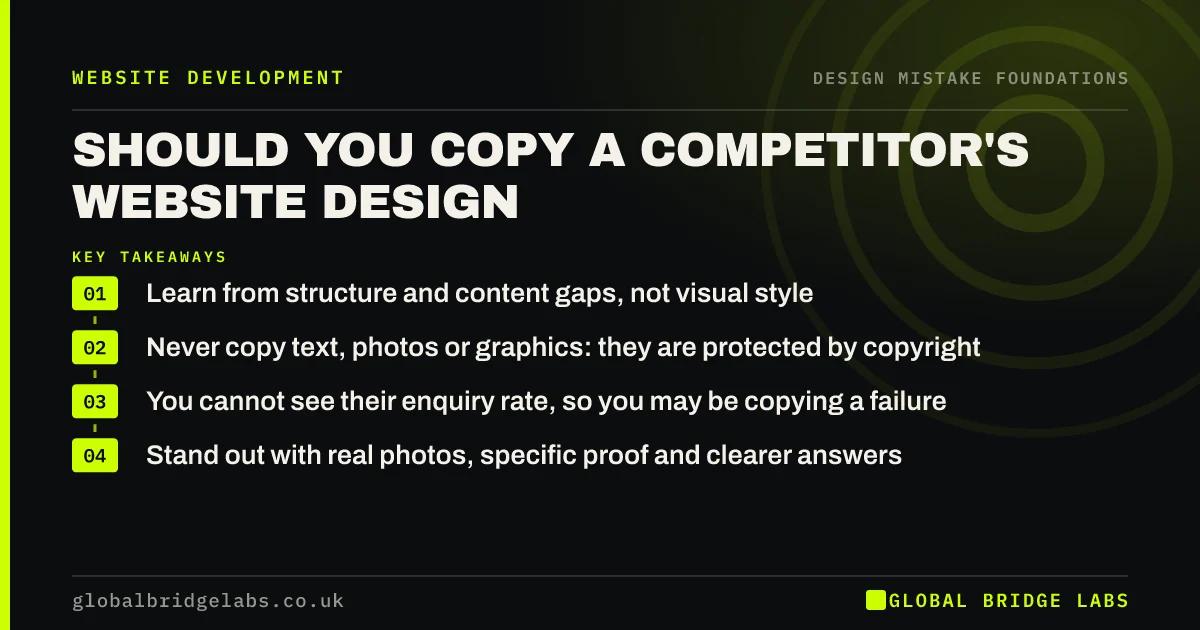
- Learn from structure and content gaps, not visual style.
- Never copy text, photos or graphics: they are protected by copyright.
- You cannot see their enquiry rate, so you may be copying a failure.
- Stand out with real photos, specific proof and clearer answers.
Want a fair comparison with your competitors? Message us on WhatsApp.
Chat on WhatsApp →Why do businesses copy competitor websites?
Copying feels safe. If a bigger competitor's site looks professional, matching it seems like a shortcut to looking credible. It is also easy to brief: 'make it like theirs'. The problem is that a design brief based on someone else's site skips the question of what your own buyers need.
Is it legal to copy a website design in the UK?
Copying a website's text, photographs, illustrations, logos or code without permission can infringe copyright, which in the UK arises automatically when original work is created. General ideas, such as putting reviews near a button or a three-column services layout, are not protected. The risk lies in copying the actual expression: words, images and distinctive graphics.
This is general information, not legal advice. If you are unsure whether something crosses the line, take advice before publishing.
Why does copying usually copy mistakes?
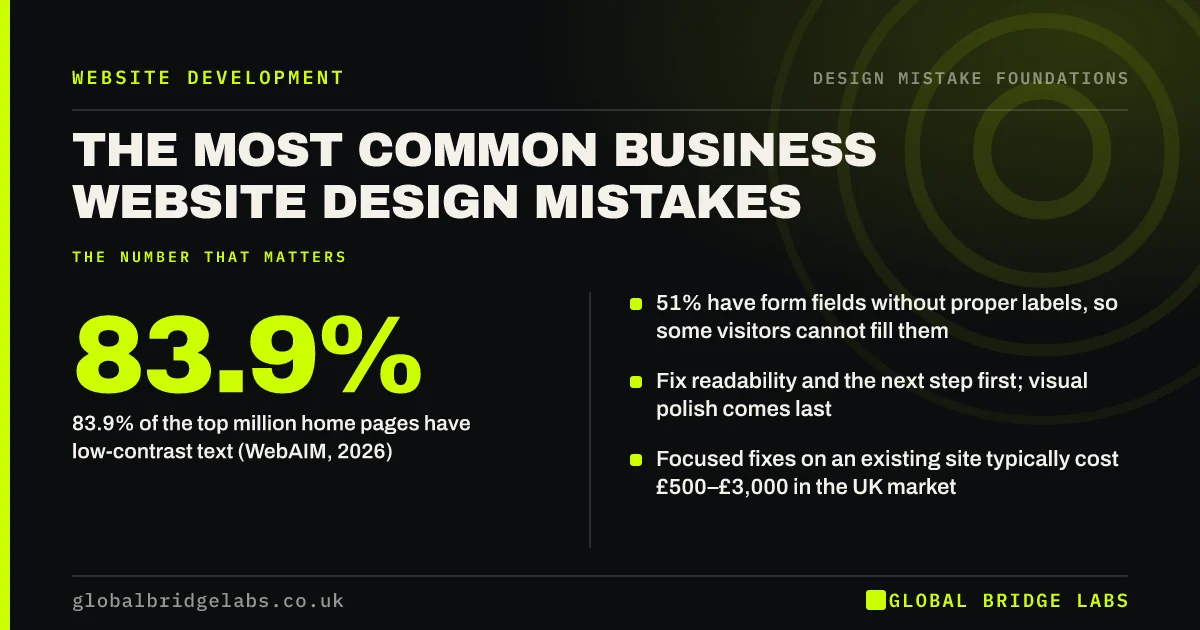
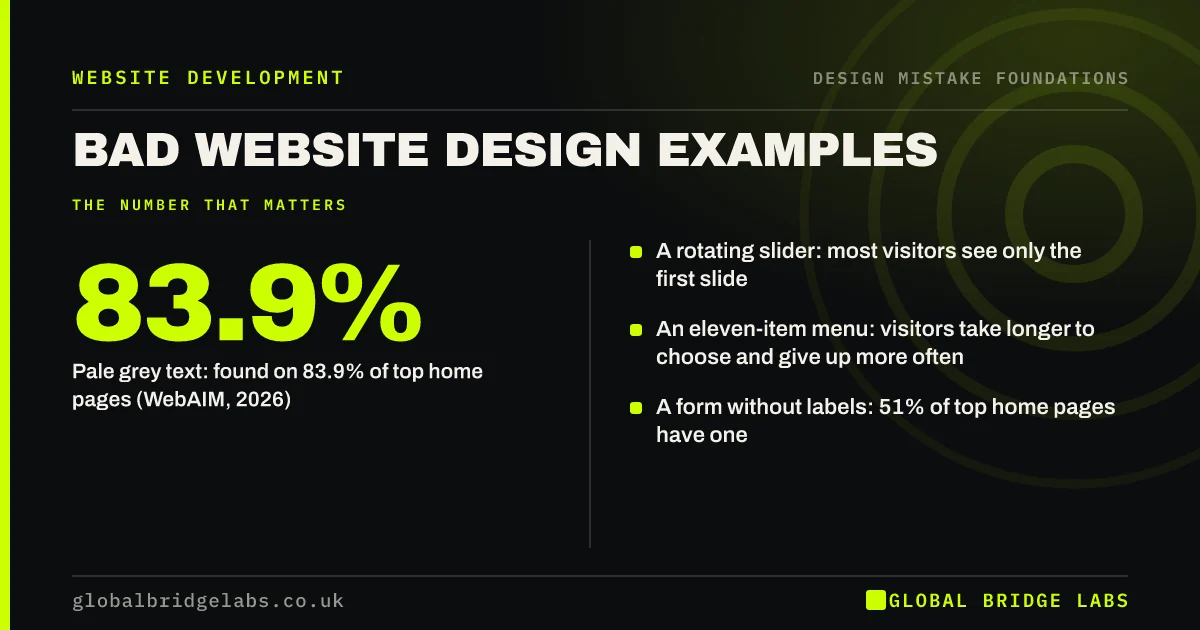
From outside, you see how a competitor's site looks, not how it performs. You do not know their enquiry rate, whether the site was approved by committee, or whether they are about to replace it. Many competitor sites share the same faults, so copying one is a reliable way to inherit low-contrast text, a crowded menu or a weak call to action.
What is worth learning from competitor sites?
Look for what they answer and what they leave out. Note the questions their service pages cover, whether they show prices, what proof they use, how quickly you can contact them on a phone and how they describe the problem. Then aim to answer the same questions more clearly and add what they miss.
- Questions answered on service pages, and gaps.
- Whether prices or ranges are shown.
- Types of proof: reviews, case studies, accreditations.
- Steps to contact from a phone.
- Words customers would use that they use, or do not.
Want help turning a competitor review into a brief? Message us on WhatsApp and we will discuss your requirements.
Chat on WhatsApp →How do you stand out instead?
Stand out with things a competitor cannot copy: real photos of your team and work, specific case studies, named reviews, clear prices or ranges, and wording drawn from your own customers' questions. These separate you far more than a different colour scheme or layout.
When does following competitors make sense?
Following sector conventions makes sense. If every clinic site has an online booking button in the header, buyers expect one on yours. Conventions reduce effort for visitors. The line is between using a familiar pattern, which helps, and reproducing a particular business's site, which does not.
What does this look like in practice?
A pattern we see: a brief says 'like competitor X, but in our colours'. When we look at competitor X on a phone, the contact details take four taps to find. Briefing from the customer's questions instead produces a site that is different where it matters.
Competitor review checklist
- Review three competitors on a phone, not a laptop.
- List the questions each answers and misses.
- Note prices, proof and contact steps.
- Copy no text, images or graphics.
- Brief your site on your customers' questions.
- Use your own photos and proof to stand out.
Next step
Pick three competitors and write down one question each fails to answer. Make sure your site answers all three.
Message us on WhatsApp for a competitor comparison, or book a 30-minute consultation.
Chat on WhatsApp →Sources and further reading
- How copyright protects your work · GOV.UK
- Creating helpful, reliable, people-first content · Google Search Central
- Photos as web content · Nielsen Norman Group
Frequently asked questions
Is it illegal to copy someone's website design?
Copying text, photos, graphics or code without permission can infringe UK copyright. Layout ideas and common design patterns are generally not protected. If you want to reuse anything specific from another site, ask permission or take legal advice first.
Can I use a competitor's website for inspiration?
Yes. Studying what competitors answer, how they present prices and proof, and how easy they are to contact is good research. Use it to make your own site clearer and more specific, not to reproduce their look or wording.
Should my website look like others in my industry?
It should follow the conventions buyers expect, such as booking buttons for clinics or emergency numbers for trades, so it feels familiar. It should not look like any one competitor. Real photos, proof and wording make the difference.
Written by

Global Bridge Labs (GBL) is a UK–Sri Lanka partner for social media, websites and BPO. Everything here comes from client delivery, not theory.