On this page
- 01Key takeaways
- 02What is a content calendar completion rate?
- 03Why measure it?
- 04What do the bands mean?
- 05Which posts count?
- 06When is completion the wrong thing to chase?
- 07What does this look like in practice?
- 08Completion rate checklist
- 09Next step
- 10Sources and further reading
- 11Frequently asked questions
Key takeaways
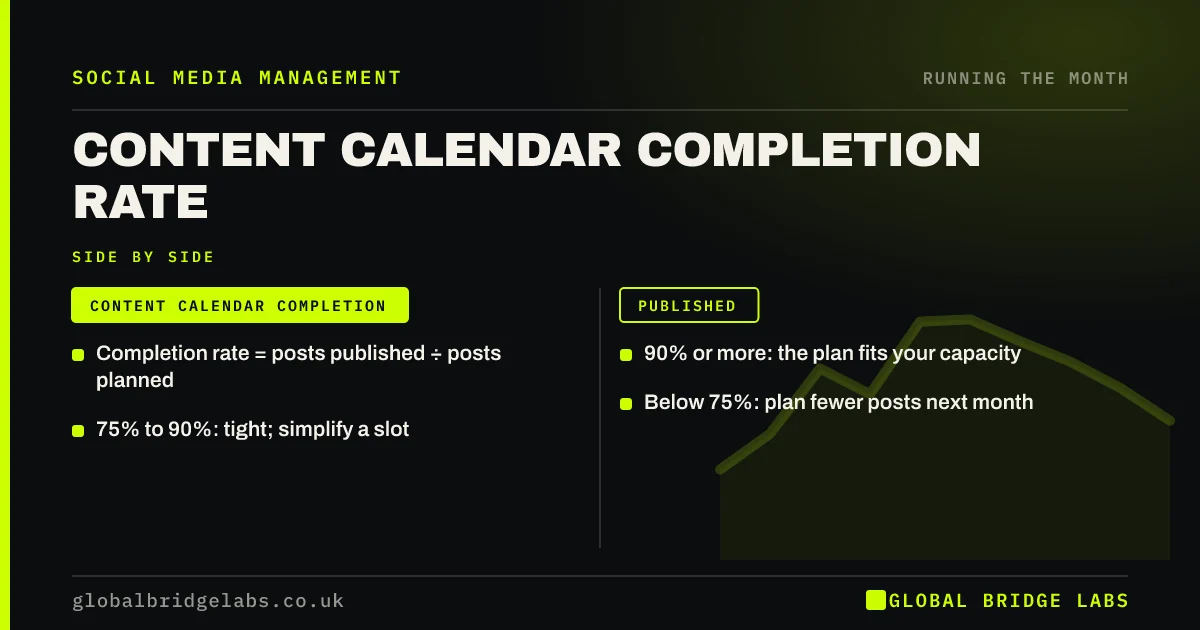
Content calendar completion rate is the number of posts published divided by the number planned for the month. It is the simplest test of whether a calendar fits your capacity. Above 90% means the plan fits. Between 75% and 90% means it is tight. Below 75% means it is too big, and next month should have fewer slots, not more effort.
- Completion rate = posts published ÷ posts planned.
- 90% or more: the plan fits your capacity.
- 75% to 90%: tight; simplify a slot.
- Below 75%: plan fewer posts next month.
Want your completion rate tracked monthly? Message us on WhatsApp.
Chat on WhatsApp →What is a content calendar completion rate?
A content calendar completion rate is the share of planned posts that were actually published in a month. If you planned 12 and published 9, the rate is 75%. It measures the plan, not the content: a calendar that is always half-finished is too big or poorly owned, however good the ideas.
Why measure it?
Because consistency underpins every other result, and this is the number that shows it. Reach and enquiries are hard to judge when posting is erratic. Once completion is steady above 90%, other measures start to mean something, and changes to content can be judged fairly.
What do the bands mean?
As GBL working rules of thumb: 90% or more means the plan fits, so keep it or add one slot. 75% to 90% means it is tight, so simplify the slot that is usually missed. Below 75% means the plan is too big for the hours available, so remove slots next month. Three months below 75% means change ownership or get help.
Which posts count?
Count planned feed posts that went out within a day of their date, including swaps for reserve posts in the same slot. Do not count unplanned extras, which hide the gap, or Stories, unless you planned them as slots. Record the rate at the end of each month next to the plan.
When is completion the wrong thing to chase?
When reaching 100% means publishing weak posts. Leaving a slot empty or using a reserve post is better than filler. And completion says nothing about whether posts bring enquiries; it is a capacity measure, alongside your goal measure, not instead of it.
What does this look like in practice?
A pattern we see: a team that feels it is failing at social media, without knowing it publishes about half of what it plans. Recording the rate for a month usually makes the fix obvious: a smaller plan that gets done.
Completion rate checklist
- Count planned and published posts each month.
- Divide published by planned.
- Keep or add a slot at 90% or more.
- Simplify a slot between 75% and 90%.
- Cut slots below 75%.
Next step
Count last month's planned and published posts now. Write the rate at the top of next month's calendar and size the plan to it.
Message us on WhatsApp with your rate and we will suggest next month's size, or book a 30-minute consultation.
Chat on WhatsApp →Sources and further reading
- Meta Business Help Centre · Meta
- LinkedIn Pages best practices · LinkedIn
Frequently asked questions
How do I measure if my content calendar is working?
Start with completion rate, posts published divided by posts planned, which shows whether the plan fits your capacity. Then look at your goal measure, such as enquiries from social media. Both are needed: one for consistency, one for results.
What is a good content calendar completion rate?
90% or more of planned posts published is a good rate. Between 75% and 90% is tight. Below 75% means the plan is too big for the time available and next month should have fewer slots.
Do reserve posts count towards completion?
Yes, if a reserve post filled a planned slot within a day of its date. Unplanned extra posts should not count, because they hide gaps in the plan and make the rate look better than it is.
Written by

Global Bridge Labs (GBL) is a UK–Sri Lanka partner for social media, websites and BPO. Everything here comes from client delivery, not theory.