On this page
- 01Key takeaways
- 02Why do client delays matter to the fee?
- 03What should the contract say?
- 04Is it fair to be charged for late changes?
- 05How do you avoid delays?
- 06When should the agency absorb a delay?
- 07What does this look like in practice?
- 08Approval terms checklist
- 09Next step
- 10Sources and further reading
- 11Frequently asked questions
Key takeaways
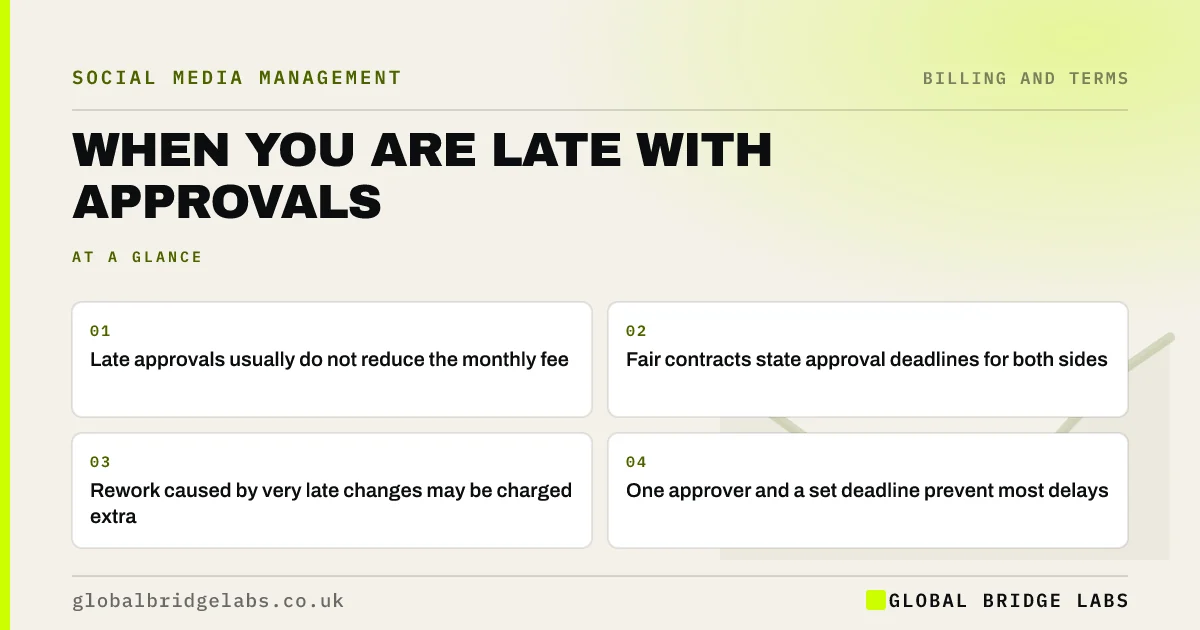
Client delays with a social media agency, such as late approvals or missing photos, usually do not reduce the monthly fee, because the agency has reserved the time. Fair contracts say what happens: posts move, unused work is not refunded and repeated delays can trigger extra charges for rework.
- Late approvals usually do not reduce the monthly fee.
- Fair contracts state approval deadlines for both sides.
- Rework caused by very late changes may be charged extra.
- One approver and a set deadline prevent most delays.
Want an approval routine that fits your week? Message us on WhatsApp.
Chat on WhatsApp →Why do client delays matter to the fee?
An agency plans its month around your scope. When approvals or materials arrive late, the reserved time is lost or work has to be redone at short notice. The fee pays for that reserved capacity, so late input usually does not reduce it, even if fewer posts go out.
What should the contract say?
A fair contract sets out both sides' responsibilities: what the client supplies and by when, how long approvals take, what happens to unapproved posts and how very late changes are charged. Clear terms protect the client too, because the agency must meet its own deadlines.
- Materials the client supplies and by when.
- Approval deadline, such as two working days.
- What happens to posts not approved in time.
- How late changes and rework are charged.
Is it fair to be charged for late changes?
Usually, if it is stated in advance and limited to real rework. Changing a finished video after approval costs the agency new hours, often billed at £75–£100 an hour at typical UK retainer levels. Charging for normal revision rounds already in the scope would not be fair.
Want clear approval terms in your plan? Ask us on WhatsApp and we will discuss your requirements.
Chat on WhatsApp →How do you avoid delays?
Name one approver, set a regular approval slot in their diary and approve the month's calendar in one sitting. Share photos through a shared folder weekly rather than on request. If the approver is away, name a deputy.
When should the agency absorb a delay?
When the delay is the agency's fault, or when it is a one-off caused by something outside your control, a good agency will be flexible. Repeated delays, however, are a sign the process needs fixing, not that the agency should work for free.
What does this look like in practice?
A pattern we see with UK owner-managed businesses: the owner is the only approver and is busy on jobs, so posts sit waiting for days. Global Bridge Labs (GBL) sets up a monthly approval session and a simple rule that minor posts can go live after two working days without objection.
Approval terms checklist
Agree these before you start.
- One approver and one deputy.
- Approval deadline for each type of content.
- What happens to late or unapproved posts.
- How rework after approval is charged.
- When materials must be supplied.
Next step
Tell us who approves content now and how long it takes. We will suggest an approval routine that fits your week.
Message us on WhatsApp, or book a 30-minute consultation.
Chat on WhatsApp →Sources and further reading
- Late commercial payments: charging interest and debt recovery · GOV.UK
- Consumer Rights Act 2015 · legislation.gov.uk
- Meta Business Help Centre · Meta
Frequently asked questions
Do I still pay my social media agency if I approve posts late?
Usually yes. The monthly fee pays for reserved time, which is lost when approvals or materials arrive late. A fair contract explains what happens to delayed posts, and a good agency will be flexible about one-off delays outside your control.
Can an agency charge for changes after approval?
Yes, if the contract says so. Changing work after it has been approved creates new hours, often charged at the agency's hourly rate. Normal revision rounds included in the scope should not be charged extra.
What is a reasonable approval deadline?
Two to three working days is common for routine posts, with longer for video or campaigns. Some agreements allow minor posts to go live if there is no objection by the deadline. Agree it in writing so both sides plan around it.
How can I approve social media posts faster?
Name one approver and a deputy, book a regular slot to review the month's calendar, and give feedback in writing in one round. Approving in batches is far quicker than reviewing posts one at a time as they arrive.
Written by

Global Bridge Labs (GBL) is a UK–Sri Lanka partner for social media, websites and BPO. Everything here comes from client delivery, not theory.