
On this page
- 01Key takeaways
- 02What is a scope of work?
- 03Which twelve lines does a scope need?
- 04What does vague wording look like?
- 05What should the client side of the scope say?
- 06How do you handle changes to the scope?
- 07When is a detailed scope too much?
- 08How often should the scope be reviewed?
- 09What does this look like in practice?
- 10Scope checklist
- 11Next step
- 12Sources and further reading
- 13Frequently asked questions
Key takeaways
A social media scope of work is the list of what an agency will deliver each month, written as numbers. It is the document that makes a fixed fee fair to both sides. Twelve lines cover almost every engagement, and each one should be measurable.
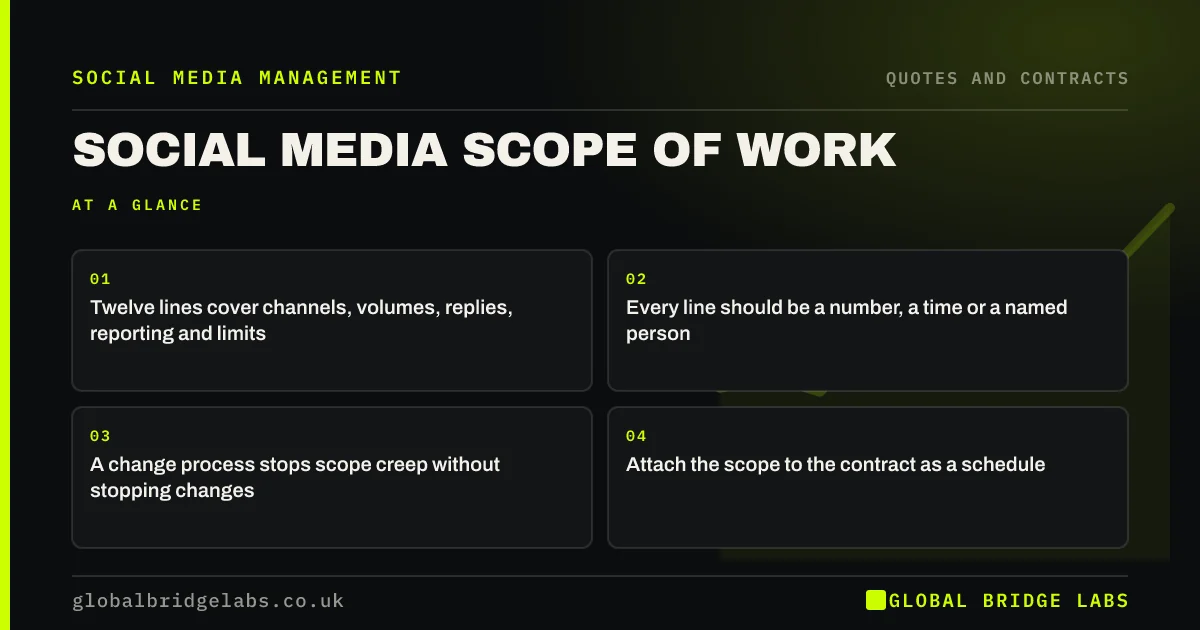
- Twelve lines cover channels, volumes, replies, reporting and limits.
- Every line should be a number, a time or a named person.
- A change process stops scope creep without stopping changes.
- Attach the scope to the contract as a schedule.
Want a scope drafted for your channels? Message us on WhatsApp.
Chat on WhatsApp →What is a scope of work?
A scope of work is a written schedule that defines the services, deliverables, volumes, timings and responsibilities covered by a fee. In social media it turns a general promise of management into specific monthly commitments both sides can check.
Which twelve lines does a scope need?
These twelve lines cover the work, its limits and who is responsible for what. Together they fit on a single page. Copy them into a document, send it with your brief and ask each agency to complete every line, so that the scopes you receive can be laid side by side.
- Channels managed.
- Posts per month, by type.
- Videos per month and who films.
- Stories or short updates per week.
- Reply hours and response time.
- Paid campaigns managed and review frequency.
- Monthly report contents and date.
- Meetings: frequency and length.
- Approval rounds and turnaround.
- What the client supplies, and when.
- Exclusions and their prices.
- Named contacts on both sides.
What does vague wording look like?
Vague wording uses words that cannot be checked. Regular posting, ongoing community management and monthly reporting sound fine and mean nothing. Precise wording says 14 posts a month, replies within four working hours between 9am and 5pm on weekdays, and a one-page report by the fifth working day.
What should the client side of the scope say?
It should say what you will supply and how fast you will approve. Most delays come from the client side: no photos, slow sign-off, changing priorities. Writing your own commitments into the scope protects the result as much as the agency's.
- Photos and clips supplied weekly to a shared folder.
- Offers and dates supplied a month ahead.
- One named approver.
- Approval within two working days.
Want a scope with both sides' commitments on one page? Send us your channels on WhatsApp and we will discuss your requirements.
Chat on WhatsApp →How do you handle changes to the scope?
Agree a simple change process. Small swaps within the same effort, such as a video instead of two posts, need no paperwork. Anything that adds work is quoted and approved before it starts. Review the scope every quarter and reset it if needs have changed.
When is a detailed scope too much?
A scope is too detailed when it fixes things that should flex, such as exact posting days or topics months ahead. Fix volumes, hours and response times. Leave the content itself to the monthly plan, so the agency can respond to what is happening in your business.
How often should the scope be reviewed?
Review the scope every quarter. Needs change: a new service launches, a channel stops performing, message volume grows. A 20-minute review against the monthly reports keeps the scope matched to what the business needs, and stops the fee paying for work that no longer earns its place.
- Which lines delivered enquiries?
- Which lines went unused?
- What has changed in the business?
- What should be swapped, added or removed?
What does this look like in practice?
Global Bridge Labs (GBL) prices against a written scope covering channels, content volume, community management in UK hours and monthly reporting. A pattern we see is that most disputes between businesses and their agencies trace back to a single unmeasurable word in the scope.
Scope checklist
Confirm before signing.
- All twelve lines completed.
- No line relies on words such as regular or ongoing.
- Your own commitments included.
- Exclusions priced.
- Change process agreed.
- Scope attached to the contract.
Next step
Tell us your channels and what you want handled. We will draft a scope you can use to brief any agency.
Message us on WhatsApp for a draft scope of work, or book a 30-minute consultation.
Chat on WhatsApp →Sources and further reading
- Employee earnings in the UK (Annual Survey of Hours and Earnings) · Office for National Statistics
- Meta Business Help Centre · Meta
Frequently asked questions
What is a scope of work in social media management?
It is the written schedule of what the agency will deliver each month: channels, post and video volumes, reply hours, reporting, meetings, approval rounds and exclusions. It is attached to the contract and makes a fixed fee checkable.
What is scope creep?
Scope creep is work growing beyond what was agreed without the fee changing, such as extra channels or repeated revisions. It strains the relationship and often reduces quality. A written scope and a simple change process prevent it.
How detailed should a social media scope be?
Detailed on volumes, hours and response times, and flexible on content. Fix how much is delivered and how fast replies happen. Leave topics and timing to the monthly plan. Review the scope each quarter and adjust it.
Who writes the scope of work, the client or the agency?
Usually the agency drafts it from your brief, and you check it. Supplying your own twelve-line outline first makes agencies quote on the same basis and makes the quotes comparable. Either way, both sides should sign the final version.
Written by

Global Bridge Labs (GBL) is a UK–Sri Lanka partner for social media, websites and BPO. Everything here comes from client delivery, not theory.