On this page
Key takeaways
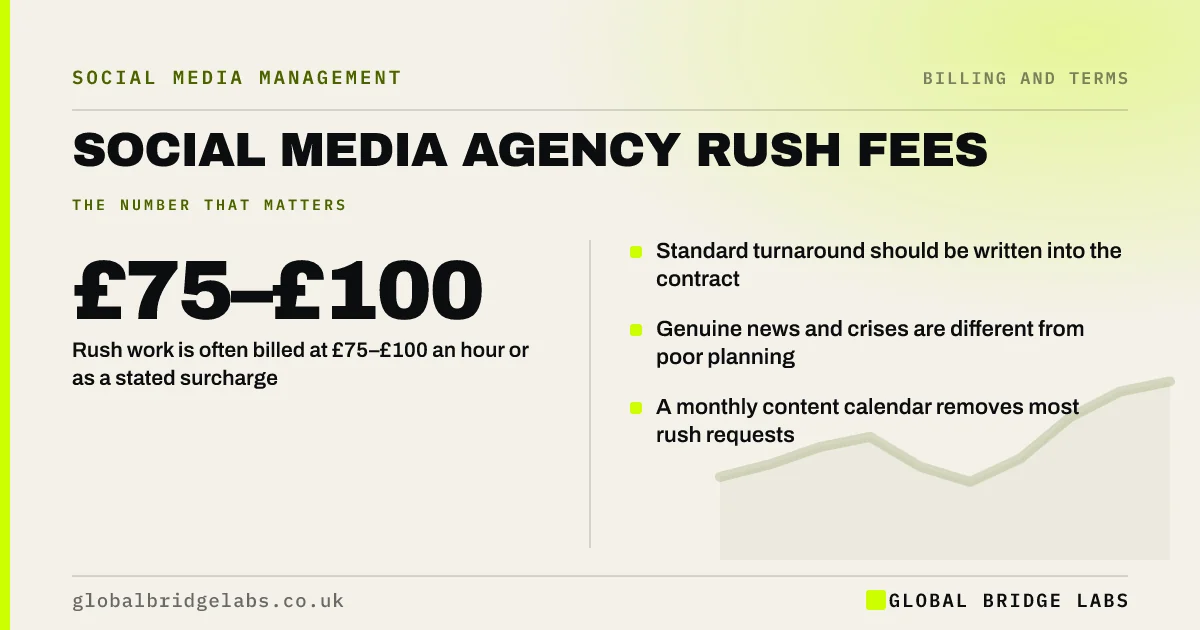
A social media agency rush fee is the extra charge for work needed faster than the standard turnaround. It pays for moving other clients' work. Rush work is usually billed as extra hours at £75–£100 an hour or as a surcharge stated in the contract. Planning ahead avoids most of it.
- Rush work is often billed at £75–£100 an hour or as a stated surcharge.
- Standard turnaround should be written into the contract.
- Genuine news and crises are different from poor planning.
- A monthly content calendar removes most rush requests.
Want a turnaround that fits how your business works? Message us on WhatsApp.
Chat on WhatsApp →What is a rush fee?
A rush fee is an extra charge for delivering work faster than the agreed standard turnaround, such as a same-day post or a weekend change. It compensates the agency for reorganising its schedule, working outside normal hours or delaying other planned work.
How much do rush fees cost?
Rush work is usually billed in one of two ways: as extra hours at the agency's rate, indicatively £75–£100 an hour at typical UK retainer levels, or as a percentage surcharge on the item. Either is fair if it is written down in advance. These are indicative figures, not a GBL price list.
- Extra hours at the agency's hourly rate.
- A stated surcharge on urgent items.
- Weekend or evening work: often priced higher.
- Included urgent requests: some retainers allow a few.
Want urgent requests included in your plan? Send us how often you need them on WhatsApp and we will discuss your requirements.
Chat on WhatsApp →What turnaround is standard?
Standard turnaround varies by task. A simple post change might be same or next working day, a new designed post a few working days, and a video longer. Whatever the agency offers, it should be written in the contract so you know when a request becomes urgent.
When should urgent work not cost extra?
Fixing an agency's own mistake should never cost extra. Many retainers also include a small number of urgent changes, such as correcting opening hours or pausing a post during a crisis. Agree these exceptions in writing so they are not argued about later.
How do you avoid rush fees?
Plan a month ahead. Share launch dates, events and offers early, approve the content calendar on time and keep a few flexible posts ready to adapt. Most rush requests come from known events that were simply not shared in time.
What does this look like in practice?
A pattern we see with UK hospitality and retail clients: offers are decided on a Thursday for the weekend, so every week feels urgent. Global Bridge Labs (GBL) builds a simple monthly offer calendar with the client, which turns most weekly emergencies into planned posts.
Turnaround checklist
Agree these in the contract.
- Standard turnaround for each type of task.
- How urgent requests are priced.
- Urgent changes included each month.
- Out-of-hours contact and cost.
- Agency mistakes fixed at no charge.
Next step
Tell us how often you need urgent changes. We will suggest a turnaround and planning routine that keeps extra charges low.
Message us on WhatsApp to talk through turnaround, or book a 30-minute consultation.
Chat on WhatsApp →Sources and further reading
- Late commercial payments: charging interest and debt recovery · GOV.UK
- Maximum weekly working hours · GOV.UK
- Consumer Rights Act 2015 · legislation.gov.uk
Frequently asked questions
How much do social media agencies charge for urgent work?
Urgent work is usually billed as extra hours at the agency's rate, indicatively £75–£100 an hour at typical UK retainer levels, or as a surcharge stated in the contract. Weekend and evening work is often priced higher. Check the contract for how rush work is charged.
What is a normal turnaround for a social media post?
It depends on the task. Simple text changes are often same or next working day, a new designed post a few working days, and video longer. The standard turnaround should be written into your agreement so both sides know what counts as urgent.
Should I pay a rush fee to fix an agency mistake?
No. Corrections to the agency's own errors should be free and fast. Rush fees apply to new or changed requests made at short notice, not to fixing work that was delivered incorrectly.
How can I avoid rush fees?
Share launches, events and offers at least a month ahead, approve the content calendar on time and keep a few adaptable posts in reserve. Most rush requests come from known events that were not shared early enough.
Written by

Global Bridge Labs (GBL) is a UK–Sri Lanka partner for social media, websites and BPO. Everything here comes from client delivery, not theory.