On this page
- 01Key takeaways
- 02Which platform sells the most event tickets?
- 03What does the promotion timeline look like?
- 04Why do reminders outperform reach?
- 05What makes an event post convert?
- 06When is social the wrong channel for an event?
- 07What does this look like in practice?
- 08How do you handle a poorly selling event?
- 09Next step
- 10Sources and further reading
- 11Frequently asked questions
Key takeaways
Events are filled by reminders, not by reach. Facebook events and email do the work for local events; LinkedIn for professional ones. The most important post is the one three days before, not the announcement.
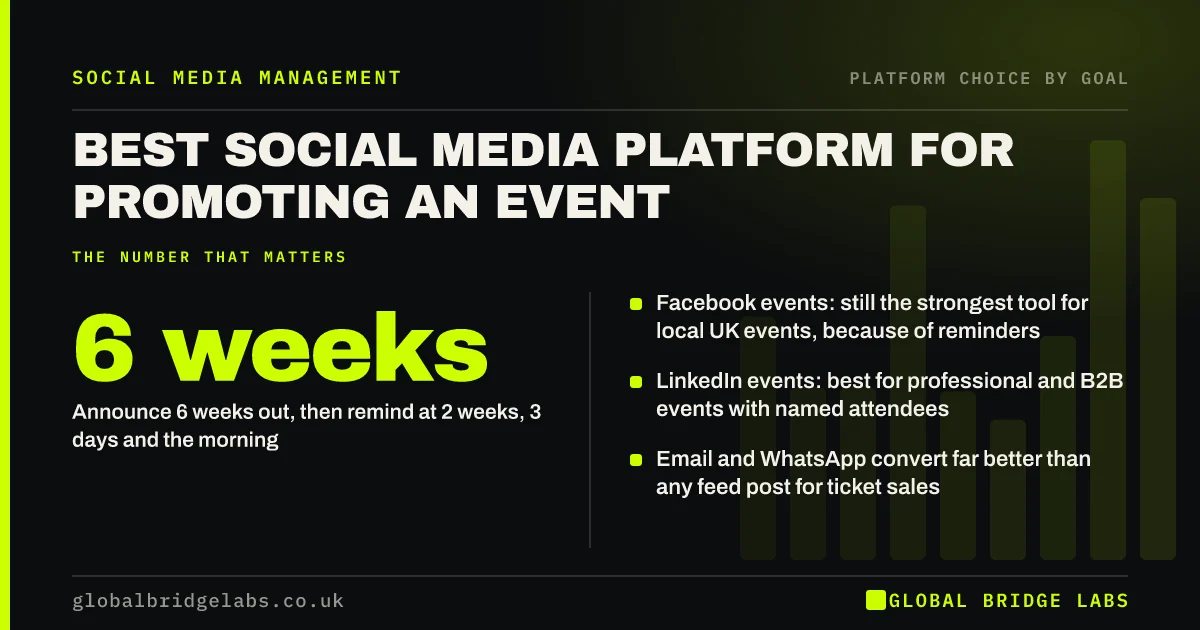
- Facebook events: still the strongest tool for local UK events, because of reminders.
- LinkedIn events: best for professional and B2B events with named attendees.
- Email and WhatsApp convert far better than any feed post for ticket sales.
- Announce 6 weeks out, then remind at 2 weeks, 3 days and the morning of.
- Attendance is driven by the third reminder, not by the first announcement.
Filling an event? We will build the reminder schedule with you on WhatsApp.
Chat on WhatsApp →Which platform sells the most event tickets?
For local consumer events, Facebook, because the events feature has a reminder mechanic no other platform matches. Someone who marks interested receives prompts you do not have to send, which is precisely what event marketing needs.
For professional events, LinkedIn, because attendance is partly social proof: people decide to attend when they can see which peers are going. For any event, email and WhatsApp to people who already know you convert several times better than any public post.
What does the promotion timeline look like?
Six weeks of decreasing intervals, because event attendance is driven by proximity to the date rather than by awareness.
- Week 6: announce with date, place, price and who it is for. Open bookings.
- Week 4: the reason to come. What attendees will leave with.
- Week 2: social proof. Who is coming, what previous attendees said.
- 3 days out: the reminder that produces most late bookings.
- Morning of: the practical post. Time, place, parking, what to bring.
Why do reminders outperform reach?
Because most people who attend an event decided weeks earlier and then nearly forgot. The announcement creates intention; the reminder converts it into attendance, and without the reminder a large share of intending attendees simply do not come.
This is why a small, well-reminded audience fills a room better than a large, announced-once one. If you have 200 engaged local followers and a proper reminder schedule, you will outperform a post that reached 5,000 people who saw it once.
We will run the reminder sequence so you do not have to. Message us on WhatsApp.
Chat on WhatsApp →What makes an event post convert?
Specificity about logistics, which sounds unglamorous and is what stops people booking. Most event posts fail on practical information rather than on persuasion.
Every post should carry the date, the start and end time, the exact location with a landmark, the price, and what happens if they cannot make it. Uncertainty about any of these is a reason to decide later, and later usually means never.
When is social the wrong channel for an event?
When the event is small, specific and high value, such as a dinner for twelve buyers or a technical briefing for a named list. Those are filled by personal invitation, and public promotion actively harms them by making the invitation feel less personal.
It is also wrong when you have no existing audience. An event promoted from a standing start on social media is a hard sell, and the hours are usually better spent on direct outreach and partner promotion through organisations that already have the audience you need.
What does this look like in practice?
A UK business networking group announced monthly events once, six weeks out, and consistently had around 40% of registered attendees turn up. The announcements reached plenty of people.
Adding three reminders, at two weeks, three days and the morning of, with the location and parking details in the last two, raised attendance materially without changing the audience or the promotion budget. Nothing about the event changed. The room was fuller because people were reminded when the decision was actually being made.
How do you handle a poorly selling event?
Decide at two weeks out, not on the day. If bookings are under half of target with a fortnight to go, you have three options and all of them are better than hoping: change the format, extend the date, or run it smaller and well.
What does not work is discounting in the final week, which annoys everyone who paid full price and rarely moves the numbers. Personal invitations do work: twenty direct messages to people who would genuinely benefit will fill more seats than any amount of additional public promotion.
Running it smaller is underrated. Twenty people in a room that suits twenty is a better event, and a better story for the next one, than forty in a room built for a hundred.
Next step
Take your next event and write the four reminder dates in the calendar now, working backwards from the date. Most UK small business events are under-attended because of a missing reminder rather than a missing audience.
Message us on WhatsApp and we will build the six-week promotion plan for your event.
Chat on WhatsApp →Sources and further reading
- Meta Business Help Centre · Meta
- LinkedIn Pages best practices · LinkedIn
Frequently asked questions
Which social media platform is best for promoting events?
Facebook for local consumer events, because its events feature sends reminders you do not have to. LinkedIn for professional events, where seeing which peers are attending drives the decision. Email converts better than either for people who know you.
How far in advance should you promote an event?
Six weeks, with decreasing intervals: announce at six weeks, give the reason to come at four, add social proof at two, then remind three days before and on the morning itself. The three-day reminder is what produces most late bookings.
Why do people register for events and not attend?
Because they decided weeks earlier and nearly forgot. Attendance is driven by reminders rather than by the announcement, so a small well-reminded audience fills a room better than a large one that saw a single post.
What information must every event post include?
Date, start and end time, exact location with a nearby landmark, price, and what happens if someone cannot attend. Uncertainty about any of those is the most common reason people decide to book later, and later almost always means never.
Written by

Global Bridge Labs (GBL) is a UK–Sri Lanka partner for social media, websites and BPO. Everything here comes from client delivery, not theory.