On this page
- 01Key takeaways
- 02Why does structure matter on a small budget?
- 03How do you work out how many ad sets you can run?
- 04What does a simple structure look like?
- 05When should you add more?
- 06What does this look like in practice?
- 07Account structure checklist
- 08Next step
- 09Sources and further reading
- 10Frequently asked questions
Key takeaways
Ad account structure for a small budget should be simple: usually one or two campaigns with one ad set each. Meta's learning phase looks for about 50 optimisation events a week per ad set. Divide your weekly budget by your cost per result to see how many ad sets you can realistically feed.
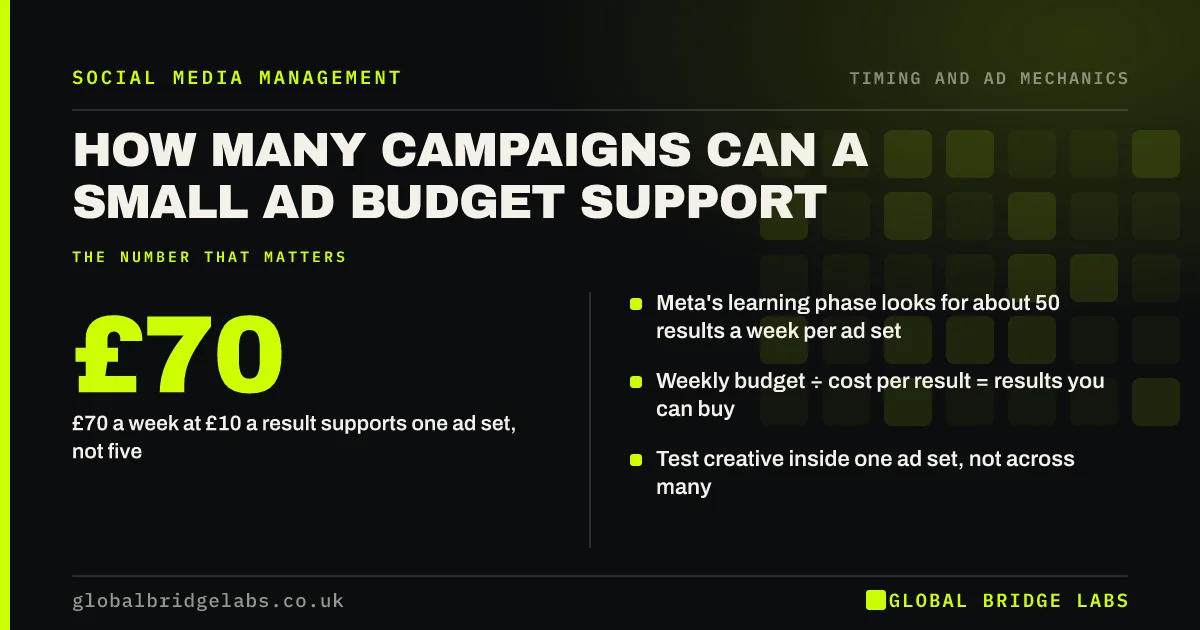
- Meta's learning phase looks for about 50 results a week per ad set.
- Weekly budget ÷ cost per result = results you can buy.
- £70 a week at £10 a result supports one ad set, not five.
- Test creative inside one ad set, not across many.
Want your account simplified? Message us on WhatsApp.
Chat on WhatsApp →Why does structure matter on a small budget?
Each ad set learns separately. Split a small budget across many ad sets and each gets too few results to learn, so costs stay high and results are hard to read. Fewer ad sets give the system more data and you a clearer answer.
How do you work out how many ad sets you can run?
Divide weekly spend by your cost per result to get results a week, then divide by about 50. Illustrative example: £140 a week at £7 per result buys 20 results, under half what one ad set needs to exit learning quickly. One ad set is plenty. Use a more frequent event, such as landing page views, if results are rare.
Send us your weekly spend and cost per result on WhatsApp and we will discuss your requirements.
Chat on WhatsApp →What does a simple structure look like?
One prospecting campaign with one ad set and three or four ads for your main offer. Optionally a small retargeting campaign with one ad set. Seasonal offers run as a separate short campaign only when budget allows. That is enough for most budgets under £1,000 a month.
- Campaign 1: prospecting, 1 ad set, 3–4 ads.
- Campaign 2: retargeting, 1 ad set, 2 ads.
- Campaign 3: seasonal, only when funded.
When should you add more?
When an ad set reliably gets enough results each week and you want to test a genuinely different audience or offer. Add one at a time and give it enough budget to learn. Remove ad sets that have not produced results after a fair test.
What does this look like in practice?
A pattern we see: an account with £400 a month runs eight ad sets testing interests, ages and towns, and every one stays in learning. Consolidating to one broad ad set with four ads usually lowers cost per result within a few weeks.
Account structure checklist
- Calculate weekly results your budget can buy.
- Run one ad set per campaign to start.
- Test creative inside the ad set.
- Add audiences one at a time.
- Remove ad sets that fail a fair test.
Next step
Count your active ad sets and divide last week's results by that number. If each averages well under 50, consolidate.
Message us on WhatsApp with your numbers, or book a 30-minute consultation.
Chat on WhatsApp →Sources and further reading
- Meta Business Help Centre · Meta
- About budgets · Meta
Frequently asked questions
How many ad sets should I run on a small budget?
Usually one per campaign, sometimes two. Meta's learning phase looks for about 50 optimisation events a week per ad set, which small budgets rarely reach even with one. More ad sets split the results further, so costs stay higher and results are harder to read.
Should I test audiences in separate ad sets?
On a small budget, usually not. Broad targeting within one ad set often performs as well, and testing creative inside the ad set teaches more for the money. Test a new audience separately only when budget allows each ad set to get enough results.
What if I never get 50 results a week?
Many small accounts do not. Ads still run and can perform well. You can optimise for a more frequent event, such as landing page views or messages, or consolidate ad sets. Judge results over several weeks rather than expecting the learning phase to complete quickly.
Written by

Global Bridge Labs (GBL) is a UK–Sri Lanka partner for social media, websites and BPO. Everything here comes from client delivery, not theory.