On this page
- 01Key takeaways
- 02Is a website tax deductible?
- 03How are running costs treated?
- 04How is a new website build treated?
- 05What records should you keep?
- 06When is tax treatment less straightforward?
- 07What does this look like in practice?
- 08Website tax checklist
- 09Next step
- 10Sources and further reading
- 11Frequently asked questions
Key takeaways
In the UK, website costs are usually tax deductible, but how depends on the cost. Running costs such as hosting, domains, care and updates are normally allowable business expenses. Building a new website may be treated as a capital asset, often claimable through capital allowances such as the Annual Investment Allowance. Confirm treatment with your accountant.
- Running costs: normally allowable expenses.
- New build: may be capital, often relieved via allowances.
- Annual Investment Allowance: can cover qualifying spend.
- Always check with your accountant.
Want your website budget split for tax purposes? Message us on WhatsApp.
Chat on WhatsApp →Is a website tax deductible?
A website is usually tax deductible in the UK, either as a business expense or through capital allowances. Day-to-day running costs such as hosting and updates are generally allowable expenses. A new build that brings lasting benefit may be treated as capital, with relief through allowances rather than as a direct expense.
How are running costs treated?
Running costs such as hosting, domain renewals, care plans, software subscriptions and minor updates are generally treated as allowable business expenses, deducted from profits in the year they are paid. GOV.UK lists the kinds of costs self-employed people can claim, and the same principles apply to companies.
- Hosting and domain renewals.
- Care, updates and minor changes.
- Software and plugin subscriptions.
Want build and running costs separated in your budget? Message us on WhatsApp and we will discuss your requirements.
Chat on WhatsApp →How is a new website build treated?
A new website build may be treated as capital expenditure because it provides benefit over several years. Capital spending on qualifying items can often be relieved through capital allowances, including the Annual Investment Allowance. Some elements may be treated differently, so your accountant should advise on the split.
What records should you keep?
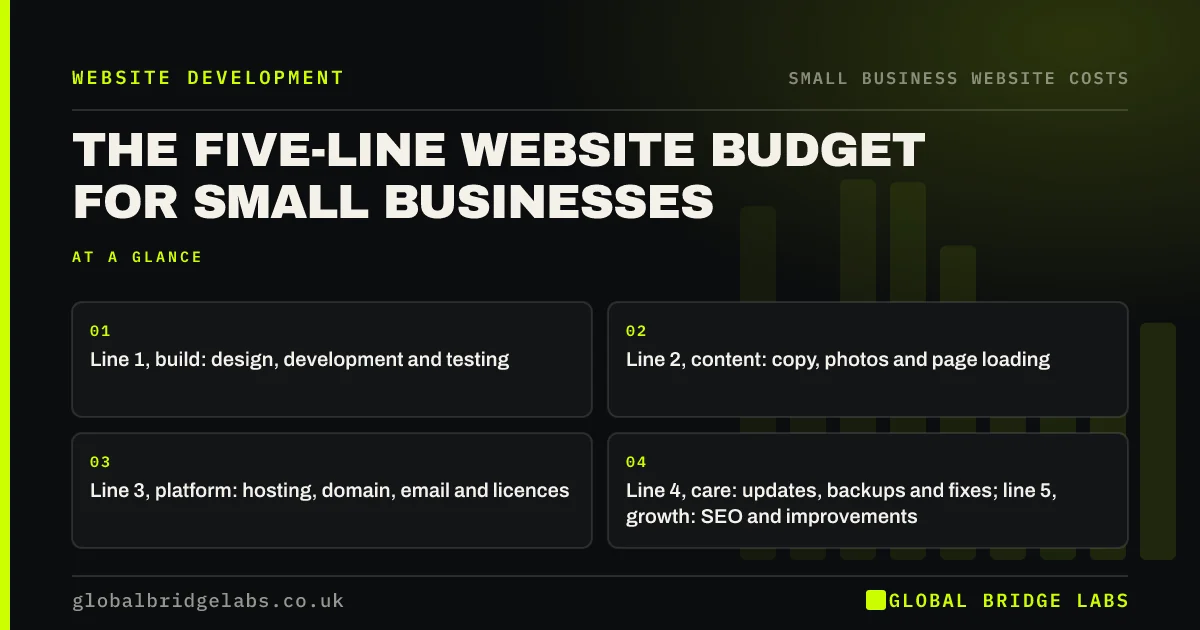
Keep invoices that separate build, content, hosting and care, plus contracts and payment records. Clear itemised invoices make it easier for your accountant to treat each part correctly. Ask suppliers to itemise.
When is tax treatment less straightforward?
Treatment is less straightforward for large custom builds, software developed for sale, sites mixing personal and business use, or where a website is part of research and development. Professional advice matters most in these cases.
What does this look like in practice?
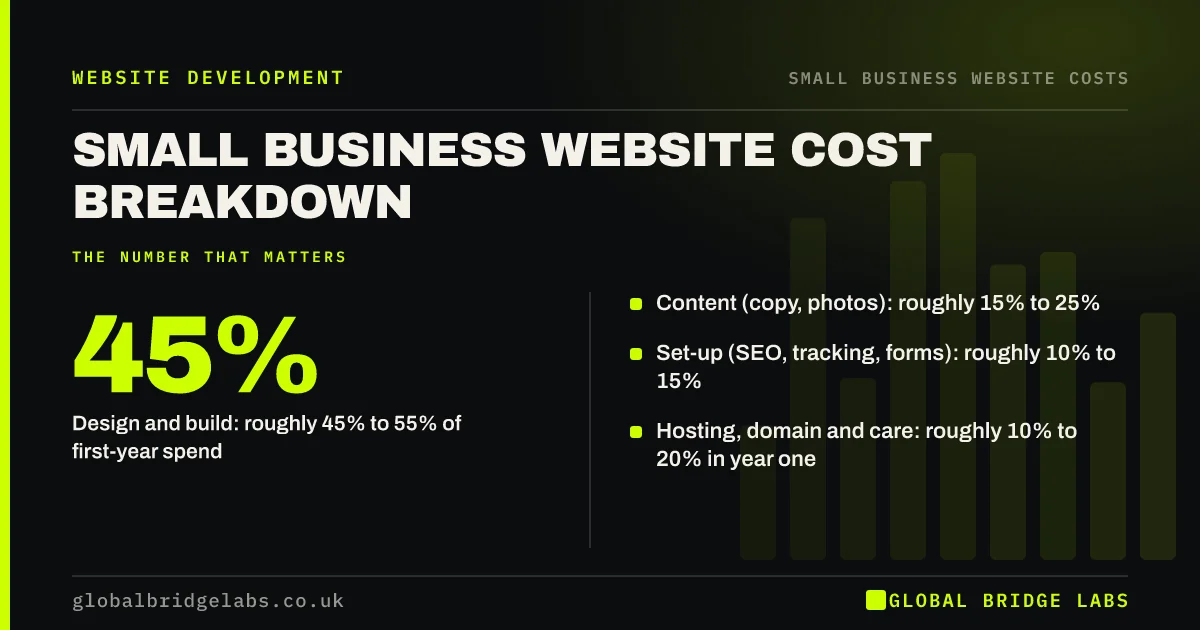
At Global Bridge Labs (GBL), we see clients ask for itemised invoices at year end. A UK architect's practice asked us to separate design and build, content and the first year of care on one invoice. Their accountant could then treat each line appropriately without chasing extra detail.
Website tax checklist
- Ask suppliers for itemised invoices.
- Keep build and running costs separate.
- Record dates of payment.
- Keep contracts with invoices.
- Ask your accountant about capital allowances.
- Review treatment for large projects.
Next step
Before you pay for a new website, ask your supplier to itemise the invoice into build, content, platform and care. Share it with your accountant.
Message us on WhatsApp for an itemised website budget template, or book a 30-minute consultation.
Chat on WhatsApp →Sources and further reading
- Expenses if you're self-employed · GOV.UK
- Claim capital allowances · HM Revenue & Customs
- Capital allowances: Annual Investment Allowance · HM Revenue & Customs
Frequently asked questions
Can I claim my website as a business expense?
Usually, yes. Running costs such as hosting, domains, care and software subscriptions are generally allowable business expenses. A new website build may instead be treated as a capital cost, relieved through capital allowances. Your accountant can confirm the right treatment for your business and project.
Can I claim capital allowances on a website?
Capital allowances can often apply where website spending is treated as capital, for example a new build providing lasting benefit. The Annual Investment Allowance can cover qualifying capital spending up to its limit. Treatment depends on what was bought, so ask your accountant to confirm for your project.
Is website maintenance tax deductible?
Website maintenance such as updates, security care, minor fixes and hosting is generally treated as a day-to-day running cost and an allowable business expense. Larger changes that substantially improve or rebuild the site may be treated differently. Keep itemised invoices so each cost can be classified correctly.
Written by

Global Bridge Labs (GBL) is a UK–Sri Lanka partner for social media, websites and BPO. Everything here comes from client delivery, not theory.