On this page
- 01Key takeaways
- 02What are the main red flags in a website quote?
- 03Which red flags are about ownership?
- 04Which red flags are about cost?
- 05Which red flags are about promises?
- 06Are red flags always deal breakers?
- 07What does this look like in practice?
- 08Red flag checklist
- 09Next step
- 10Sources and further reading
- 11Frequently asked questions
Key takeaways
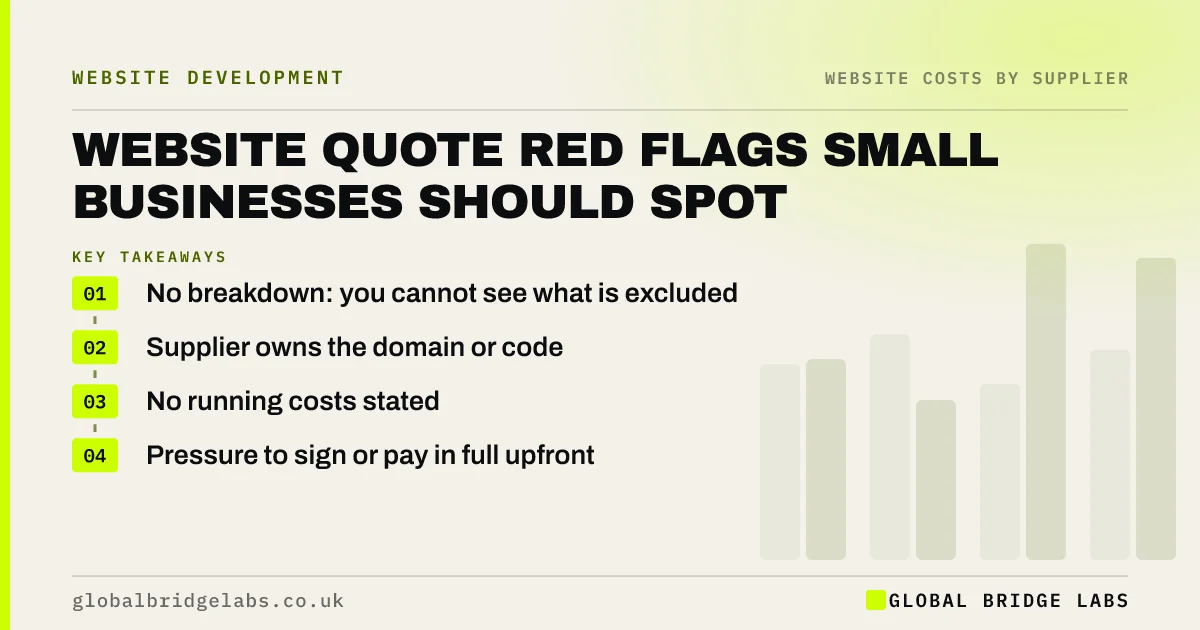
The biggest website quote red flags are a single total with no breakdown, no mention of who owns the domain and code, missing running costs, unlimited promises and pressure to sign fast. Each one moves cost or risk to you later. Ask for written answers on scope, ownership, exit and care before paying a deposit.
- No breakdown: you cannot see what is excluded.
- Supplier owns the domain or code.
- No running costs stated.
- Pressure to sign or pay in full upfront.
Want a quote checked for red flags? Message us on WhatsApp.
Chat on WhatsApp →What are the main red flags in a website quote?
The main red flags are a vague one-line scope, no stated exclusions, no ownership terms, no running costs and no process for changes. These are not always signs of a bad supplier, but they make disputes and surprise invoices far more likely. Ask for each to be answered in writing.
Which red flags are about ownership?
Ownership red flags include the supplier registering the domain in their name, hosting on a platform you cannot leave, and no clause assigning copyright in design and code to you. Without assignment, copyright stays with the creator. These terms decide what it costs to move supplier later.
- Domain registered to the supplier.
- Proprietary platform with no export.
- No copyright assignment clause.
Want ownership terms checked before you sign? Message us on WhatsApp and we will discuss your requirements.
Chat on WhatsApp →Which red flags are about cost?
Cost red flags include no hosting or care figures, plugins or apps priced later, unlimited revisions with no definition, and change requests with no rate. Each leaves a cost unpriced until you are committed. A fair quote states running costs and the day rate for extra work.
Which red flags are about promises?
Promise red flags include guaranteed first-page rankings, guaranteed lead numbers and "unlimited" anything. No supplier controls Google's rankings. Claims like these suggest the supplier is selling to win, not scoping honestly. Ask what they will measure and report instead.
Are red flags always deal breakers?
Not always. Small freelancers may use simple quotes without bad intent. Ask for the missing items in writing. A supplier who answers clearly and fixes the gaps is worth considering; one who avoids the questions is telling you something.
What does this look like in practice?
At Global Bridge Labs (GBL), we reviewed a quote for a UK beauty salon that promised page-one rankings in 30 days and listed hosting as "TBC". On questioning, the supplier would keep the domain and charge £60 a month hosting with a 24-month term. The salon chose another supplier with written ownership terms.
Red flag checklist
- Ask for a breakdown of the price.
- Confirm you own the domain, code and content.
- Get running costs in writing.
- Ask for the change request rate.
- Ignore ranking guarantees.
- Never pay in full upfront for a build.
Next step
Read your quote against the red flags above and send the supplier one email listing every gap. Their reply is part of your decision.
Message us on WhatsApp for a website quote red flag checklist, or book a 30-minute consultation.
Chat on WhatsApp →Sources and further reading
- Consumer Rights Act 2015 · legislation.gov.uk
- How copyright protects your work · GOV.UK
- Small Business Guide: cyber security · National Cyber Security Centre
Frequently asked questions
What are warning signs of a bad web designer?
Warning signs include vague quotes with no breakdown, no clear ownership terms, guaranteed rankings, pressure to sign quickly, requests for full payment upfront and no live examples you can check on your phone. Any one of these is worth questioning. Several together suggest choosing a different supplier.
Should a web designer own my domain?
No. Your domain should be registered in your business's name, with you holding the login, even if the designer manages it. If a designer registers it in their own name, moving supplier later can be slow or expensive. Ask for this in writing before work starts.
Can a web designer guarantee first page on Google?
No. Nobody controls Google's rankings, and Google itself warns against anyone promising them. A good designer sets up the site so it can be found and explains what they will measure. Treat ranking guarantees as a reason to look more closely at the rest of the quote.
Written by

Global Bridge Labs (GBL) is a UK–Sri Lanka partner for social media, websites and BPO. Everything here comes from client delivery, not theory.