On this page
- 01Key takeaways
- 02What does social media do for a training provider?
- 03How much does training provider social media cost?
- 04What content works for course providers?
- 05What claims need care?
- 06When is an agency not worth it for a training provider?
- 07What does this look like in practice?
- 08Training provider social media checklist
- 09Next step
- 10Sources and further reading
- 11Frequently asked questions
Key takeaways
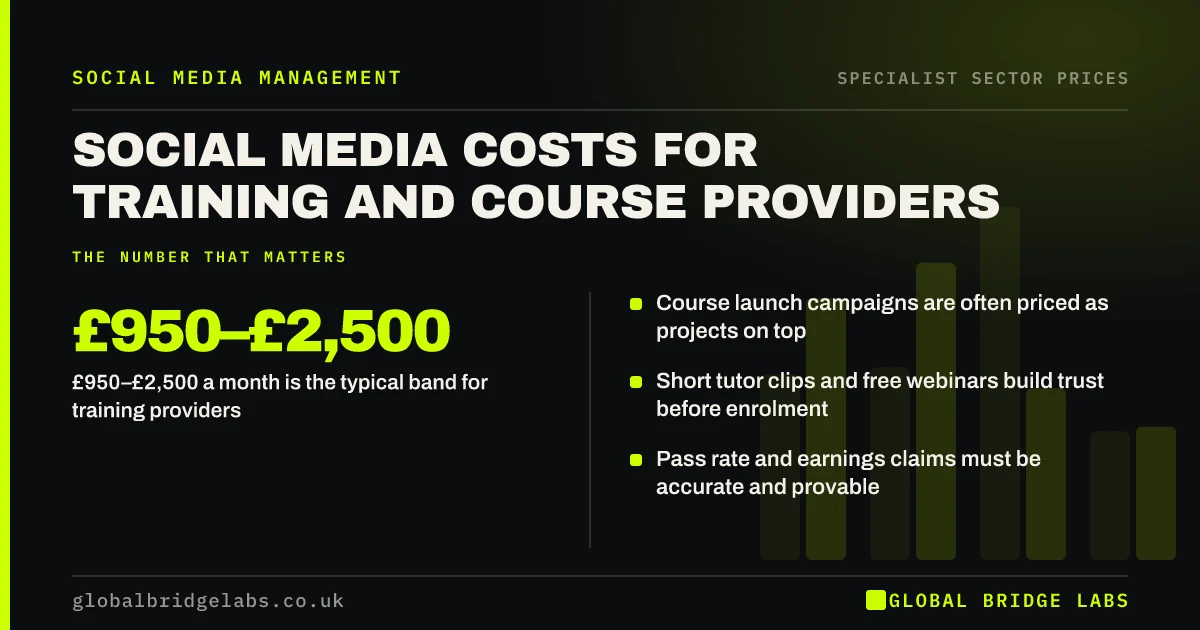
Social media cost for UK training providers usually sits in the £950–£2,500 a month band, with course launches priced as extra campaigns. Webinars and short tutor clips do most of the work. Claims about qualifications, pass rates and earnings must be accurate and provable.
- £950–£2,500 a month is the typical band for training providers.
- Course launch campaigns are often priced as projects on top.
- Short tutor clips and free webinars build trust before enrolment.
- Pass rate and earnings claims must be accurate and provable.
Want your course marketing on social costed? Message us on WhatsApp.
Chat on WhatsApp →What does social media do for a training provider?
For training and course providers, social media shows the tutors, previews the teaching style, answers questions people have before enrolling and fills webinars and open days. It also reaches employers who buy training for staff, often through LinkedIn.
How much does training provider social media cost?
Ongoing management with tutor clips, course posts and enquiry replies typically sits in the £950–£2,500 band. Course launches with ads and webinar promotion are often priced as projects. These are indicative figures, not a GBL price list.
- Ongoing management: £950–£2,500 a month.
- Course launch campaign: priced as a project.
- Webinar promotion: indicative £300–£1,000 per event.
- Enrolment ads: separate media budget.
Want a plan built around your next intake? Send us your course dates on WhatsApp and we will discuss your requirements.
Chat on WhatsApp →What content works for course providers?
Short clips of tutors explaining one idea, student stories with consent, answers to common worries about cost and time, and free taster sessions work well. People enrol when they trust the tutor and can picture finishing the course.
What claims need care?
Claims about pass rates, accreditation, job outcomes and earnings must be accurate and backed by evidence under the CAP Code. "Guaranteed job" or income claims are high risk. State which qualification a course leads to and who awards it.
When is an agency not worth it for a training provider?
It is not worth it if tutors will not appear on camera or share expertise, because generic course posts rarely sell places. An agency earns its fee when it turns tutor knowledge into regular clips and runs launch campaigns around intake dates.
What does this look like in practice?
A pattern we see with UK training providers: posts appear only when a course is about to start, so each launch begins from cold. Global Bridge Labs (GBL) keeps tutor clips going between intakes and runs a short webinar campaign before each launch, so enquiries build steadily.
Training provider social media checklist
Agree these before you start.
- Intake dates for the year.
- Tutors willing to appear on camera.
- Evidence for any pass rate or outcome claims.
- Webinar or taster sessions planned.
- How enrolments from social are tracked.
Next step
Tell us your courses, intake dates and who your learners are. We will tell you which band to expect and how to plan launches.
Message us on WhatsApp for a training provider estimate, or book a 30-minute consultation.
Chat on WhatsApp →Sources and further reading
- UK Code of Non-broadcast Advertising and Direct & Promotional Marketing (CAP Code) · ASA / CAP
- LinkedIn Pages best practices · LinkedIn
- Create a YouTube channel · YouTube Help
Frequently asked questions
How much does social media cost for a training provider?
Most UK training and course providers fall in the £950–£2,500 a month band for ongoing management. Course launches with webinar promotion and ads are often priced as separate projects, and enrolment ads need their own media budget.
Which platforms work best for course providers?
LinkedIn suits professional and employer-funded training. Facebook and Instagram suit adult learners and leisure courses. YouTube works for longer tutorials that build trust. TikTok can reach younger learners. Match the platform to who pays for the course.
Can I advertise pass rates on social media?
Yes, if they are accurate, current and you can prove them. Under the CAP Code, claims must be substantiated, so keep the data. Avoid implying guaranteed results or jobs, and be clear about how the pass rate is calculated.
Do free webinars help sell courses?
Often, yes. A free session lets people experience the tutor and the teaching style before paying. Promote it a few weeks ahead, follow up quickly with attendees and make enrolment easy at the end of the session.
Written by

Global Bridge Labs (GBL) is a UK–Sri Lanka partner for social media, websites and BPO. Everything here comes from client delivery, not theory.