On this page
- 01Key takeaways
- 02What is a lead generation workshop or webinar?
- 03Which businesses do workshops suit?
- 04How do you promote a workshop on social media?
- 05How should the session run?
- 06How do you follow up after a workshop?
- 07What data rules apply to registrations?
- 08When is a workshop not worth it?
- 09What does this look like in practice?
- 10Workshop checklist
- 11Next step
- 12Sources and further reading
- 13Frequently asked questions
Key takeaways
A free workshop or webinar turns followers into clients by giving them an hour of real value and a reason to talk to you afterwards. It suits services where expertise is the product. Pick one narrow problem, promote it for two to three weeks, teach rather than pitch, and follow up every attendee within 48 hours.
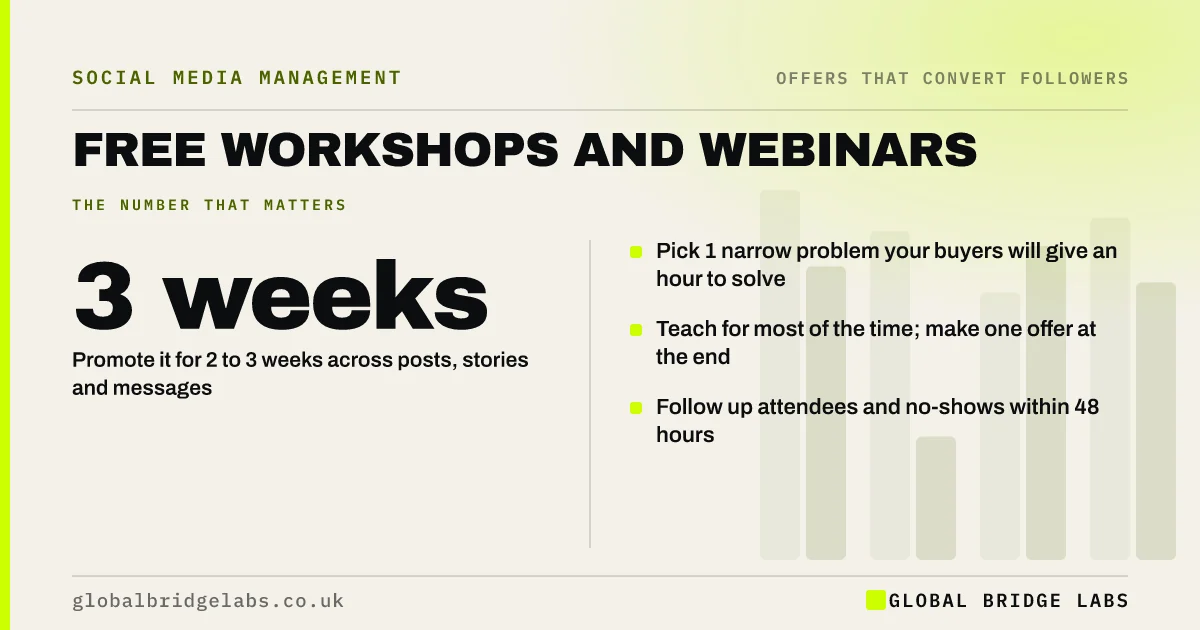
- Pick 1 narrow problem your buyers will give an hour to solve.
- Promote it for 2 to 3 weeks across posts, stories and messages.
- Teach for most of the time; make one offer at the end.
- Follow up attendees and no-shows within 48 hours.
Planning a workshop? Message us on WhatsApp and we will help plan the promotion.
Chat on WhatsApp →What is a lead generation workshop or webinar?
A lead generation workshop or webinar is a free, live session, online or in person, in which a business teaches potential customers something useful about a problem it solves, collecting registrations and following up attendees with an offer. It lets followers experience your expertise before they pay for it.
Which businesses do workshops suit?
Workshops suit businesses whose value is knowledge or judgement: accountants, solicitors, consultants, clinics, trainers, financial planners and B2B services. They suit less well businesses whose value is a product or a quick job. A kitchen showroom evening can work; a webinar on plumbing rarely will.
How do you promote a workshop on social media?
Promote it for two to three weeks with a registration link in your bio, three or four posts on the problem it solves, regular stories, and a personal invitation by message to people who have engaged recently. A short advert to your warm audience often fills the remaining places.
- Week 1: announce the problem and the date.
- Week 2: share one insight from the session.
- Week 3: last places, true numbers, and a reminder.
How should the session run?
Run the session as teaching. Spend most of the time on the problem and how to solve it, with real examples. Leave time for questions, which are buying signals. In the last few minutes, make one offer: a call, an assessment or a package, with a reason to take it this week.
Want help structuring the session? Message us on WhatsApp and we will discuss your requirements.
Chat on WhatsApp →How do you follow up after a workshop?
Follow up within 48 hours. Send attendees the slides or recording, a summary of the offer and a booking link. Send no-shows the recording with the same offer. Then contact anyone who asked a question personally. Most of the value of a workshop comes from this follow-up, not from the session itself.
What data rules apply to registrations?
Registration details are personal data under UK GDPR. Say what you will use them for: the event itself, and marketing only if they agree. Under PECR, marketing emails to individuals afterwards generally need consent, so add a clear opt-in on the registration form rather than assuming it.
When is a workshop not worth it?
A workshop is not worth it when you have too small a warm audience to fill it, when the topic is too broad to promise a clear result, or when nobody has time to follow up. A short, focused post series or a free consultation offer may do more.
What does this look like in practice?
A pattern we see in professional services: a well-attended webinar followed by a single thank-you email, and few new clients. Personal follow-up of everyone who asked a question, within two days, is usually where the clients come from.
Workshop checklist
- Choose one narrow problem.
- Set up registration with clear consent options.
- Promote for two to three weeks.
- Teach first; make one offer at the end.
- Follow up attendees and no-shows within 48 hours.
- Track registrations, attendees, calls and clients.
Next step
List the three questions buyers ask you most often. The one you could talk about for an hour is your first workshop topic.
Message us on WhatsApp and we will help plan your first workshop, or book a 30-minute consultation.
Chat on WhatsApp →Sources and further reading
- Electronic and telephone marketing under PECR · Information Commissioner's Office
- What is valid consent? · Information Commissioner's Office
- Right to be informed (privacy information) · Information Commissioner's Office
- LinkedIn Pages best practices · LinkedIn
Frequently asked questions
Do webinars generate leads for small businesses?
They can, particularly for professional and B2B services where expertise is the product. A narrow topic, two to three weeks of promotion and quick personal follow-up make the difference. Without follow-up, webinars produce attendees rather than clients.
How long should a free workshop be?
Forty-five minutes to an hour suits most topics, including questions. Shorter sessions can work for a single tip. Keep the teaching focused on one problem and keep the offer to the last few minutes.
How many people need to attend a webinar for it to be worth it?
Fewer than you might think. Ten engaged attendees in your target market can produce clients if you follow up well. Judge it on calls booked and clients won, not on registrations. Expect a share of registrants not to attend, and send them the recording.
Written by

Global Bridge Labs (GBL) is a UK–Sri Lanka partner for social media, websites and BPO. Everything here comes from client delivery, not theory.