On this page
- 01Key takeaways
- 02What does a competitor analysis cover?
- 03How much does a competitor analysis cost?
- 04What should you get at the end?
- 05How do you use it without copying?
- 06When is a paid analysis not worth it?
- 07What does this look like in practice?
- 08Competitor analysis checklist
- 09Next step
- 10Sources and further reading
- 11Frequently asked questions
Key takeaways
Social media competitor analysis cost in the UK is indicatively £300–£1,000 for a one-off review of three to five competitors, taking 4 to 10 hours. A useful analysis ends with a few clear opportunities for you, not a spreadsheet of follower counts. Repeat it once or twice a year.
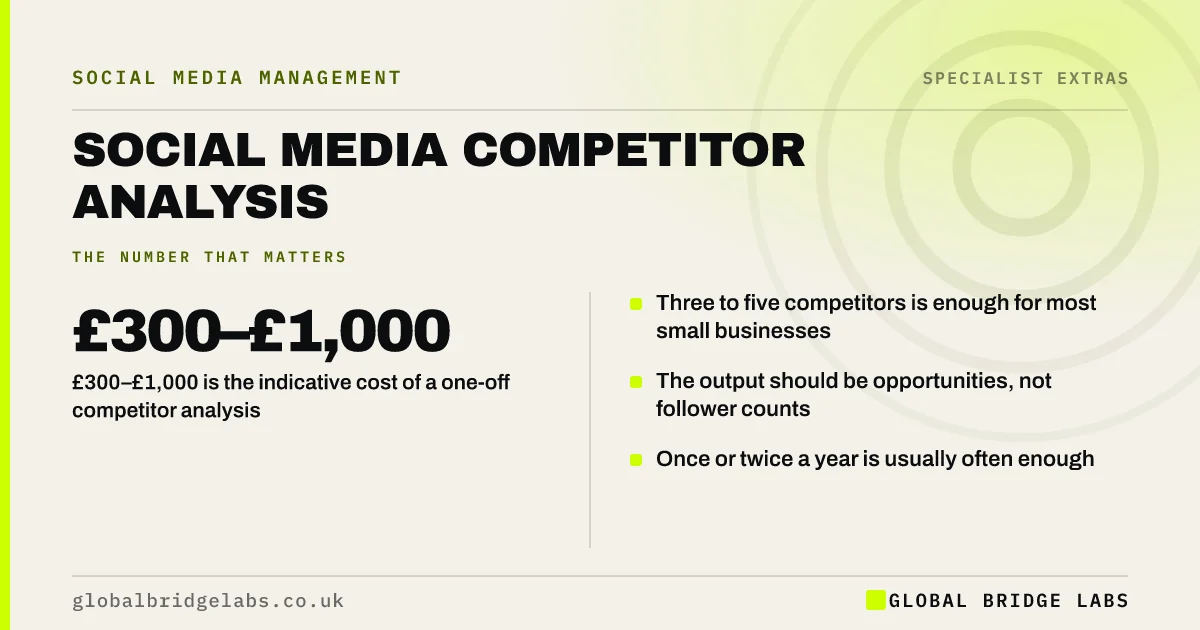
- £300–£1,000 is the indicative cost of a one-off competitor analysis.
- Three to five competitors is enough for most small businesses.
- The output should be opportunities, not follower counts.
- Once or twice a year is usually often enough.
Want to know what your competitors do well on social? Message us on WhatsApp.
Chat on WhatsApp →What does a competitor analysis cover?
A social media competitor analysis reviews which channels rivals use, how often they post, which formats and topics get responses, how they handle comments, what offers they promote and what ads they run. It then compares that with your own presence to find gaps.
How much does a competitor analysis cost?
Reviewing three to five competitors and writing up the findings takes about 4 to 10 hours, which is £300–£1,000 at the £75–£100 an hour implied by typical UK retainers. More competitors or channels take longer. These are indicative figures, not a GBL price list.
- Three competitors, two channels: indicative £300–£600.
- Five competitors, several channels: indicative £600–£1,000.
- Ad library review: often included.
- Repeat review: usually quicker.
Want a competitor review costed? Send us your main rivals on WhatsApp and we will discuss your requirements.
Chat on WhatsApp →What should you get at the end?
You should get three to five specific opportunities: topics competitors ignore, questions customers ask them that go unanswered, formats you could do better and channels where nobody local is active. A list of competitors' follower numbers is not an analysis.
How do you use it without copying?
Use competitor analysis to find gaps, not to copy. Copying a rival's posts makes you look the same and rarely works. The useful question is what customers want that nobody is giving them, and how your real work can answer it.
When is a paid analysis not worth it?
It is not worth paying for if you will not act on it, or if you have few direct competitors online. A quick self-review of two rivals' pages, using their public posts and ad libraries, may be enough for a small local business.
What does this look like in practice?
A pattern we see with UK trades and clinic clients: competitors post often but never answer the questions customers actually ask, such as price ranges and timescales. Global Bridge Labs (GBL) turns gaps like that into a content plan, so the client becomes the business that answers them.
Competitor analysis checklist
Agree these before the review.
- Three to five named competitors.
- Channels to review.
- Ad library checks included.
- Opportunities as the main output.
- Date for the next review.
Next step
Tell us your main competitors and channels. We will tell you what a useful review would cover and what it costs.
Message us on WhatsApp for a competitor review, or book a 30-minute consultation.
Chat on WhatsApp →Sources and further reading
- Meta Business Help Centre · Meta
- LinkedIn Pages best practices · LinkedIn
- TikTok for Business · TikTok
Frequently asked questions
How much does a social media competitor analysis cost?
As an indicative UK range, reviewing three to five competitors takes 4 to 10 hours and costs about £300–£1,000 at agency rates of £75–£100 an hour. More competitors or channels take longer, and repeat reviews are usually quicker.
How many competitors should I analyse?
Three to five is enough for most small businesses: two or three direct local rivals and one or two businesses doing social media well in your sector elsewhere. More than that produces data you will not use.
Can I see my competitors' social media ads?
Yes, for many platforms. Meta's Ad Library shows active ads on Facebook and Instagram, and other platforms offer similar transparency tools. They show what rivals are promoting and how long ads have run.
How often should competitor analysis be done?
Once or twice a year is usually enough for small businesses, plus a quick check when a new competitor opens or your results change suddenly. Competitors' social habits rarely change month to month.
Written by

Global Bridge Labs (GBL) is a UK–Sri Lanka partner for social media, websites and BPO. Everything here comes from client delivery, not theory.