On this page
Key takeaways
A non-solicitation clause stops you hiring the agency's staff directly for a set period, often six to twelve months after the contract ends, or makes you pay a fee if you do. It protects the agency's investment in its people. It is reasonable if it is time-limited, covers only staff who worked on your account and sets a clear fee.
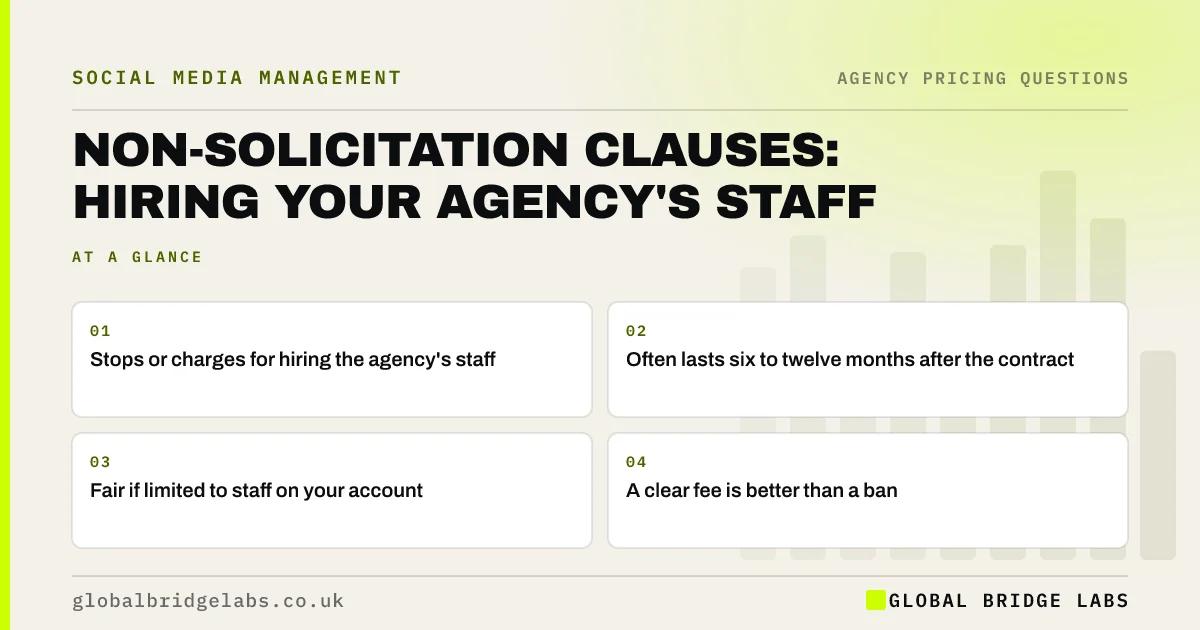
- Stops or charges for hiring the agency's staff.
- Often lasts six to twelve months after the contract.
- Fair if limited to staff on your account.
- A clear fee is better than a ban.
Want to check a no-hire clause? Message us on WhatsApp.
Chat on WhatsApp →What does a non-solicitation clause do?
A non-solicitation or no-hire clause is a contract term that prevents a client from recruiting the agency's employees, or requires a fee if it does. Agencies train staff on client accounts, and losing a trained person to a client is costly for them.
What does hiring an agency's staff cost?
If the clause allows hiring with a fee, it is often set like a recruitment fee: a share of the person's first-year salary, or a fixed sum. Check the period, which staff are covered and whether it applies if the person applies to you unprompted.
- Period: often six to twelve months.
- Covered staff: ideally only those on your account.
- Fee: fixed or a share of salary.
- Unprompted applications: check the wording.
Send us the clause on WhatsApp and we will discuss your requirements.
Chat on WhatsApp →Is a non-solicitation clause fair?
Generally yes, within limits. A clause that covers every employee of a large agency for years, with no fee option, is heavy-handed. A short period, limited to people who worked on your account, with a clear fee, is a fair balance.
When does it matter most?
When you plan to bring social media in-house and like the person running your account. Agree the terms before signing, so a later hire is a known cost rather than a dispute. The person's own employment contract may also have restrictions.
What does this look like in practice?
A pattern we see: a client wants to hire its account manager, and the clause is vague. Agreeing a clear fee in advance usually lets the move happen on good terms for everyone.
Non-solicitation checklist
- Check the period after the contract ends.
- Limit it to staff on your account.
- Agree a clear fee rather than a ban.
- Check how unprompted applications are treated.
- Raise it before signing, not when hiring.
Next step
If you might bring social media in-house within two years, raise the no-hire clause before signing.
Message us on WhatsApp for a contract check, or book a 30-minute consultation.
Chat on WhatsApp →Sources and further reading
- Employment status · GOV.UK
- Employment contracts and conditions: notice periods · GOV.UK
Frequently asked questions
Can I hire someone from my social media agency?
Check the contract. Many include a non-solicitation clause that bans or charges for hiring the agency's staff for a period after the contract ends. Agree the terms before you approach anyone.
Are no-hire clauses enforceable?
They can be if reasonable in scope and length. Very broad or long clauses are harder to enforce. Take legal advice if a dispute arises.
What is a typical fee for hiring agency staff?
It varies. Some agencies set a fixed sum, others a share of the person's first-year salary, similar to a recruitment fee. Agree the figure in writing.
Written by

Global Bridge Labs (GBL) is a UK–Sri Lanka partner for social media, websites and BPO. Everything here comes from client delivery, not theory.