On this page
- 01Key takeaways
- 02What is a social media services agreement?
- 03Which eight clauses matter most?
- 04What term and notice are reasonable?
- 05What should the ownership clause say?
- 06What does data protection require?
- 07Which terms should make you pause?
- 08What about liability and insurance?
- 09What does this look like in practice?
- 10Contract checklist
- 11Next step
- 12Sources and further reading
- 13Frequently asked questions
Key takeaways
Social media agency contract terms matter more than the price, because they decide what a mistake costs. Check eight clauses: scope, term, notice, fees and increases, ownership, data protection, liability and exit. A fair contract lets you leave within 30 to 90 days with your accounts and content.
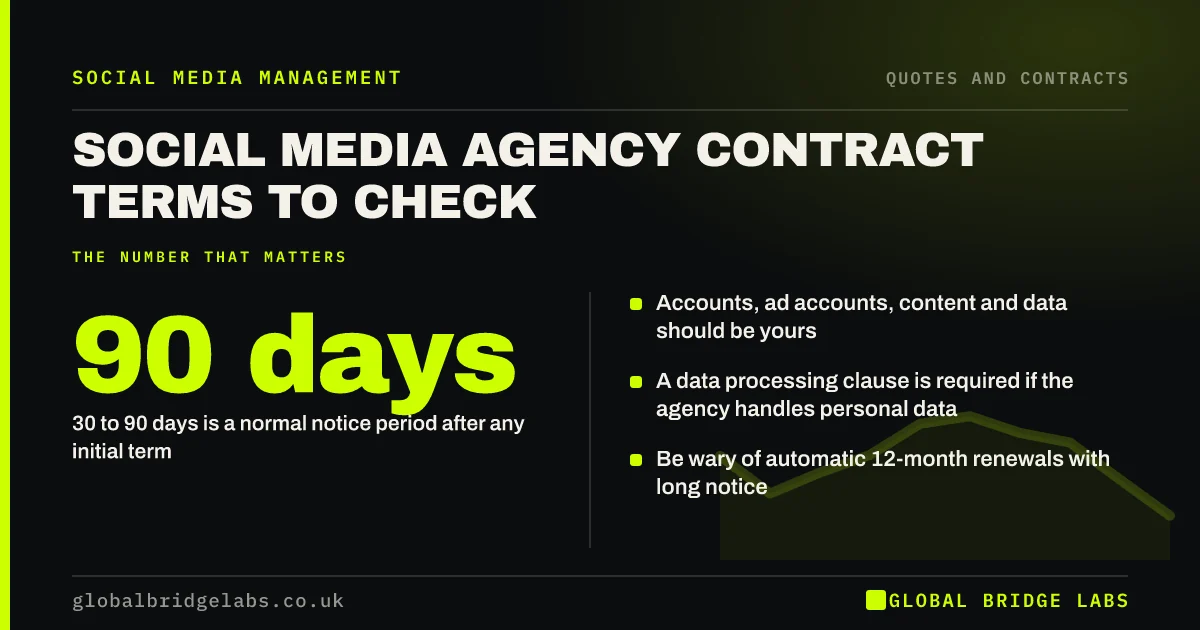
- 30 to 90 days is a normal notice period after any initial term.
- Accounts, ad accounts, content and data should be yours.
- A data processing clause is required if the agency handles personal data.
- Be wary of automatic 12-month renewals with long notice.
Want a second view on an agency contract? Message us on WhatsApp.
Chat on WhatsApp →What is a social media services agreement?
A social media services agreement is the contract between a business and an agency or freelancer that sets out the work, the fee, how long it runs, who owns what and how either side can end it. The proposal sells the service. The agreement is what applies when something goes wrong.
Which eight clauses matter most?
Eight clauses carry almost all the commercial risk. Read these before anything else, and ask for changes in writing where they are unclear. This is general guidance, not legal advice. For a large or long contract, have a solicitor read it.
- Scope: deliverables as numbers, attached as a schedule.
- Term: any minimum period and how it renews.
- Notice: how many days, and how notice must be given.
- Fees: amount, payment timing and how increases work.
- Ownership: accounts, content, files and data.
- Data protection: the processing terms UK GDPR requires.
- Liability: caps and responsibility for published content.
- Exit: handover duties and timing.
What term and notice are reasonable?
An initial term of three to six months followed by a rolling arrangement with 30 to 90 days' notice is common. Some services, including Global Bridge Labs (GBL), run rolling monthly from the start. Automatic renewal for another 12 months, with a narrow window to cancel, protects the agency, not the outcome.
Want social media on a rolling monthly basis? Send us your channels on WhatsApp and we will discuss your requirements.
Chat on WhatsApp →What should the ownership clause say?
It should say that social accounts, ad accounts and analytics belong to you, that copyright in finished content transfers to you on payment, and that working files are handed over on exit. In the UK the creator owns copyright by default, so the transfer must be in writing.
What does data protection require?
If the agency handles personal data for you, such as customer messages or lead forms, UK GDPR requires a written contract between you as controller and the agency as processor. It must cover instructions, security, sub-processors, deletion and help with data subject requests.
Which terms should make you pause?
Pause at terms that make leaving expensive or shift all risk to you: long automatic renewals, the agency owning accounts or content, uncapped price increases, payment for the full term on early exit, and no duty to hand anything over.
What about liability and insurance?
Check who is responsible if something published causes a problem. A fair contract makes the agency responsible for its own errors, such as using an unlicensed image, and you responsible for the accuracy of what you approve. Ask whether the agency holds professional indemnity insurance, and check that any cap on liability is not trivially low.
- Agency: its own errors and unlicensed material.
- Client: accuracy of facts and claims you approve.
- Insurance: professional indemnity cover in place.
- Cap: proportionate to the fees paid.
What does this look like in practice?
A pattern we see when UK businesses change supplier: the contract renewed automatically months earlier and nobody noticed the cancellation window. Putting the renewal date and notice deadline in the calendar on the day you sign costs nothing and avoids a year of fees.
Contract checklist
Tick each before signing.
- Scope attached with numbers.
- Minimum term and renewal understood.
- Notice period and method recorded in your calendar.
- Price increase mechanism stated.
- Ownership of accounts, content and files assigned to you.
- Data processing terms included.
- Handover duties on exit listed.
Next step
Tell us the term, notice and ownership wording you have been offered. We will tell you how it compares with what we see as normal.
Message us on WhatsApp for a commercial view on contract terms, or book a 30-minute consultation.
Chat on WhatsApp →Sources and further reading
- Contracts and liabilities between controllers and processors · Information Commissioner's Office
- How copyright protects your work · GOV.UK
- Controllers and processors · Information Commissioner's Office
Frequently asked questions
What should a social media agency contract include?
A scope with deliverables as numbers, the term and renewal, notice, fees and how they can increase, ownership of accounts and content, data processing terms, liability and handover duties on exit. Ask for the scope to be attached as a schedule.
How long are social media agency contracts?
Many have an initial term of three to six months, then roll monthly or quarterly with 30 to 90 days' notice. Some run rolling monthly from the start. Twelve-month terms with automatic renewal are less favourable to the client.
Do I need a data processing agreement with my social media agency?
Yes, if the agency handles personal data on your behalf, such as customer messages, enquiries or lead form details. UK GDPR requires a written contract between a controller and its processor. It should name any sub-processors and any transfer of data outside the UK.
Can I change an agency's standard contract?
Usually. Notice periods, renewal terms, ownership wording and price increase clauses are commonly negotiated. Ask for changes in writing before signing, as they are hard to obtain afterwards. Agencies expect it, and a refusal to discuss any change tells you something.
Written by

Global Bridge Labs (GBL) is a UK–Sri Lanka partner for social media, websites and BPO. Everything here comes from client delivery, not theory.