On this page
Key takeaways
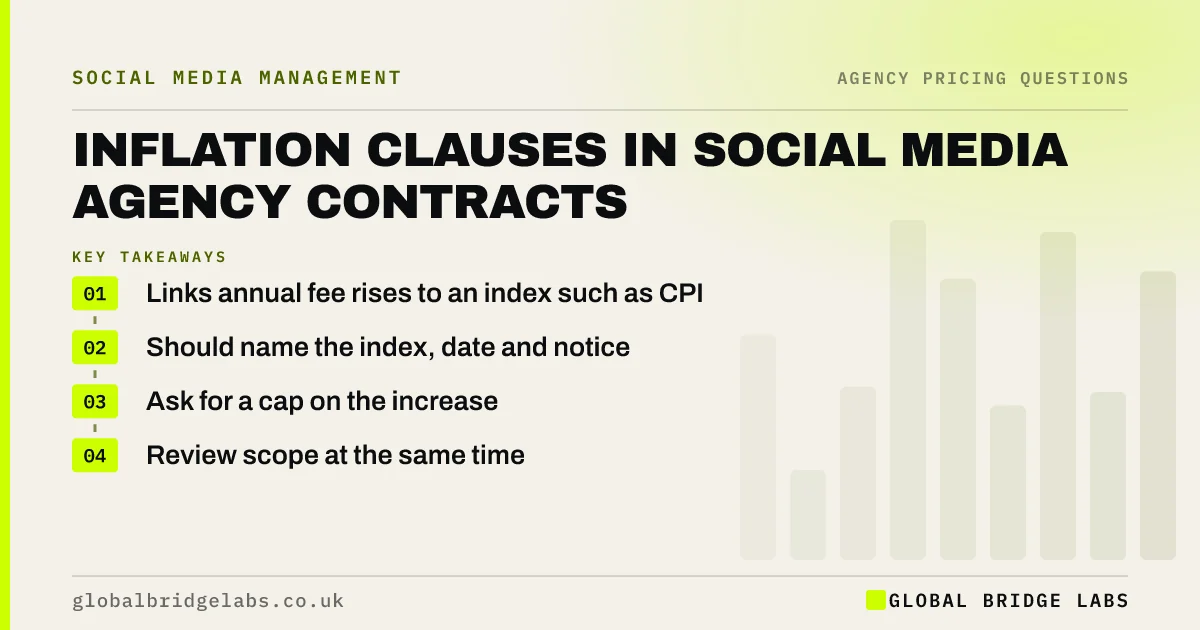
An inflation or indexation clause lets a social media agency raise its fee each year in line with a published index, usually the Consumer Prices Index (CPI). It is common and reasonable if it names the index, the review date and the notice period. Ask for a cap and the right to review scope at the same time.
- Links annual fee rises to an index such as CPI.
- Should name the index, date and notice.
- Ask for a cap on the increase.
- Review scope at the same time.
Want your contract's price clause checked? Message us on WhatsApp.
Chat on WhatsApp →What is an indexation clause?
An indexation clause is a contract term that adjusts the fee each year by the change in a published price index. The Office for National Statistics (ONS) publishes CPI and other measures monthly. The clause turns a vague price review into a predictable formula.
What makes a fair inflation clause?
It names one index and which month's figure applies, sets a review date and gives you notice, often 30 days. A cap limits the rise in high-inflation years. A floor of zero stops the fee falling, which is common. Anything above inflation should need your agreement.
- One named index and month.
- A fixed annual review date.
- Notice before the rise.
- A cap, for example a set percentage.
Send us the clause on WhatsApp and we will discuss your requirements.
Chat on WhatsApp →Should you accept an inflation clause?
On a longer contract, a clear clause is better than an open-ended review, because you can budget for it. On a rolling monthly agreement, you can negotiate each year anyway, so the clause matters less. Avoid clauses that let the agency choose the higher of several indices.
When should you push back?
When the clause has no cap, uses an unusual index, allows more than one rise a year or lets the agency add other increases on top. Also push back if results have fallen; a fee rise should come with a scope and performance review.
What does this look like in practice?
A pattern we see: a client is surprised by a rise because the clause was buried and named no index. Agreeing a named index, a cap and a scope review at renewal usually turns the rise into a routine conversation.
Inflation clause checklist
- Check which index and month is used.
- Confirm the review date and notice.
- Ask for a cap.
- Block extra rises on top.
- Pair the rise with a scope review.
Next step
Find the price review clause in your agency contract. If it names no index or cap, ask for both.
Message us on WhatsApp for a contract check, or book a 30-minute consultation.
Chat on WhatsApp →Sources and further reading
- Inflation and price indices · Office for National Statistics
- Late commercial payments: charging interest and debt recovery · GOV.UK
Frequently asked questions
Can an agency raise its fees every year?
If the contract allows it. Many include an annual review linked to CPI. On a rolling monthly contract, you can usually give notice if you do not accept a rise.
Which inflation index is used in contracts?
CPI is the most common in the UK, published monthly by the ONS. Some older contracts use RPI. The clause should name one index and which month's figure applies.
What is a reasonable cap on price increases?
That is for negotiation, but a cap protects you in high-inflation years. Agree a percentage you can budget for, and require your consent for anything above it.
Written by

Global Bridge Labs (GBL) is a UK–Sri Lanka partner for social media, websites and BPO. Everything here comes from client delivery, not theory.