On this page
- 01Key takeaways
- 02How should a small business set an outsourcing budget?
- 03What do typical outsourcing budgets look like?
- 04What else should the budget include?
- 05How do you fund an outsourcing budget?
- 06Why budget a pilot before a full year?
- 07When is a low budget a false economy?
- 08How do you track spend against the budget?
- 09What does this look like in practice?
- 10Budget checklist
- 11Next step
- 12Sources and further reading
- 13Frequently asked questions
Key takeaways
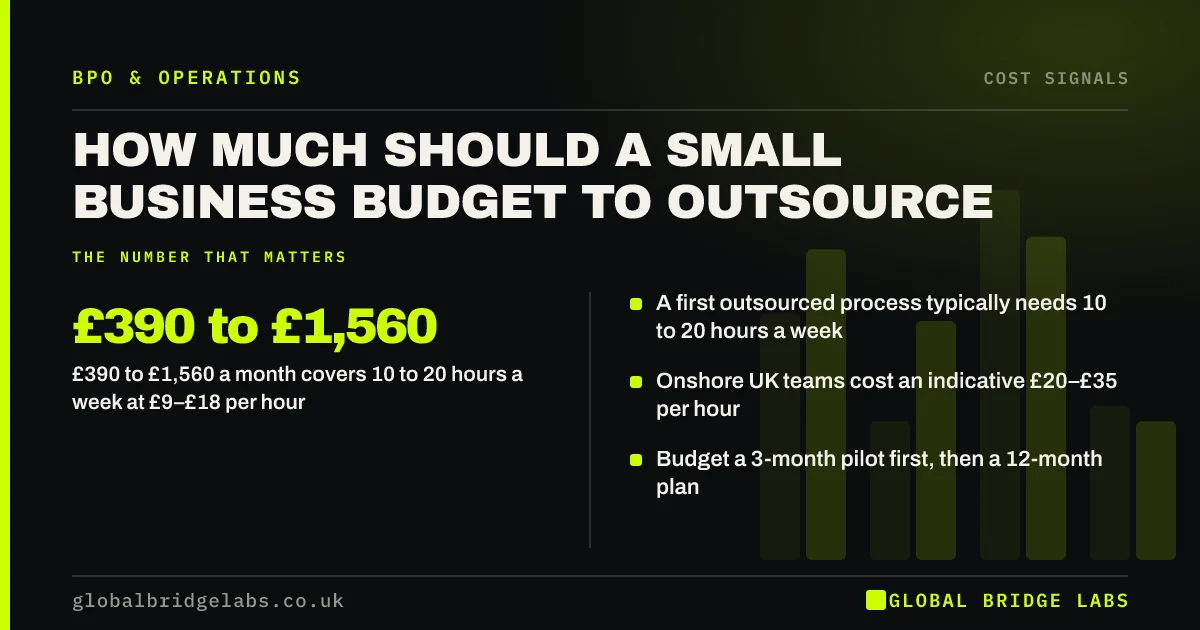
An outsourcing budget for a small business starts from the hours of work, not a percentage of turnover. Most first processes need 10 to 20 hours a week. At indicative offshore rates of £9–£18 per hour, that is about £390 to £1,560 a month. Add internal management time and any setup fee, and set a 3-month pilot budget before a yearly one.
- £390 to £1,560 a month covers 10 to 20 hours a week at £9–£18 per hour.
- A first outsourced process typically needs 10 to 20 hours a week.
- Onshore UK teams cost an indicative £20–£35 per hour.
- Budget a 3-month pilot first, then a 12-month plan.
Want a budget for your first process? Message us on WhatsApp with the hours.
Chat on WhatsApp →How should a small business set an outsourcing budget?
Set it from the work. Measure the hours a process takes, choose onshore or offshore, multiply by an indicative rate, and add setup and management time. Then compare the total with what the work costs you today. Budgeting as a percentage of turnover tends to buy either too little capacity or more than you need.
What do typical outsourcing budgets look like?
The ranges below use indicative market rates and assume a managed service with cover and supervision. They are for planning, not quotes, and rates vary with hours, skills and contract terms.
- 10 hours a week offshore at £9–£18: about £390 to £780 a month.
- 20 hours a week offshore at £9–£18: about £780 to £1,560 a month.
- Full-time offshore seat, 37.5 hours: about £1,460 to £2,930 a month.
- 20 hours a week onshore at £20–£35: about £1,730 to £3,030 a month.
Want these ranges narrowed for your process? Ask us on WhatsApp and we will discuss your requirements.
Chat on WhatsApp →What else should the budget include?
Include your own time and the one-off costs. Internal ownership typically takes two to four hours a week for the first three months, falling to about an hour a week. Some providers charge setup fees, and you may need extra software licences, a shared inbox or a phone system change.
- Internal owner time, valued at their hourly cost.
- Setup or onboarding fees, if any.
- Extra software licences for the outsourced team.
- Time to write or update process documents.
How do you fund an outsourcing budget?
Most small businesses fund it from costs it replaces: overtime, temp spend, a vacant role or owner time moved to revenue work. Show the offset explicitly. A budget of £1,000 a month that removes £800 of overtime and returns 10 owner hours a week is close to self-funding before any revenue gains.
Why budget a pilot before a full year?
A 3-month pilot budget limits risk and gives you real numbers for the yearly plan. Hours often fall after the first month as the team learns the process and rework drops. Setting a yearly budget from week-one hours usually over-budgets; setting it from pilot data is more accurate.
When is a low budget a false economy?
When it buys too few hours to cover the work, a provider without supervision, or an arrangement with no quality checks. An under-resourced seat builds a new backlog. It is better to outsource one process properly than three processes thinly.
How do you track spend against the budget?
Check three numbers each month: hours billed, cost per task and hours returned to your team. Hours billed should reconcile with the provider's activity report. Cost per task should fall after the first month as rework drops. Hours returned should show up in your own diaries. If any of the three moves the wrong way for two months, review the scope.
- Hours billed against hours planned.
- Cost per task against the in-house baseline.
- Hours returned to the owner and team.
- Quality and speed against the agreed service levels.
What does this look like in practice?
A pattern we see in UK e-commerce brands turning over £1m to £3m: a first budget for 20 hours a week of customer email, funded by ending temp spend and weekend overtime. After three months the hours settle at 16 a week, and the yearly budget is set from that, with extra hours booked only for November and December.
Budget checklist
Use these steps to set your budget.
- Measure the hours the process needs each week.
- Choose onshore or offshore.
- Multiply by an indicative hourly rate.
- Add management time, fees and licences.
- Identify the costs it will replace.
- Approve a 3-month pilot, then set the yearly budget.
Next step
Tell us the process and the hours. We will give you a realistic monthly range and suggest how to structure a pilot budget.
Message us on WhatsApp for a budget range, or book a 30-minute consultation.
Chat on WhatsApp →Sources and further reading
- National Minimum Wage and National Living Wage rates · GOV.UK
- Rates and thresholds for employers 2026 to 2027 · HM Revenue & Customs
- UK Customer Satisfaction Index · Institute of Customer Service
Frequently asked questions
How much does outsourcing cost for a small business?
It depends on hours and location. As indicative ranges, managed offshore teams cost £9–£18 per hour and onshore UK teams £20–£35. A typical first process of 10 to 20 hours a week offshore costs about £390 to £1,560 a month.
What percentage of revenue should be spent on outsourcing?
There is no useful percentage. Budget from the hours of work and compare with what the work costs in-house. Businesses with heavy customer contact or admin may spend more; others very little. The test is cost per task and time returned, not a ratio.
Are there setup costs when outsourcing?
Sometimes. Some providers charge an onboarding fee; all setups need your time to document the process and review early work, typically two to four hours a week for three months. Include both in the budget and ask whether any fee is refundable.
Written by

Global Bridge Labs (GBL) is a UK–Sri Lanka partner for social media, websites and BPO. Everything here comes from client delivery, not theory.