On this page
- 01Key takeaways
- 02What does data entry cost per record?
- 03What does a worked example look like?
- 04How do you keep outsourced data entry accurate?
- 05When should data entry stay in-house?
- 06Should you automate data entry instead?
- 07What about data protection?
- 08How do you prepare data entry for handover?
- 09What does this look like in practice?
- 10Data entry checklist
- 11Next step
- 12Sources and further reading
- 13Frequently asked questions
Key takeaways
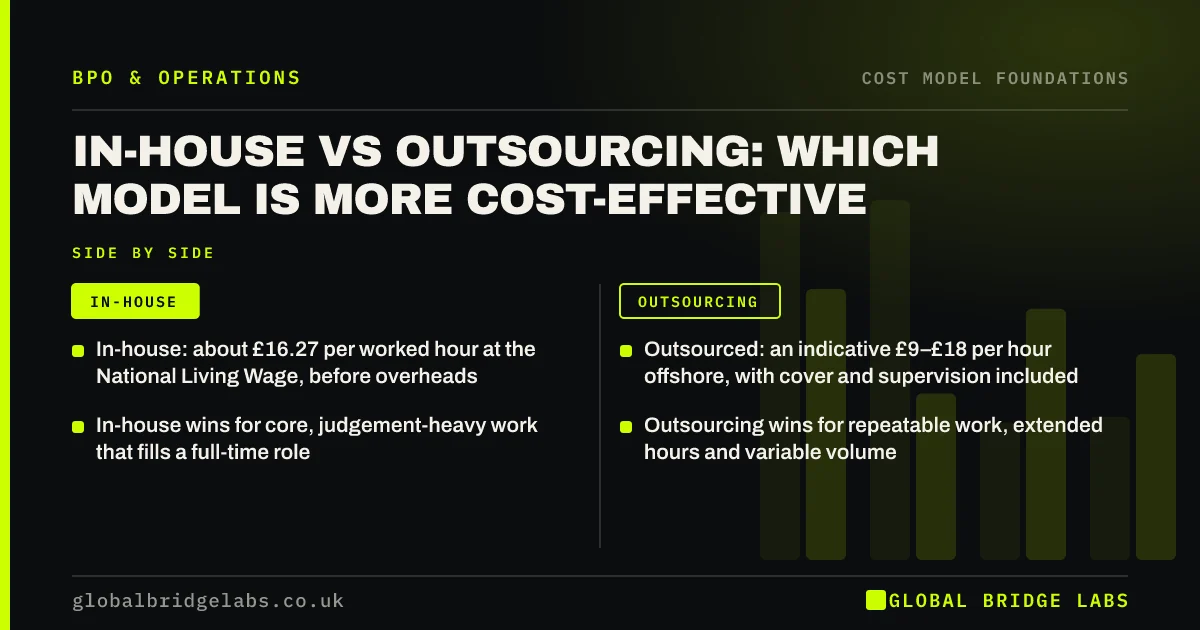
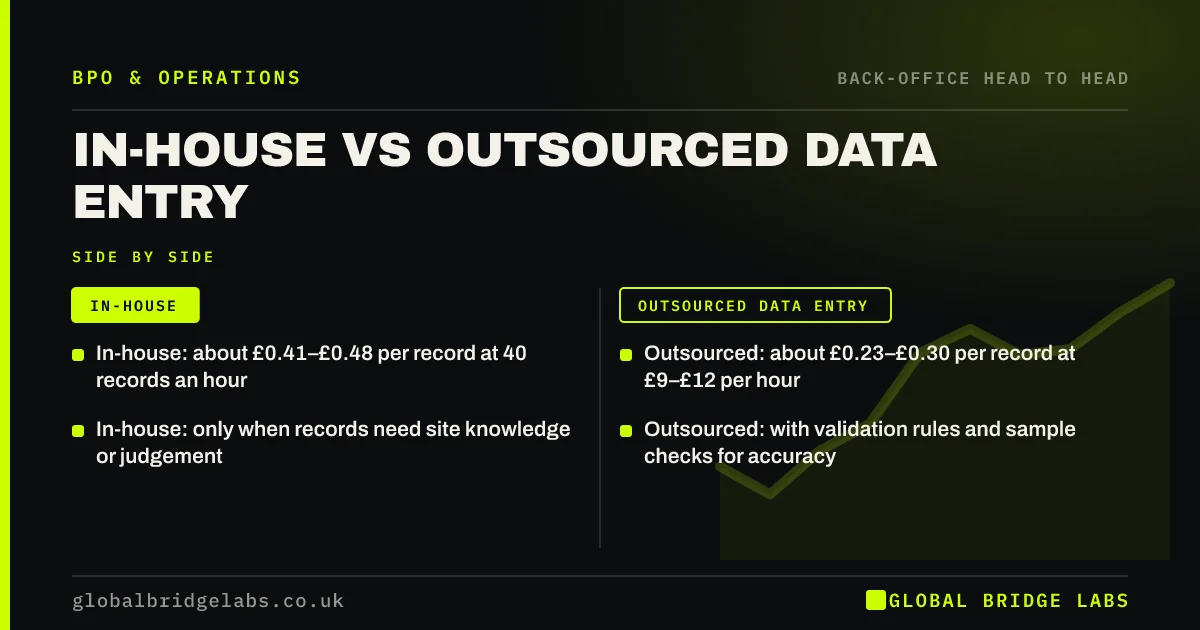
In-house vs outsourced data entry is the clearest cost case in back-office work. At 40 records an hour, in-house entry at the National Living Wage costs about £0.41 per record, or £0.48 at 85% utilisation. Outsourced at £9–£12 per hour, it costs about £0.23–£0.30. For 100,000 records a year that is roughly £18,000 saved.
- In-house: about £0.41–£0.48 per record at 40 records an hour.
- Outsourced: about £0.23–£0.30 per record at £9–£12 per hour.
- In-house: only when records need site knowledge or judgement.
- Outsourced: with validation rules and sample checks for accuracy.
Want your cost per record worked out? Message us on WhatsApp with your volumes.
Chat on WhatsApp →What does data entry cost per record?
Cost per record is the loaded cost of an hour of work divided by records completed in that hour, plus the cost of fixing errors. It lets you compare in-house and outsourced options on the same basis, whatever the hourly rate.
What does a worked example look like?
An employee on the National Living Wage costs about £16.27 per worked hour. At 40 records an hour, that is £0.41 per record; at 85% utilisation, £0.48. For 100,000 records a year, about 2,500 productive hours, in-house costs about £40,700–£47,800.
Outsourced at an indicative £9–£12 per hour, the same volume costs about £22,500–£30,000. The saving is about £18,000 a year at the midpoints, before overheads and management on the in-house side.
Want this calculated for your record types? Send us a sample on WhatsApp.
Chat on WhatsApp →How do you keep outsourced data entry accurate?
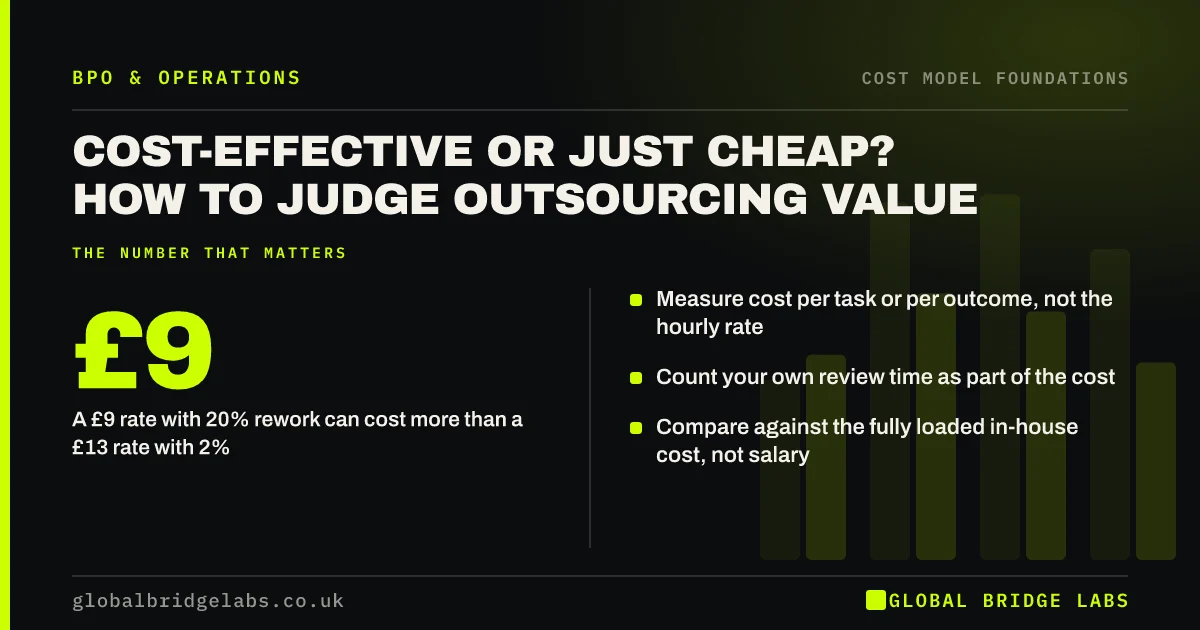
Build accuracy into the process, not the person. Use validation rules in the system, required fields and drop-down lists, sample-check a percentage of records each week, and double-key critical fields such as amounts and bank details. Track the error rate on your scorecard.
- Validation rules and required fields.
- Weekly sample checks of completed records.
- Double-keying for amounts and bank details.
- Error rate reported monthly.
When should data entry stay in-house?
When records need judgement or site knowledge, such as interpreting handwritten job sheets with local shorthand, or when volume is only a few hours a week and someone with spare time already does it well. In those cases, fix the form or automate capture first.
Should you automate data entry instead?
Automate where the source is structured and consistent, such as digital forms or standard invoices. Outsource where sources vary, need reading and checking, or arrive in mixed formats. Many businesses combine the two: automation captures, people check and fix exceptions.
What about data protection?
If the records contain personal data, the provider is a processor under UK GDPR and needs a written contract, and an offshore team needs a valid transfer safeguard. Give access only to the systems and fields needed.
How do you prepare data entry for handover?
Collect ten real examples of each record type, including awkward ones, and write down how each field should be filled. Agree what the team should do when a source is unclear: flag it, skip it or ask. Clear rules for exceptions matter more than speed in the first weeks.
What does this look like in practice?
A pattern we see in UK logistics firms: proof-of-delivery details are keyed into the system by office staff at the end of each day, and backlogs build after busy weeks. A managed team keys them overnight with validation and sample checks, so billing starts the next morning.
Data entry checklist
Use these steps to compare.
- Count records per month by type.
- Time a sample to get records per hour.
- Calculate in-house cost per record.
- Get outsourced per-hour or per-record quotes.
- Set validation and sample-check rules.
- Track cost per record and error rate monthly.
Next step
Send us your record types and monthly volumes. We will calculate cost per record both ways in a 30-minute call.
Message us on WhatsApp for a data entry cost comparison, or book a 30-minute consultation.
Chat on WhatsApp →Sources and further reading
- National Minimum Wage and National Living Wage rates · GOV.UK
- Rates and thresholds for employers 2026 to 2027 · HM Revenue & Customs
- Contracts and liabilities between controllers and processors · Information Commissioner's Office
- International transfers of personal data · Information Commissioner's Office
Frequently asked questions
How much does data entry cost per record?
It depends on speed and rate. At 40 records an hour, in-house entry at the National Living Wage costs about £0.41–£0.48 per record once idle time is included, while outsourced entry at an indicative £9–£12 per hour costs about £0.23–£0.30 per record.
Is outsourced data entry accurate?
It can be very accurate with validation rules, required fields, double-keying of critical fields such as amounts and bank details, and weekly sample checks. Measure the error rate and review it monthly, whoever does the work, and feed recurring mistakes back as process updates.
Should I automate or outsource data entry?
Automate structured, consistent sources such as digital forms and standard invoices. Outsource varied or unstructured sources that need reading, interpreting and checking. Many businesses combine the two: automation captures what it can, and people check and fix the exceptions. Review the split every year.
How quickly can outsourced data entry start?
Often within about two weeks for a documented process, once access, examples and rules for exceptions are agreed. Expect lower speed and more questions in the first weeks, then steady output. Start with one record type and add others once accuracy matches your standard.
Written by

Global Bridge Labs (GBL) is a UK–Sri Lanka partner for social media, websites and BPO. Everything here comes from client delivery, not theory.