On this page
- 01Key takeaways
- 02What goes on an annual calendar?
- 03Why start with the revenue year?
- 04How do the annual, quarterly and monthly views fit together?
- 05Which dates move every year?
- 06When is an annual calendar too much?
- 07What does this look like in practice?
- 08Annual calendar checklist
- 09Next step
- 10Sources and further reading
- 11Frequently asked questions
Key takeaways
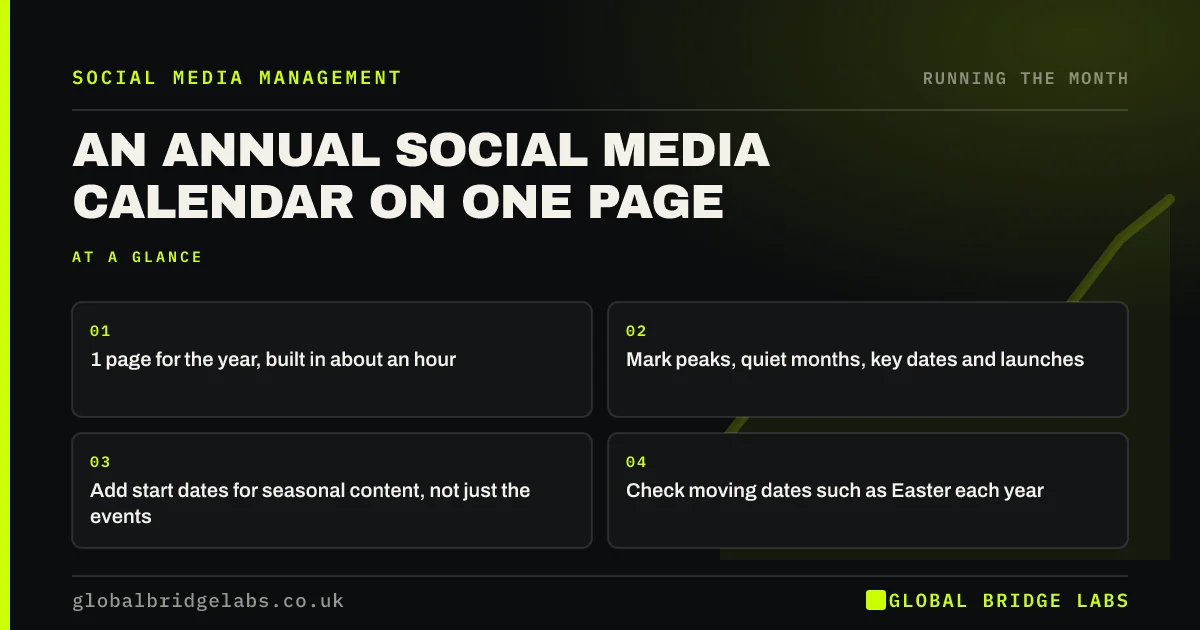
An annual social media calendar is a one-page view of the year: your busy and quiet months, the key dates your buyers act on, planned launches and events, a few themes, and the start dates for seasonal content. Build it once a year, in about an hour, and refresh it each quarter. It never lists individual posts.
- 1 page for the year, built in about an hour.
- Mark peaks, quiet months, key dates and launches.
- Add start dates for seasonal content, not just the events.
- Check moving dates such as Easter each year.
Want your year mapped on one page? Message us on WhatsApp.
Chat on WhatsApp →What goes on an annual calendar?
Five things across twelve columns: your revenue peaks and quiet months, the bank holidays and school holidays for your area, the seasonal moments your buyers act on, your own launches, events and milestones, and the start dates for seasonal content four to eight weeks before each peak. Add three or four themes if they help.
Why start with the revenue year?
Because content should arrive before buying decisions, and those follow your revenue pattern. A garden business's year is decided in February and March; a hospitality business's Christmas is booked in the autumn. Mapping when money comes in shows when content must go out.
How do the annual, quarterly and monthly views fit together?
The annual view is set once a year and shows the shape of the year. The quarterly view takes the next three months and adds detail and slot changes. The monthly calendar plans the actual posts. Each level looks only as far ahead as it can stay accurate.
Which dates move every year?
Easter, Mothering Sunday, Black Friday, school holidays and religious festivals such as Ramadan, Eid, Diwali and Lunar New Year all move. Check them when you build the year, using GOV.UK for bank holidays and your council for school terms.
When is an annual calendar too much?
It is too much if it grows into a year of planned posts, which will not survive. Keep it to one page. For a very small or non-seasonal business, a list of 10 to 20 key dates may be all the annual view needs.
What does this look like in practice?
A pattern we see: the same seasonal peak missed every year because it is remembered only when it arrives. A one-page year with the content start dates marked usually ends that.
Annual calendar checklist
- Map revenue peaks and quiet months.
- Add bank and school holidays for your area.
- Add the seasonal moments your buyers act on.
- Add launches, events and milestones.
- Mark content start dates before each peak.
Next step
Draw twelve columns and mark your three busiest months. Then count back eight weeks from each and mark when content must start.
Message us on WhatsApp and we will map your year, or book a 30-minute consultation.
Chat on WhatsApp →Sources and further reading
- UK bank holidays · GOV.UK
- School term and holiday dates · GOV.UK
Frequently asked questions
Should I plan my social media for the whole year?
Plan the shape of the year on one page: peaks, quiet months, key dates, launches and when seasonal content must start. Do not plan individual posts a year ahead; plan those month by month.
What should be on a 12-month social media calendar?
Your busy and quiet months, bank and school holidays, the seasonal moments your buyers act on, your launches, events and milestones, and start dates for seasonal content four to eight weeks before each peak.
When should I build next year's social media calendar?
In the autumn, ideally in October, before the Christmas rush, so January and the first quarter are planned before December gets busy. Refresh it each quarter as dates, launches and plans change.
Written by

Global Bridge Labs (GBL) is a UK–Sri Lanka partner for social media, websites and BPO. Everything here comes from client delivery, not theory.