On this page
- 01Key takeaways
- 02What does a top agency's extra fee pay for?
- 03Which parts of the premium reach your account?
- 04How do you test whether a premium is good value?
- 05When is paying the premium worth it?
- 06When is the premium mostly overhead?
- 07What does this look like in practice?
- 08Premium breakdown checklist
- 09Next step
- 10Sources and further reading
- 11Frequently asked questions
Key takeaways
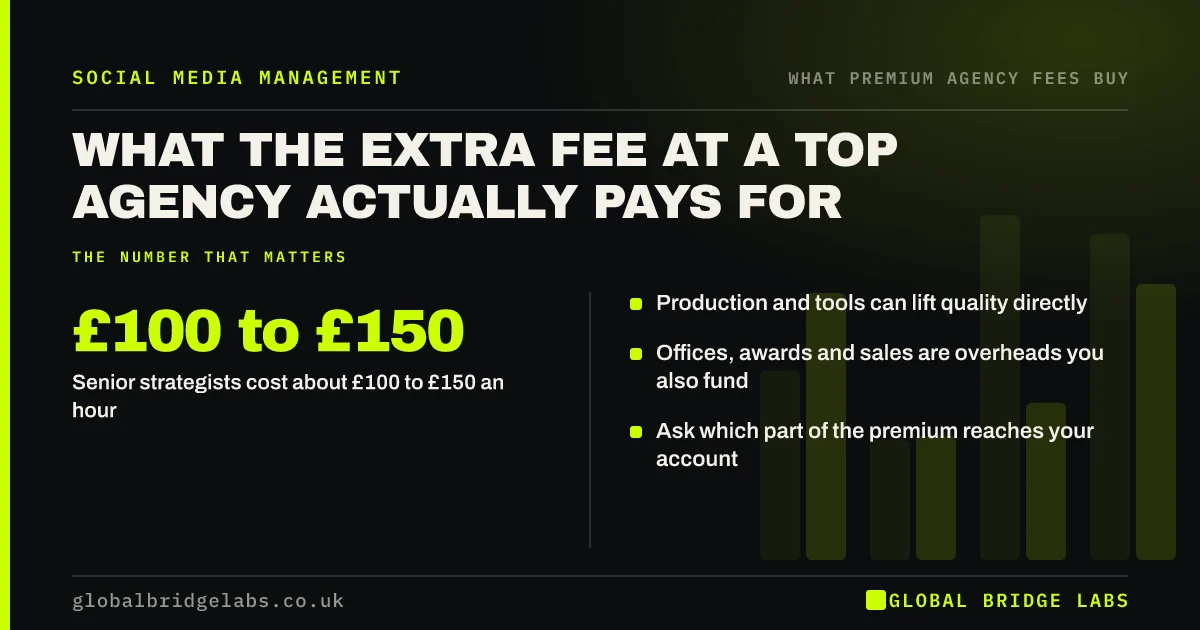
The extra fee at a top agency pays for some mix of senior people, stronger production, better tools, larger overheads and reputation. Only the first three reach your account directly. Before paying more, ask which part of the higher fee buys extra hours or seniority for you, and which part funds offices, awards and new business.
- Senior strategists cost about £100 to £150 an hour.
- Production and tools can lift quality directly.
- Offices, awards and sales are overheads you also fund.
- Ask which part of the premium reaches your account.
Want to see what a higher quote really buys? Message us on WhatsApp.
Chat on WhatsApp →What does a top agency's extra fee pay for?
A higher agency fee typically pays for more senior staff, stronger creative and production, better data and tools, and higher overheads such as central offices, award entries and new business teams. As indicative UK rates, senior strategy time costs about £100 to £150 an hour against £60 to £90 for production.
Which parts of the premium reach your account?
Senior time, production quality and tools reach your account directly, if they are actually assigned to you. Overheads, reputation building and sales costs do not, though they may keep the agency stable and attract good staff. Ask for the hours and seniority your fee buys each month.
- Reaches you: senior hours, production, tools.
- Indirect: training, stability, recruitment.
- Does not reach you: offices, awards, pitching.
How do you test whether a premium is good value?
Compare two proposals on hours, seniority and deliverables, then put a yearly price on the difference. If the premium buys meaningfully more senior time or better production for your goals, it may pay back. If it buys the same hours at a higher rate, it is mostly overhead.
Comparing a top agency's quote with a smaller one? Send both on WhatsApp and we will discuss your requirements.
Chat on WhatsApp →When is paying the premium worth it?
It is worth it when the extra fee buys senior strategy you lack, production you cannot get elsewhere, or sector experience that shortens the learning curve, and the likely extra results exceed the yearly cost.
When is the premium mostly overhead?
It is mostly overhead when the hours and seniority match a cheaper rival, when your account would sit with junior staff, or when the agency's advantages lie in work you do not need, such as television-scale production.
What does this look like in practice?
A pattern we see: two proposals differ by about £1,000 a month, yet list near-identical hours and roles. Asking each to name the senior person and their monthly hours usually explains the gap.
Premium breakdown checklist
- Ask for monthly hours by role.
- Name the senior people and their time.
- List production and tools included.
- Put a yearly cost on the difference.
- Decide whether the extra reaches your account.
Next step
Ask each agency to split its fee into hours by role. The premium becomes visible immediately.
Message us on WhatsApp for a proposal comparison, or book a 30-minute consultation.
Chat on WhatsApp →Sources and further reading
- Earnings and hours worked, occupation by four-digit SOC: ASHE Table 14 · Office for National Statistics
- Advertising Association / WARC Expenditure Report · Advertising Association
- IPA Effectiveness Awards · IPA
Frequently asked questions
Why do top social media agencies charge more?
Top agencies charge more because they employ more senior people, invest in production and tools, carry higher overheads such as central offices and award entries, and serve larger clients. Some of that improves your account directly. Some funds the agency's reputation and growth, which you pay for without receiving directly.
Is a more expensive agency more profitable?
Not necessarily. Higher fees often cover higher costs, such as senior salaries, premises and new business teams. Margins vary widely between agencies of all sizes. As a buyer, focus less on the agency's margin and more on the hours, seniority and results your fee actually buys.
How can I tell if a premium buys more hours?
Ask both agencies how many hours a month the retainer represents and who does them. Divide each fee by its hours to compare blended rates. If the premium agency's hours and seniority are similar, the extra fee is paying for overheads or reputation rather than extra work on your account.
Written by

Global Bridge Labs (GBL) is a UK–Sri Lanka partner for social media, websites and BPO. Everything here comes from client delivery, not theory.