On this page
- 01Key takeaways
- 02How do overheads show up in agency fees?
- 03Which overheads are higher at premium agencies?
- 04How should you compare quotes with different overheads?
- 05When are higher overheads worth paying for?
- 06When are you paying for image?
- 07What does this look like in practice?
- 08Overheads checklist
- 09Next step
- 10Sources and further reading
- 11Frequently asked questions
Key takeaways
Overheads, such as offices, management, sales teams, software, insurance and award entries, are recovered through every agency's hourly rates. Larger and award-winning agencies often carry more of them, especially central offices and new business teams. That explains part of why two quotes for similar hours can differ by hundreds of pounds a month.
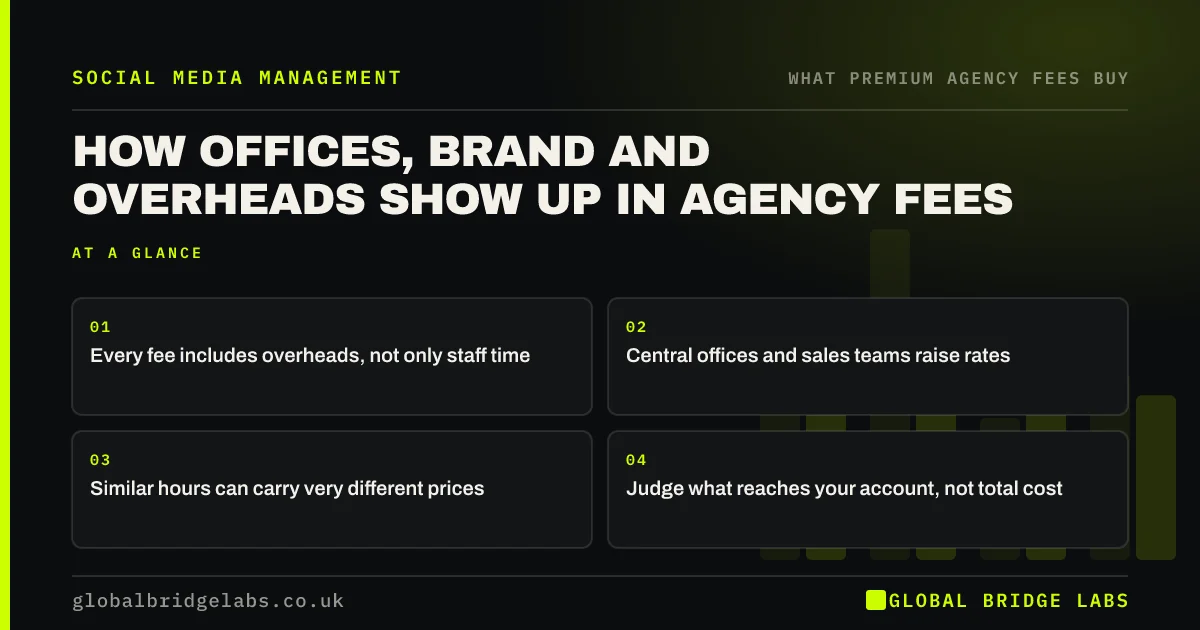
- Every fee includes overheads, not only staff time.
- Central offices and sales teams raise rates.
- Similar hours can carry very different prices.
- Judge what reaches your account, not total cost.
Want to see how much of a quote is overhead? Message us on WhatsApp.
Chat on WhatsApp →How do overheads show up in agency fees?
Overheads are built into hourly rates. Agencies estimate the time staff can bill, then set rates high enough to cover salaries plus offices, management, software, insurance, sales, training and profit. Higher overheads mean higher rates for the same hours of work.
Which overheads are higher at premium agencies?
Premium agencies often carry larger offices in expensive locations, bigger management layers, new business and marketing teams, award entries and events. Some also invest more in training and tools, which can benefit you. Others are mainly about image.
- Central offices and premises.
- Management and new business teams.
- Awards, events and brand marketing.
- Training and tools, which may help you.
How should you compare quotes with different overheads?
Compare on hours, seniority and deliverables. Ask each agency how many hours your fee buys and who does them. If one costs more for the same hours and people, the difference is overhead. Then decide whether anything that overhead funds benefits your account.
Want help comparing quotes on equal terms? Message us on WhatsApp and we will discuss your requirements.
Chat on WhatsApp →When are higher overheads worth paying for?
They are worth it when they fund things you use: training that keeps staff sharp, tools that improve results, in-person workshops or backup cover when people are away.
When are you paying for image?
You are paying for image when the extra fee funds premises, events and awards that never touch your account, while the hours and people match a cheaper rival.
What does this look like in practice?
A pattern we see: a remote agency and a city-centre agency quote similar hours and roles, but the city agency costs more. The work is comparable; the difference is rent and management.
Overheads checklist
- Ask for hours and roles in each quote.
- Work out each blended hourly rate.
- Identify what extra overheads fund.
- Value training, tools and cover.
- Discount premises and image costs.
Next step
Divide each quote by its monthly hours. The difference in rates is mostly overhead.
Message us on WhatsApp for a quote comparison, or book a 30-minute consultation.
Chat on WhatsApp →Sources and further reading
- Earnings and hours worked, occupation by four-digit SOC: ASHE Table 14 · Office for National Statistics
- Running a limited company: company and accounting records · GOV.UK
- Advertising Association / WARC Expenditure Report · Advertising Association
Frequently asked questions
Why do agencies in big cities charge more?
Agencies in big cities usually pay more for premises and staff, and these overheads feed into hourly rates. For social media, which is mostly delivered remotely, location rarely changes quality. A regional or remote agency may offer similar people and hours at a lower fee.
What percentage of an agency fee is overhead?
It varies widely by agency, and few publish it. Staff time is usually the largest part, with overheads such as premises, management, tools and sales on top, plus profit. Rather than estimating percentages, compare the hours and seniority each fee buys, which shows overhead differences indirectly.
Do remote agencies cost less?
Often, because they avoid central office costs. That saving can mean lower fees or more hours for the same fee. Remote agencies need good communication habits, such as regular video calls and clear reporting. Judge them on the same evidence as any agency: results, references and the team.
Written by

Global Bridge Labs (GBL) is a UK–Sri Lanka partner for social media, websites and BPO. Everything here comes from client delivery, not theory.