On this page
- 01Key takeaways
- 02What does audience research include?
- 03How much does audience research cost?
- 04Why is research better than guessing?
- 05When can you skip paid research?
- 06What does this look like in practice?
- 07Audience research checklist
- 08Next step
- 09Sources and further reading
- 10Frequently asked questions
Key takeaways
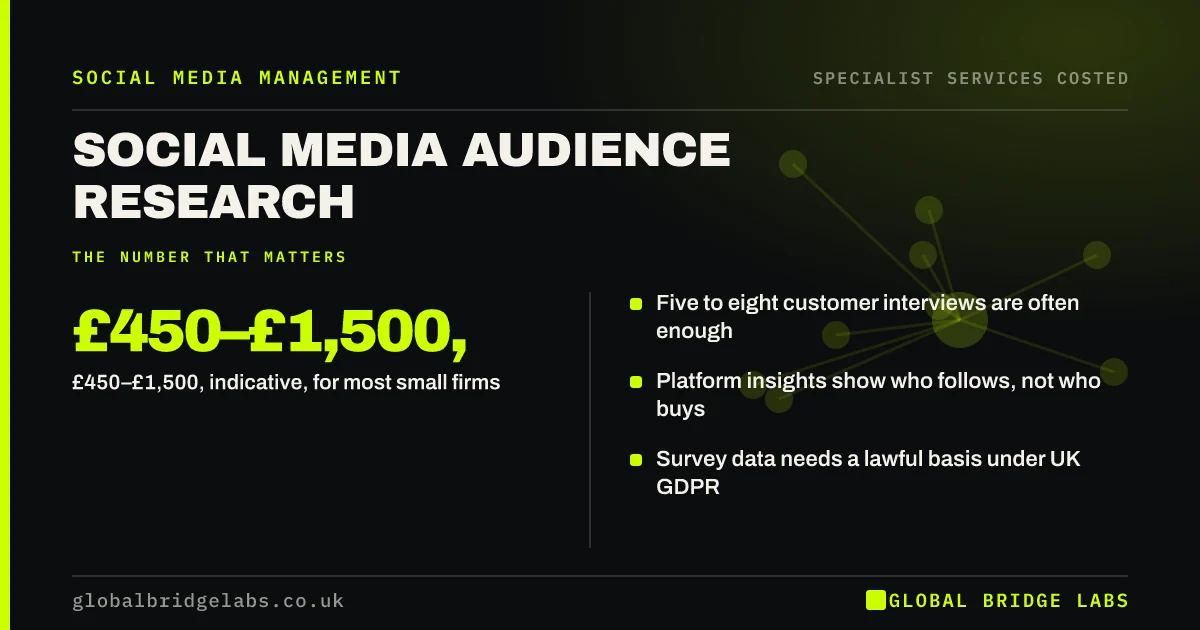
Social media audience research typically costs an indicative £450–£1,500 in the UK (6 to 15 hours at £75–£100 an hour). That covers five to eight customer interviews, a short survey, a review of platform insights and a written summary of who buys, why and where. It is worth paying for before a strategy, not after.
- £450–£1,500, indicative, for most small firms.
- Five to eight customer interviews are often enough.
- Platform insights show who follows, not who buys.
- Survey data needs a lawful basis under UK GDPR.
Not sure who your social media should speak to? Message us on WhatsApp.
Chat on WhatsApp →What does audience research include?
Social media audience research is finding out who your best customers are, what problems bring them to you, which words they use and where they spend time online. It combines short customer interviews, a survey, sales data and platform insights into a summary the content plan can use.
How much does audience research cost?
A light version, reviewing insights and sales data with three interviews, takes about 6 hours, roughly £450–£600. A fuller version with eight interviews, a survey and personas takes up to 15 hours, about £1,125–£1,500. Paid survey panels or incentives for interviewees are extra.
- Light review and three interviews: £450–£600.
- Full research with survey: up to £1,500.
- Interview incentives: small vouchers, extra.
- Annual refresh: 3 to 5 hours, £225–£500.
Tell us who you think your buyers are on WhatsApp and we will discuss your requirements.
Chat on WhatsApp →Why is research better than guessing?
Most businesses describe their buyer in broad terms. Interviews usually reveal the specific trigger that made someone search, the doubts they had and the words they used. Those details make posts that the right people recognise as being about them.
When can you skip paid research?
If you speak to customers every day and can name their top questions, you can run a light version yourself. Paid research earns its cost when sales come through others, when you are entering a new market, or when results suggest you are reaching the wrong people.
What does this look like in practice?
A pattern we see: a firm targets business owners in general, but interviews show most buyers are office managers handed the problem by their boss. Changing who the posts speak to usually changes the enquiries more than changing the design.
Audience research checklist
- Interview recent buyers, not just loyal fans.
- Ask what triggered the search.
- Record the exact words customers use.
- Compare followers with actual buyers.
- Use a privacy notice for any survey.
Next step
Call three recent customers this month and ask what made them look for you. Their answers are the start of your research.
Message us on WhatsApp for an audience research plan, or book a 30-minute consultation.
Chat on WhatsApp →Sources and further reading
- Adults' media use and attitudes · Ofcom
- Lawful basis for processing personal data · Information Commissioner's Office
Frequently asked questions
How much does customer persona research cost?
For a small business, an indicative £450–£1,500 at UK agency rates, depending on the number of interviews and whether a survey is included. Large-scale panel research costs much more and is rarely needed by SMEs.
How many customer interviews are enough?
For a small business with one main type of buyer, five to eight interviews usually reveal the main patterns. Stop when you keep hearing the same answers. Several distinct buyer types need more.
Can I use social media insights instead of research?
Insights show who follows and engages, which is useful but not the same as who buys. Combine them with sales data and a few interviews to see whether your followers match your customers.
Written by

Global Bridge Labs (GBL) is a UK–Sri Lanka partner for social media, websites and BPO. Everything here comes from client delivery, not theory.