On this page
- 01Key takeaways
- 02What sets an agency's minimum fee?
- 03Why are very small retainers hard to serve?
- 04What are the options below the minimum?
- 05When should you stretch to the minimum?
- 06What does this look like in practice?
- 07Minimum fee checklist
- 08Next step
- 09Sources and further reading
- 10Frequently asked questions
Key takeaways
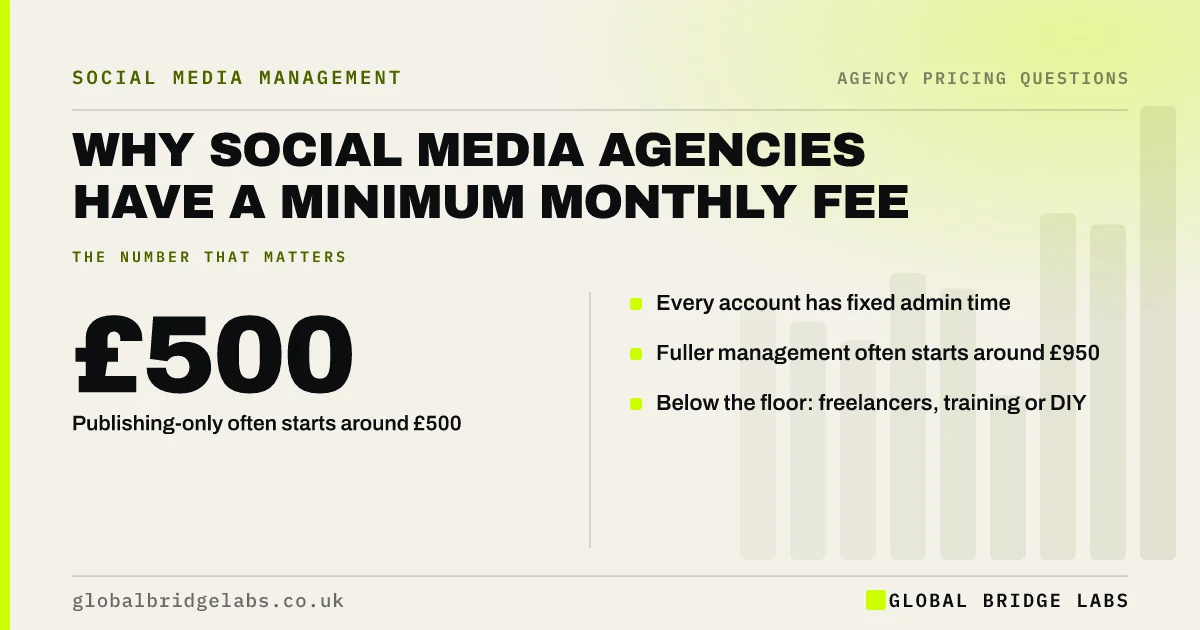
Social media agencies have a minimum monthly fee because every account carries fixed time: onboarding, planning, approvals, reporting and account management. Below a certain fee, those fixed hours leave too little for actual content. In the UK, publishing-only services often start around £500, and fuller management around £950. Below that, a freelancer or training may suit better.
- Every account has fixed admin time.
- Publishing-only often starts around £500.
- Fuller management often starts around £950.
- Below the floor: freelancers, training or DIY.
Budget below an agency minimum? Message us on WhatsApp for options.
Chat on WhatsApp →What sets an agency's minimum fee?
An agency's minimum covers the hours it spends on any client regardless of size: planning calls, the content calendar, approvals, reporting, account management and admin. At £75–£100 an hour, even five fixed hours a month is £375–£500 before a single post is created.
Why are very small retainers hard to serve?
If fixed hours take most of a small fee, the client gets little content and the agency makes a loss or cuts corners. That is why low-cost packages often use templates, junior staff and no strategy. A minimum protects both sides from an arrangement that cannot work.
- Fixed time: planning, approvals, reporting.
- Small fee: little left for content.
- Risk: templates and junior-only delivery.
- Minimum: keeps the work viable.
Tell us your budget on WhatsApp and we will discuss your requirements.
Chat on WhatsApp →What are the options below the minimum?
A freelancer at £25–£60 an hour or £400–£1,200 a month, training at £450–£1,200 so you can do it yourself, a coaching retainer, or a project such as a strategy and templates you run in-house. Each costs less than an agency minimum while still getting expert input.
When should you stretch to the minimum?
When nobody has time to do the work and social media matters to sales. A slightly larger budget for a service that works beats a smaller one that produces little. If you cannot stretch, a simpler scope on one platform is better than an underfunded broad one.
What does this look like in practice?
A pattern we see: a business pays a very low monthly fee and receives generic template posts. Moving to a one-off strategy and templates, then posting in-house, usually costs similar money and produces better results.
Minimum fee checklist
- Ask what the minimum includes.
- Check how much time goes on content.
- Compare freelancers and training below the floor.
- Narrow scope rather than thinning it.
- Avoid packages that are only templates.
Next step
Write the most you can spend each month. Then ask what the best use of that sum is, not which package fits it.
Message us on WhatsApp for options at your budget, or book a 30-minute consultation.
Chat on WhatsApp →Sources and further reading
- Rates and thresholds for employers 2026 to 2027 · HM Revenue & Customs
- Employee earnings in the UK (Annual Survey of Hours and Earnings) · Office for National Statistics
Frequently asked questions
What is the minimum for a social media agency?
In the UK, publishing-only services often start around £500 a month and fuller management around £950. Agencies differ, so ask what the minimum includes.
Can I hire an agency for less than its minimum?
Sometimes as a one-off project, such as a strategy or template set. Ongoing work below the minimum usually leaves too little time for content to be worthwhile.
What should I do with a small social media budget?
Consider a freelancer, training so you can do it yourself, a coaching retainer or a one-off strategy and templates. Focus on one platform.
Written by

Global Bridge Labs (GBL) is a UK–Sri Lanka partner for social media, websites and BPO. Everything here comes from client delivery, not theory.