On this page
- 01Key takeaways
- 02Do social media agencies work with competitors?
- 03What does exclusivity cost?
- 04What should confidentiality cover?
- 05How do you write a fair exclusivity clause?
- 06When is exclusivity not worth asking for?
- 07What does this look like in practice?
- 08Exclusivity checklist
- 09Next step
- 10Sources and further reading
- 11Frequently asked questions
Key takeaways
Social media agency exclusivity is a promise not to work for your direct competitors. Many agencies work with several businesses in the same sector, which brings experience. Exclusivity is reasonable in a narrow form, such as the same sector in the same area, and may cost more if it limits the agency's work.
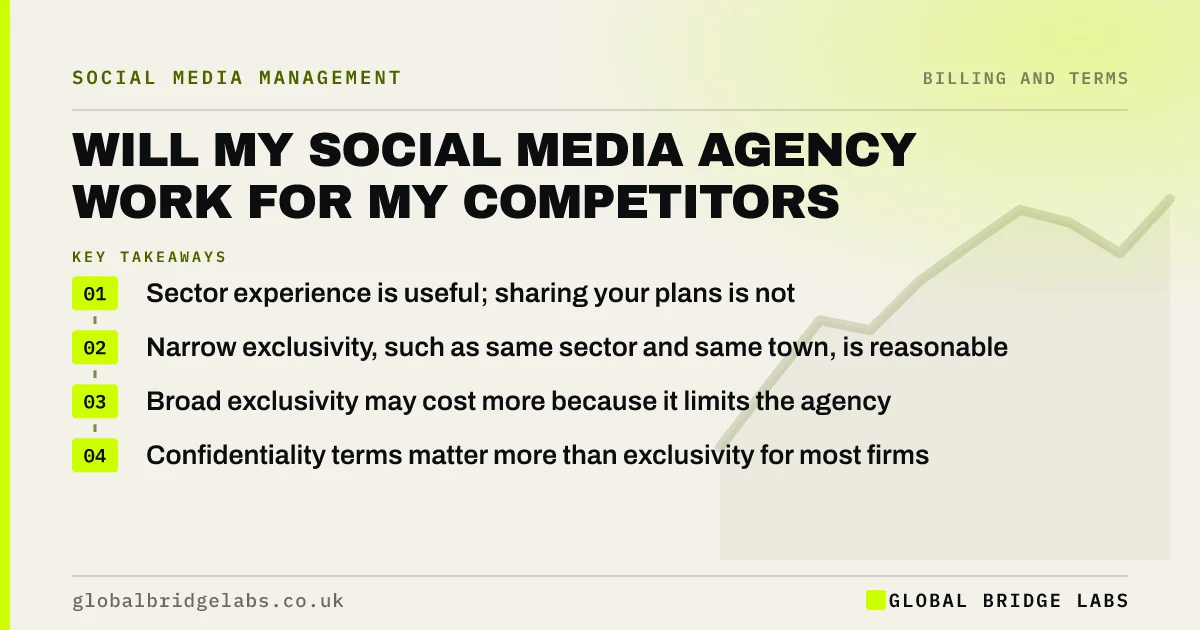
- Sector experience is useful; sharing your plans is not.
- Narrow exclusivity, such as same sector and same town, is reasonable.
- Broad exclusivity may cost more because it limits the agency.
- Confidentiality terms matter more than exclusivity for most firms.
Want to talk about confidentiality and fit? Message us on WhatsApp.
Chat on WhatsApp →Do social media agencies work with competitors?
Often, yes. An agency that has worked with several restaurants or trades firms understands that sector's customers and content. Working with businesses in the same sector is normal. Working for your direct local competitor at the same time is where conflicts can arise.
What does exclusivity cost?
Narrow exclusivity usually costs nothing, because agencies rarely want two direct rivals in the same town. Broad exclusivity, such as no other clients in your sector nationwide, limits the agency's business, so some agencies charge more or decline it. Ask what is included before assuming.
Want to know how we handle same-sector clients? Ask us on WhatsApp and we will discuss your requirements.
Chat on WhatsApp →What should confidentiality cover?
Confidentiality matters more than exclusivity for most businesses. The contract should state that your plans, results, customer data and offers stay confidential and are not used for other clients. Customer data is also covered by UK GDPR, so a controller to processor agreement should be in place.
How do you write a fair exclusivity clause?
Keep it specific: name the sector, the area and the period, such as "no other estate agents within ten miles during the contract". Avoid vague wording like "no competitors". A clear clause protects you without stopping the agency running its business.
- Named sector, not "any competitor".
- Defined area or customer base.
- Length: usually the contract term.
- Confidentiality of plans and results.
When is exclusivity not worth asking for?
It is not worth asking for when your competitors sell to different customers or areas, or when the agency's sector experience is a key reason to hire them. Strong confidentiality terms usually give the protection you need without limiting the agency.
What does this look like in practice?
A pattern we see with UK local service businesses: they worry an agency will share their best ideas with a rival down the road. Global Bridge Labs (GBL) keeps client plans and results confidential and discusses any same-sector overlap openly before work starts.
Exclusivity checklist
Ask these before you sign.
- Does the agency work with direct competitors?
- Is narrow exclusivity included?
- What does broader exclusivity cost?
- Are plans and results confidential?
- Is a data processing agreement in place?
Next step
Tell us your sector and area. We will tell you openly whether we work with anyone you would see as a direct competitor.
Message us on WhatsApp, or book a 30-minute consultation.
Chat on WhatsApp →Sources and further reading
- Contracts and liabilities between controllers and processors · Information Commissioner's Office
- Controllers and processors · Information Commissioner's Office
- Unfair commercial practices guidance (CMA207) · Competition and Markets Authority
Frequently asked questions
Can a social media agency work for my competitor?
Yes, unless your contract says otherwise. Many agencies work with several businesses in the same sector, which brings useful experience. If a direct local rival is a concern, ask for narrow exclusivity and strong confidentiality terms in the contract.
Does exclusivity cost extra?
Narrow exclusivity, such as no direct competitors in your town, often costs nothing. Broad exclusivity that stops the agency working across a whole sector limits their business, so some agencies charge more for it or decline. Ask before assuming.
What protects my business more than exclusivity?
Confidentiality. A clear clause stating that your plans, results, customer data and offers are not shared or reused protects you even if the agency works in your sector. A controller to processor agreement covers customer data under UK GDPR.
Is sector experience a good thing?
Usually, yes. An agency that has worked with similar businesses understands the customers, rules and content that work. The question is not whether they know your sector but whether they keep each client's information separate.
Written by

Global Bridge Labs (GBL) is a UK–Sri Lanka partner for social media, websites and BPO. Everything here comes from client delivery, not theory.