On this page
- 01The questions
- 02Why the outcome question comes first
- 03What does a good answer on hours sound like?
- 04Why ask what they need from you?
- 05The ownership and exit questions
- 06The four questions that reveal the most
- 07How should you run the first 90 days?
- 08Next step
- 09Sources and further reading
- 10Frequently asked questions
The questions
Ask all fourteen. The answers to the last four matter more than anything in the proposal, and they are the ones agencies are least prepared for.
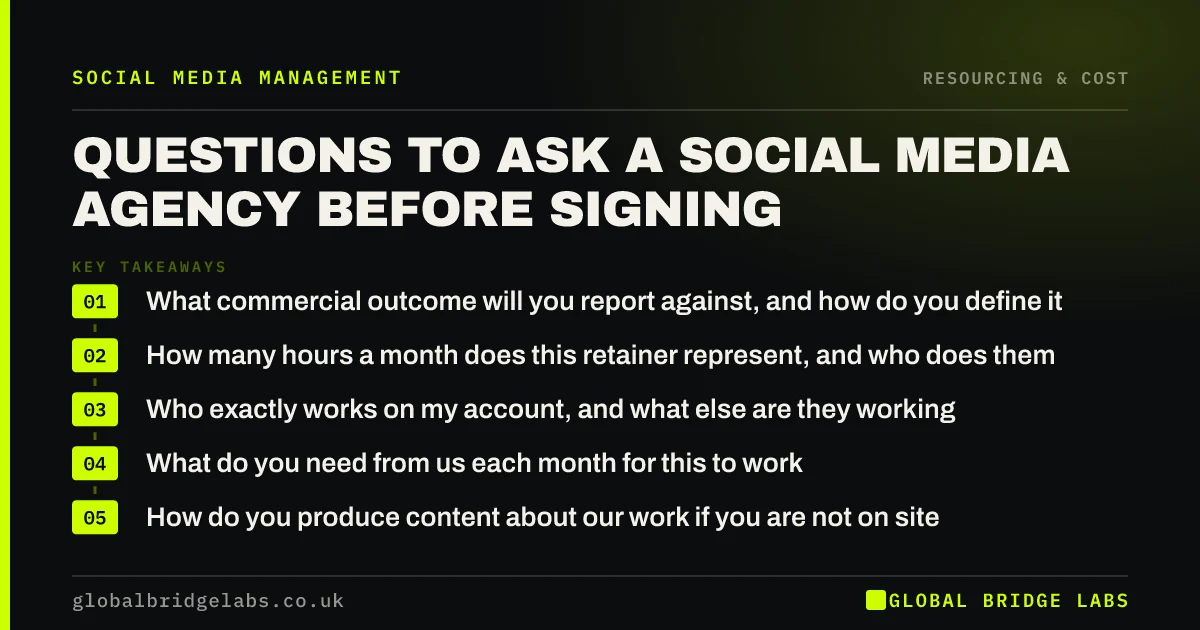
- What commercial outcome will you report against, and how do you define it?
- How many hours a month does this retainer represent, and who does them?
- Who exactly works on my account, and what else are they working on?
- What do you need from us each month for this to work?
- How do you produce content about our work if you are not on site?
- What happens if we do not supply material one month?
- Who handles comments and messages, and inside what hours?
- Is paid budget included, and do you charge a management percentage?
- Who owns the accounts, the content and the data if we leave?
- What is the notice period and is there a minimum term?
- Show me an account like mine and tell me what the enquiry numbers did.
- What would make you tell us to stop spending on this?
- What went wrong on a recent client account and what did you change?
- If this is not working in six months, how will we know?
Ask us these questions directly. Message us on WhatsApp and we will answer all fourteen.
Chat on WhatsApp →Why the outcome question comes first
Because the answer tells you what you are buying. An agency that answers in posts, reach or engagement is selling activity. An agency that answers in conversations, enquiries and cost per enquiry is selling outcomes.
Both are legitimate products, but only the second can be judged. If the answer is activity, the contract should be priced accordingly and you should keep the outcome measurement yourself.
What does a good answer on hours sound like?
Specific and unembarrassed. Roughly 18 hours a month, of which four are senior time on strategy and review, ten are production, and four are community management, is a good answer.
Reluctance to answer is the signal. Every agency knows its own capacity model, and an unwillingness to convert a retainer into hours usually means the hours are lower than the price implies.
Why ask what they need from you?
Because the most common cause of failure is not agency capability, it is the absence of raw material from the business. An agency that has thought about this will have a clear answer: a shared photo folder, a monthly call, a named approver, and customer questions forwarded as they arise.
An agency that says nothing, we handle everything is either inexperienced or planning to produce generic content. Nobody can make content about your work without access to your work.
We tell UK clients exactly what we need from them before we start. Message us on WhatsApp to see the list.
Chat on WhatsApp →The ownership and exit questions
Ask them before you sign, because they are almost impossible to negotiate afterwards. You should own the accounts, the ad account, the content produced, the creative files and the data.
Watch for arrangements where the agency creates pages under its own business manager, retains ownership of creative files, or holds the ad account. All three are common and all three make leaving expensive. Agree in writing that accounts are yours and access is granted, not the reverse.
The four questions that reveal the most
What would make you tell us to stop spending on this? A good agency has an answer, usually involving conversion problems downstream of social. An agency that cannot imagine recommending less spend is selling, not advising.
What went wrong recently and what did you change? Everyone has failures. An agency that claims none is either new or not being straight with you.
If this is not working in six months, how will we know? The answer should be a specific number and a review date, agreed now.
And: show me an account like mine and tell me what the enquiry numbers did. Reach figures are easy. Enquiry figures require the agency to have been measuring the right thing all along.
How should you run the first 90 days?
Agree the first quarter in the contract, so both sides know what good looks like before anyone is disappointed.
A reasonable shape: month one is audit, access, strategy and the first content batch, with limited publishing. Month two is a held cadence and tracking live. Month three is the first meaningful report and one recommendation about what to stop. Judging an agency on enquiries in month one is unfair and produces the wrong decision.
Set a review meeting for day 100, in the calendar, at the point of signing. The agencies worth working with will welcome it, because it replaces a vague sense of whether things are going well with a specific conversation against agreed expectations.
- Month 1: audit, access, strategy, first batch.
- Month 2: cadence held, tracking live.
- Month 3: first real report and one stop recommendation.
- Day 100 review booked at signing.
Next step
Take the list to every agency you shortlist, including us. The comparison between answers is more informative than any individual proposal.
Message us on WhatsApp and we will answer all fourteen questions for your business, in writing.
Chat on WhatsApp →Sources and further reading
- Employee earnings in the UK (Annual Survey of Hours and Earnings) · Office for National Statistics
- Business population estimates · Department for Business and Trade
Frequently asked questions
What should I ask a social media agency before hiring them?
Start with what commercial outcome they will report against, how many hours the retainer represents and who does them, what they need from you monthly, and who owns the accounts and content if you leave. Those four answers separate most agencies.
Who should own social media accounts, us or the agency?
You, always. Accounts, ad accounts, content, creative files and data should be owned by your business with access granted to the agency. Arrangements where the agency holds ownership make leaving expensive and are very difficult to unwind afterwards.
What is a normal notice period for a social media retainer?
Thirty to ninety days is common, sometimes with an initial minimum term of three to six months because results take time to appear. Minimum terms are reasonable; automatic annual renewal with a long notice period is less so.
What is a warning sign when choosing an agency?
Reluctance to convert the retainer into hours, an answer of nothing when asked what they need from you, guarantees of specific results, and an inability to describe a recent failure. Each of those usually indicates selling rather than advising.
Written by

Global Bridge Labs (GBL) is a UK–Sri Lanka partner for social media, websites and BPO. Everything here comes from client delivery, not theory.