On this page
- 01Key takeaways
- 02What should a good agency case study include?
- 03What are the warning signs in a case study?
- 04How do case studies compare with awards as evidence?
- 05When is a case study strong evidence?
- 06When should a case study not persuade you?
- 07What does this look like in practice?
- 08Case study checklist
- 09Next step
- 10Sources and further reading
- 11Frequently asked questions
Key takeaways
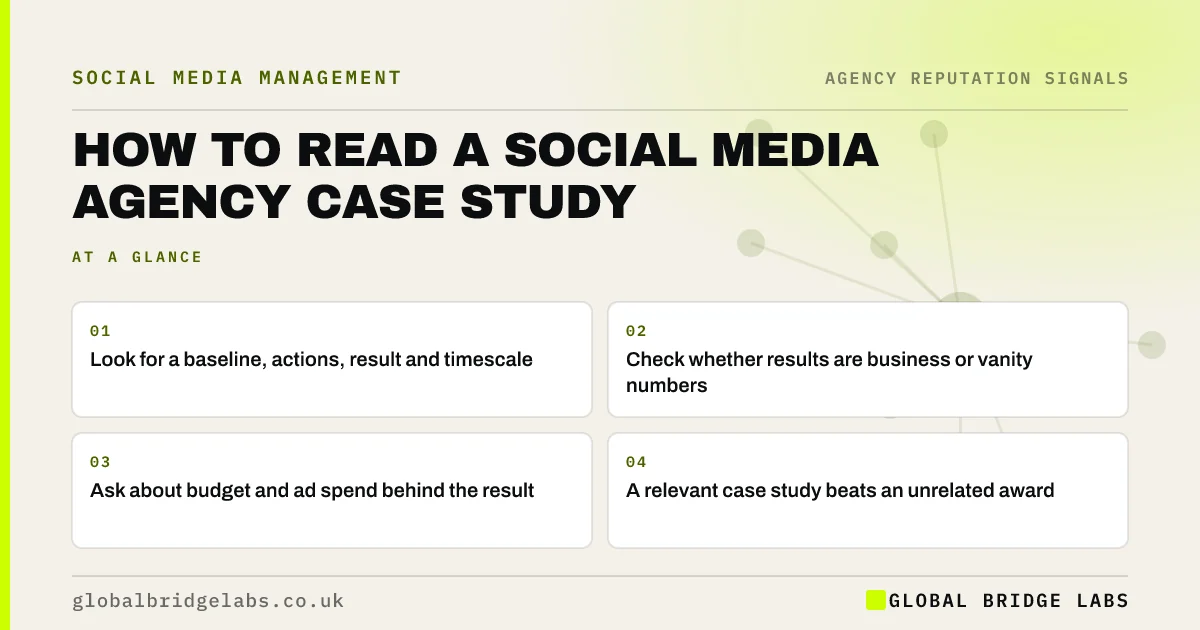
A good social media agency case study states the client's starting point, what the agency did, the result in business terms and the time it took. Most case studies are selective, so check what is missing: budget, ad spend, timescale and how results were measured. A specific case study for a client like you outweighs any award.
- Look for a baseline, actions, result and timescale.
- Check whether results are business or vanity numbers.
- Ask about budget and ad spend behind the result.
- A relevant case study beats an unrelated award.
Want a second opinion on an agency's case studies? Message us on WhatsApp.
Chat on WhatsApp →What should a good agency case study include?
A good case study includes the client's situation before, the goal, what the agency did, the results with numbers, the timescale and the budget range. It names the client or explains why it cannot. It separates results from social media from other causes, such as a price change or new product.
What are the warning signs in a case study?
Warning signs include percentages with no starting numbers, results with no timescale, reach and followers presented as success without leads or sales, and no mention of ad spend. A 400% rise from a tiny base can be a handful of extra enquiries.
- Percentages without a baseline.
- Vanity metrics in place of business results.
- No timescale or budget.
- No named client and no explanation.
How do case studies compare with awards as evidence?
A relevant case study is often better evidence than an award, because you choose which questions to ask and can usually speak to the client. An award shows judges were impressed by one project. A case study for a business like yours shows the agency has solved your problem before.
Want help comparing case studies from different agencies? Message us on WhatsApp and we will discuss your requirements.
Chat on WhatsApp →When is a case study strong evidence?
A case study is strong evidence when the client is similar in size, sector and budget, the results are in business terms, and the agency offers you a reference call with that client.
When should a case study not persuade you?
It should not persuade you when the client was far larger, the budget much bigger, or the result driven by paid spend the agency does not mention. Ask what happened in the months after the case study ends.
What does this look like in practice?
A pattern we see: an agency case study claims a large rise in engagement for a retailer. Asking how many extra orders it produced turns an impressive chart into a fair, smaller result that is easier to compare.
Case study checklist
- Find the baseline numbers.
- Check results are leads, sales or bookings.
- Ask for budget and ad spend.
- Note the timescale.
- Ask for a reference call with the client.
Next step
Ask each shortlisted agency for one case study from a client like you, with starting numbers. Compare those, not the awards.
Message us on WhatsApp for an agency comparison, or book a 30-minute consultation.
Chat on WhatsApp →Sources and further reading
- Substantiation: advice on backing up marketing claims · ASA and CAP
- UK Code of Non-broadcast Advertising and Direct & Promotional Marketing (CAP Code) · ASA / CAP
- About key events · Google Analytics Help
Frequently asked questions
How many case studies should an agency show?
Quality matters more than number. Two or three detailed case studies for clients similar to you are more useful than a dozen vague ones. If an agency has none in your sector, ask for its closest example and how it would adapt the approach to your business, budget and customers.
Can agencies make up case study results?
Reputable agencies do not, and marketing claims must be accurate and supported by evidence under the CAP Code. More common is selective framing, such as leaving out ad spend or a weak follow-up period. Asking for starting numbers, timescales and a reference call is the simplest protection.
What if an agency cannot name its clients?
Some clients ask agencies not to name them, which is reasonable. The agency should still describe the sector, size, goal, approach and results, and may offer a reference call with permission. If no case study can be shared in any form, ask why before relying on the agency's claims.
Written by

Global Bridge Labs (GBL) is a UK–Sri Lanka partner for social media, websites and BPO. Everything here comes from client delivery, not theory.