On this page
- 01Key takeaways
- 02Why do professional firms burn out as they grow?
- 03Where is the hidden capacity?
- 04Which work can a support team take?
- 05What about confidentiality and regulation?
- 06What does support capacity cost?
- 07When should you recruit fee earners?
- 08What does this look like in practice?
- 09Professional services scaling checklist
- 10Next step
- 11Sources and further reading
- 12Frequently asked questions
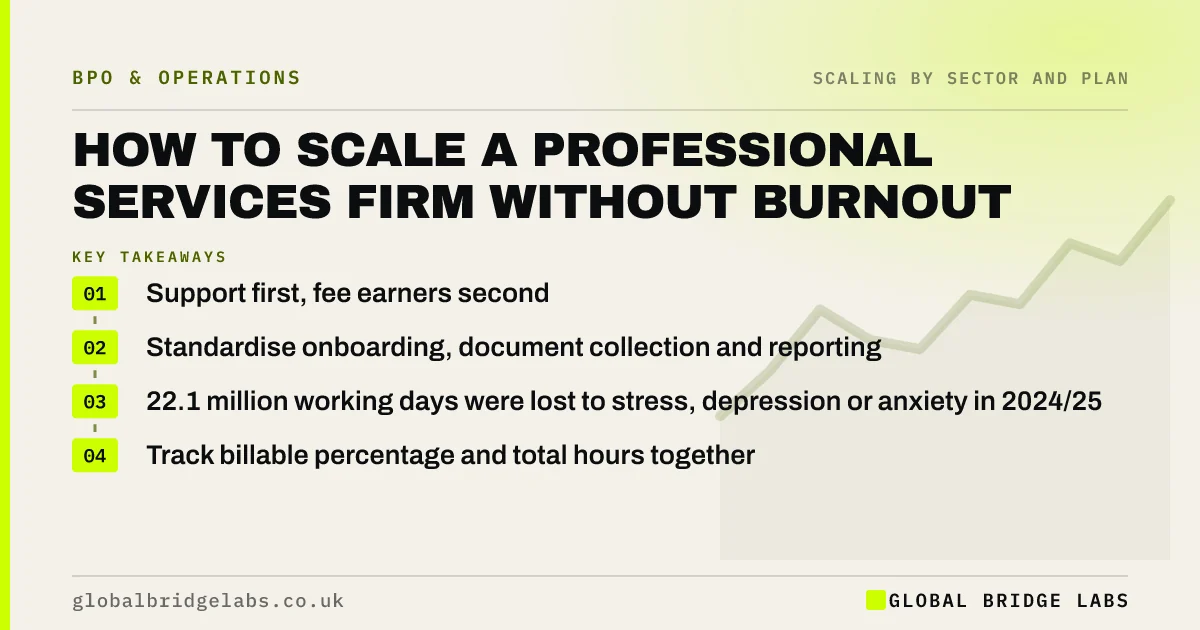
Key takeaways
To scale a professional services firm without burning people out, grow capacity around the fee earners before adding more of them. Move document chasing, scheduling, formatting and billing preparation to a managed support team, standardise the repeatable stages of each service, and track billable percentage alongside hours worked.
- Support first, fee earners second.
- Standardise onboarding, document collection and reporting.
- 22.1 million working days were lost to stress, depression or anxiety in 2024/25.
- Track billable percentage and total hours together.
Fee earners at capacity and still doing admin? Message us on WhatsApp with your team size.
Chat on WhatsApp →Why do professional firms burn out as they grow?
Professional firms burn out because revenue is tied to qualified people's hours and the first response to more work is longer days. The Health and Safety Executive reports that 22.1 million working days were lost to work-related stress, depression or anxiety in Great Britain in 2024/25. In a people business, that is lost capacity as well as a duty of care.
Where is the hidden capacity?
The hidden capacity is in the hours qualified staff spend on tasks that do not need their qualification. Chasing clients for information, booking meetings, formatting reports, entering data and preparing bills commonly take a day or more a week each. Recovering that time is quicker than recruiting.
Which work can a support team take?
A managed support team can take the administrative layer around client work. They follow written procedures, work in your practice systems with limited access and pass anything requiring professional judgement back to your staff.
- Client onboarding paperwork and document chasing.
- Diary management and meeting preparation.
- Data entry and record updates.
- Formatting of reports and standard letters.
- Billing preparation and payment chasing.
What about confidentiality and regulation?
Confidentiality and regulation set the boundaries. You remain responsible to clients and to your regulator for work done on your behalf. Use a written processor contract under UK GDPR, limit system access to what each task needs, and keep regulated advice and reserved activities with qualified staff. Check your professional body's guidance on outsourcing.
Want to discuss your requirements within your regulator's rules? Message us on WhatsApp.
Chat on WhatsApp →What does support capacity cost?
As indicative market ranges, managed offshore support costs £9–£18 per hour and onshore £20–£35 per hour. Compare that with a fee earner's charge-out rate. Each hour moved from admin to client work is worth the difference, provided there is client demand to fill it.
When should you recruit fee earners?
Recruit fee earners when billable percentage is already healthy, hours are reasonable and demand is still unmet. Hiring before fixing the support structure puts a new person into the same inefficient pattern. Hiring after it means they are productive sooner and more likely to stay.
What does this look like in practice?
A pattern we see in UK accountancy and advisory practices before deadlines: qualified staff work late chasing clients for records, then complete the actual work in a rush. A support team that starts chasing weeks earlier, on a schedule, flattens the peak. The same people do the same work with fewer late nights.
Professional services scaling checklist
Review these before the next recruitment round.
- Measure billable percentage and total hours per person.
- Log admin tasks done by qualified staff.
- Write procedures for onboarding and document collection.
- Create templates for standard deliverables.
- Set data access and confidentiality terms.
- Move admin to a support team and re-measure.
- Review workload and wellbeing each quarter.
Next step
Tell us your practice area, number of fee earners and typical billable percentage. We will estimate the capacity that support could release and what must stay with qualified staff.
Message us on WhatsApp for a practice capacity review, or book a 30-minute consultation.
Chat on WhatsApp →Sources and further reading
- Working days lost in Great Britain · Health and Safety Executive
- Work-related stress and how to manage it · Health and Safety Executive
- Contracts and liabilities between controllers and processors · Information Commissioner's Office
Frequently asked questions
How do you scale a professional services firm?
Scale a professional services firm by increasing the share of qualified staff time spent on client work, standardising the repeatable stages of each service, and using support staff or a managed team for administration. Add fee earners once existing ones are well supported and consistently busy.
Can accountants and solicitors outsource admin?
Yes, within professional and data protection rules. Administrative tasks such as document chasing, data entry, diary management and billing preparation are commonly outsourced. The firm remains responsible for the work and for client confidentiality, and regulated activities must stay with qualified people.
How do I reduce burnout in a growing firm?
Reduce burnout by removing work that does not need qualified staff, smoothing deadline peaks with earlier preparation, monitoring hours and workload, and adding capacity before people are overloaded. Employers have a duty to assess and manage the risk of work-related stress.
What is leverage in a professional services firm?
Leverage is the ratio of junior or support staff to senior fee earners. Higher leverage lets seniors focus on judgement and client relationships while others handle preparation and routine work. Support can come from employees or from a managed outside team.
Written by

Global Bridge Labs (GBL) is a UK–Sri Lanka partner for social media, websites and BPO. Everything here comes from client delivery, not theory.