On this page
- 01Key takeaways
- 02Why does an acquisition create admin pressure?
- 03What integration work can be outsourced?
- 04How does TUPE affect outsourcing after an acquisition?
- 05Should you centralise admin after the deal?
- 06What about data protection during integration?
- 07How do you keep customers during integration?
- 08When is outsourcing the wrong move after an acquisition?
- 09How long does integration workload last?
- 10What does this look like in practice?
- 11Post-acquisition checklist
- 12Next step
- 13Sources and further reading
- 14Frequently asked questions
Key takeaways
Outsourcing after an acquisition can absorb the extra workload of integration, such as migrating data, cleaning records and handling customer queries about the change, without stretching either team. Transferring staff are usually protected by TUPE, so outsourcing is best used for temporary integration work and new volume, not to replace transferred employees.
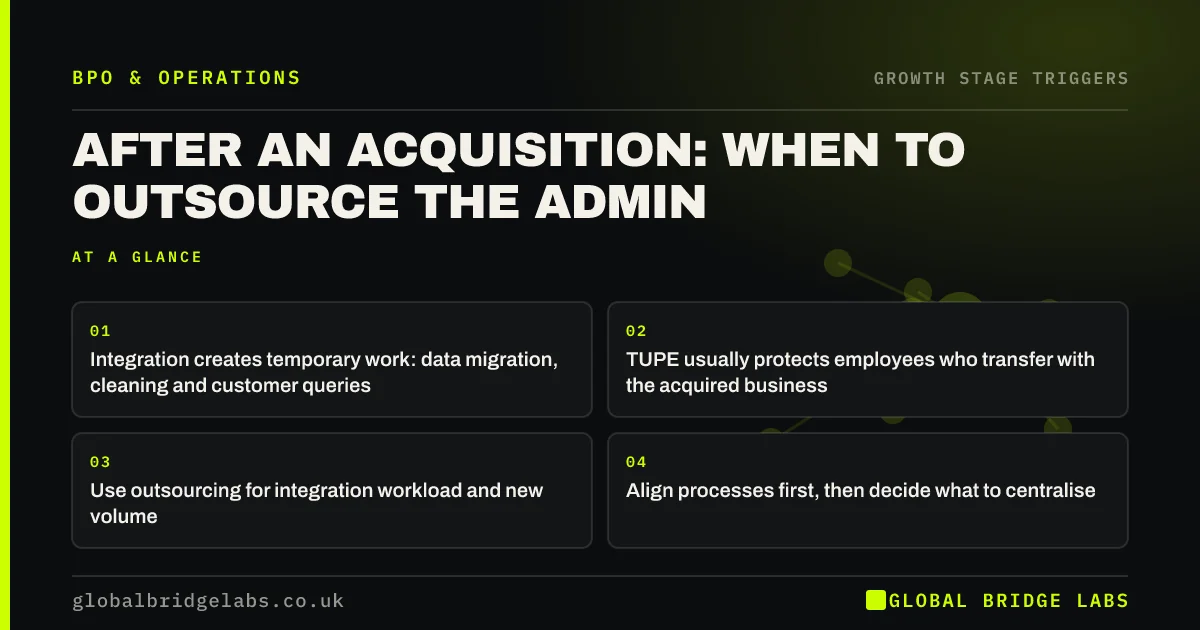
- Integration creates temporary work: data migration, cleaning and customer queries.
- TUPE usually protects employees who transfer with the acquired business.
- Use outsourcing for integration workload and new volume.
- Align processes first, then decide what to centralise.
Integrating an acquisition? Message us on WhatsApp with what needs merging.
Chat on WhatsApp →Why does an acquisition create admin pressure?
Because two businesses have two of everything: systems, customer records, supplier lists, invoicing processes and ways of answering customers. Integration adds a burst of work on top of normal operations, and it lands on the same people who are running both businesses day to day.
What integration work can be outsourced?
The repeatable, time-bound work: migrating and cleaning customer and supplier records, updating CRM data, sending and handling customer notifications, re-issuing documents and handling queries about the change. These are large for a few months and then disappear, which suits flexible capacity.
- Data migration and deduplication between systems.
- CRM clean-up and record updates.
- Customer notifications and query handling.
- Supplier and account detail changes.
Want a plan for your integration workload? Ask us on WhatsApp.
Chat on WhatsApp →How does TUPE affect outsourcing after an acquisition?
When a business or part of one is transferred, TUPE usually protects the employees who transfer, preserving their terms and continuity of employment. Separately, moving an activity carried out by employees to an outsourced provider can itself be a service provision change under TUPE. Take legal advice before changing any transferred roles.
Should you centralise admin after the deal?
Usually, once processes are aligned. First agree one way of doing each process, then decide where it sits: with one of the in-house teams, in a new shared team, or with an outsourced provider. Centralising before processes are aligned just moves two different ways of working into one place.
What about data protection during integration?
Customer data from the acquired business can generally be used for the purposes customers expected, but check privacy notices and any consents. Any provider helping with migration is a processor under UK GDPR and needs a written contract. Limit access to the records needed and remove it when the project ends.
How do you keep customers during integration?
Tell them what is changing, when, and whom to contact, and answer their questions quickly. Acquired customers are most likely to leave in the months after a deal, often because of confusion rather than dissatisfaction. Extra capacity for queries during the change protects the value you paid for.
When is outsourcing the wrong move after an acquisition?
When it would unsettle transferred staff before they trust the new owner, when processes have not been aligned, or when TUPE issues are unresolved. In those cases, use outsourcing only for clearly temporary project work and keep ongoing operations with the combined team until the picture is clear.
How long does integration workload last?
Most integration admin peaks in the first three to six months after completion. Data migration and customer notifications happen early; record clean-up, supplier changes and process alignment follow. Plan outsourced project capacity for that window with a clear end date, then decide separately whether any ongoing processes should stay outsourced.
- Months 1 to 2: customer notifications, queries and data migration.
- Months 2 to 4: record clean-up and supplier changes.
- Months 3 to 6: process alignment and system consolidation.
- Month 6: decide on ongoing operations.
What does this look like in practice?
A pattern we see in UK professional services firms acquiring a smaller practice: two CRMs, duplicated clients and hundreds of letters of engagement to re-issue. A managed team handles the migration, deduplication and client queries over three months, while both teams keep serving clients as normal.
Post-acquisition checklist
Use this in the first months after completion.
- List integration tasks and their duration.
- Take TUPE advice before changing any transferred roles.
- Align processes before centralising.
- Outsource temporary migration and query work.
- Put processor contracts in place for any provider.
- Tell customers what is changing and whom to contact.
Next step
Tell us what needs integrating and by when. We will suggest what could be outsourced as project work and what should stay with your teams.
Message us on WhatsApp about your integration, or book a 30-minute consultation.
Chat on WhatsApp →Sources and further reading
- Business transfers, takeovers and TUPE · GOV.UK
- Contracts and liabilities between controllers and processors · Information Commissioner's Office
- Lawful basis for processing personal data · Information Commissioner's Office
Frequently asked questions
Can you outsource work after acquiring a business?
Yes, particularly temporary integration work such as data migration, record clean-up and customer queries. Be careful with ongoing roles: employees who transfer are usually protected by TUPE, and moving their work to a provider can be a service provision change. Take legal advice first.
Does TUPE apply when you buy a business?
When a business or undertaking is transferred to a new owner, TUPE usually applies and employees transfer on their existing terms. A share purchase is different, because the employer does not change. Take advice on your specific deal.
How do you merge two back offices?
Agree one way of doing each process, move both businesses onto shared systems, then decide where each process sits: in-house, in a shared team or outsourced. Use extra capacity for the temporary migration workload so day-to-day service does not slip.
Written by

Global Bridge Labs (GBL) is a UK–Sri Lanka partner for social media, websites and BPO. Everything here comes from client delivery, not theory.