On this page
- 01Key takeaways
- 02What does online community management involve?
- 03How much does it cost to run a community?
- 04What rules does a community need?
- 05When is a community the wrong idea?
- 06What does this look like in practice?
- 07Community checklist
- 08Next step
- 09Sources and further reading
- 10Frequently asked questions
Key takeaways
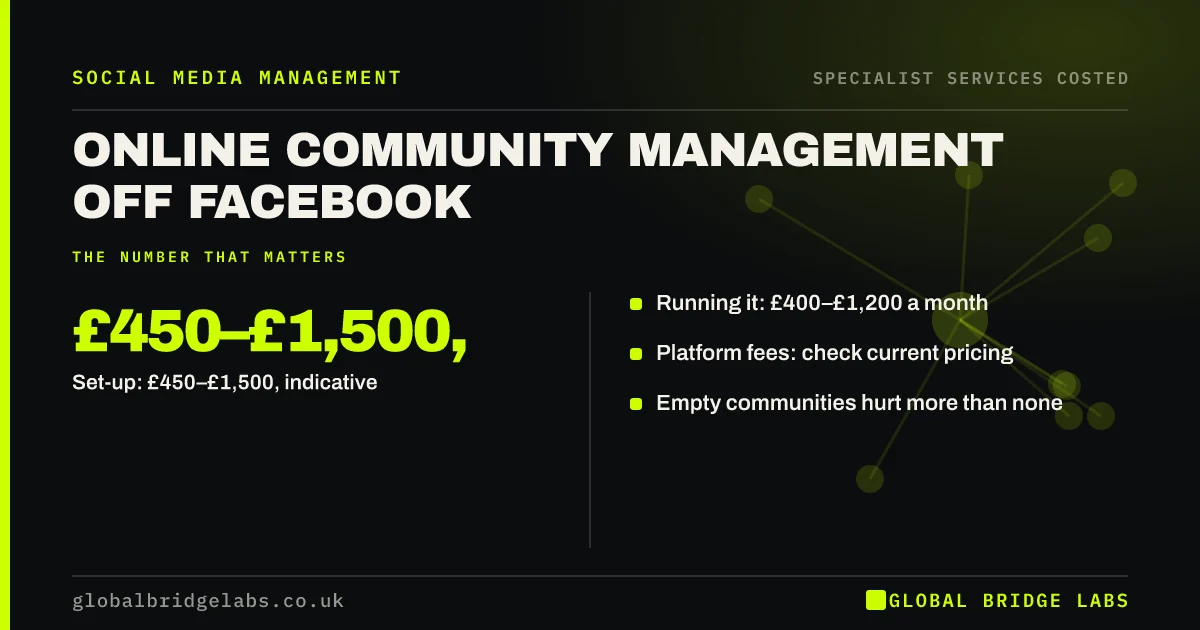
Online community management typically costs an indicative £450–£1,500 to set up a customer community on a platform such as Discord, Slack, Circle or WhatsApp (6 to 15 hours), then £400–£1,200 a month for 10 to 20 hours of moderation and activity at £40–£60 an hour. It suits brands whose customers want to talk to each other.
- Set-up: £450–£1,500, indicative.
- Running it: £400–£1,200 a month.
- Platform fees: check current pricing.
- Empty communities hurt more than none.
Thinking about a customer community? Message us on WhatsApp first.
Chat on WhatsApp →What does online community management involve?
Online community management is running a space where customers or members talk to each other and to you: setting up channels and rules, welcoming new members, starting conversations, answering questions, moderating problems and reporting activity. It differs from a Facebook Group mainly in platform and ownership of data.
How much does it cost to run a community?
Choosing the platform, setting up channels, rules and onboarding takes 6 to 15 hours, an indicative £450–£1,500. Running it at 10 to 20 hours a month at £40–£60 an hour costs £400–£1,200. Some platforms charge a monthly fee; check current pricing before committing.
- Set-up and rules: £450–£1,500.
- Moderation and activity: £400–£1,200 a month.
- Events or expert sessions: extra.
- Platform subscription: varies.
Tell us who would join your community on WhatsApp and we will discuss your requirements.
Chat on WhatsApp →What rules does a community need?
Clear rules on behaviour, advertising, personal data and what happens when they are broken. Moderators need guidance for removing harmful or defamatory posts. If members share personal information, your privacy notice must explain how it is used.
When is a community the wrong idea?
If customers buy once and have no reason to talk to each other, a community will stay empty, which looks worse than not having one. Communities suit software users, hobby brands, membership organisations, courses and professional networks where peers help each other.
What does this look like in practice?
A pattern we see: a brand opens a community, posts announcements and wonders why nobody talks. A weekly question, quick welcomes and inviting ten active customers first usually starts the conversations that keep others coming back.
Community checklist
- Confirm customers want to talk to each other.
- Choose one platform your members already use.
- Write and pin clear rules.
- Invite ten active members before launch.
- Post one question a week and welcome everyone.
Next step
Ask ten customers whether they would join and what they would want from it. Their answers decide whether to build.
Message us on WhatsApp for a community plan, or book a 30-minute consultation.
Chat on WhatsApp →Sources and further reading
- Lawful basis for processing personal data · Information Commissioner's Office
- Defamation Act 2013 · legislation.gov.uk
Frequently asked questions
How much does a community manager cost?
Outsourced community management typically costs £40–£60 an hour at UK agency rates, so 10 to 20 hours a month is about £400–£1,200. Set-up adds an indicative £450–£1,500.
Discord, Slack or a Facebook Group: which is best?
Choose the platform your members already use. Facebook Groups suit local and consumer audiences, Slack suits professionals and Discord suits gaming, tech and younger audiences. Dedicated platforms give more control but need members to adopt a new app.
How do you stop a community going quiet?
Welcome every new member, post one good question a week, highlight helpful members and run occasional events. Communities usually go quiet when the business stops showing up.
Written by

Global Bridge Labs (GBL) is a UK–Sri Lanka partner for social media, websites and BPO. Everything here comes from client delivery, not theory.