On this page
Key takeaways
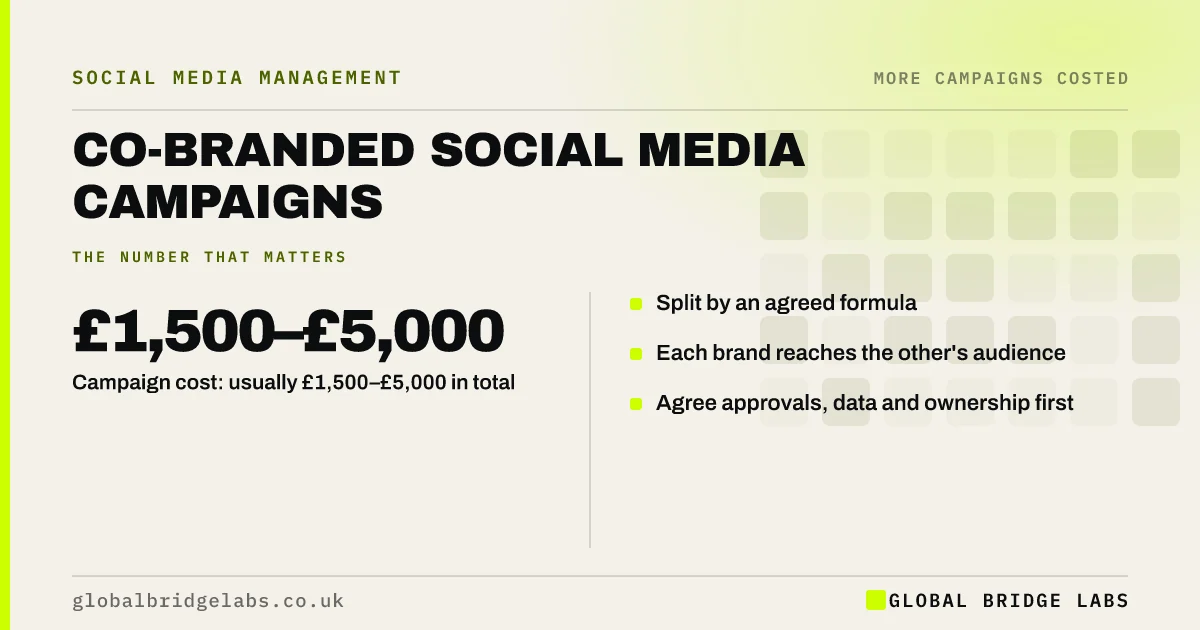
A co-branded social media campaign usually costs within the £1,500–£5,000 campaign band in total, split between the two brands by an agreed formula. Each side reaches the other's audience, so it can be cheaper than two separate campaigns. Agree costs, approvals, data and ownership in writing before any content is made.
- Campaign cost: usually £1,500–£5,000 in total.
- Split by an agreed formula.
- Each brand reaches the other's audience.
- Agree approvals, data and ownership first.
Planning a joint campaign? Message us on WhatsApp.
Chat on WhatsApp →What is a co-branded campaign?
A co-branded campaign is a joint promotion by two businesses that serve the same buyers without competing: a gym and a nutrition brand, an estate agent and a removals firm. Both promote shared content, an offer or an event to each other's followers.
How are costs usually split?
Common splits are 50/50, by audience size, or one brand paying for creation while the other pays for ads. Whatever the split, agree it in writing, along with who manages the work. Agency coordination between two brands adds time: often 2 to 4 hours, about £150–£400.
- 50/50 split: simplest.
- By audience size: fairer if unequal.
- Creation vs ads split: clear roles.
- Coordination: £150–£400 extra, indicative.
Tell us about your partner on WhatsApp and we will discuss your requirements.
Chat on WhatsApp →What must the partners agree?
Who approves content, how logos are used, who owns the content, how leads and customer data are shared under UK GDPR, how the offer is honoured and what happens if one side pulls out. Shared data needs clarity on who is the controller.
When is co-branding a poor idea?
When the partner's audience does not match your buyers, when one brand's reputation could harm the other, or when approvals across two businesses will stall the campaign. Test with one shared post before a full campaign.
What does this look like in practice?
A pattern we see: two businesses agree a joint campaign on a call, then argue over who owns the leads. A one-page agreement before starting usually prevents the dispute.
Co-branded campaign checklist
- Check audiences match your buyers.
- Agree the cost split in writing.
- Set one approval route.
- Agree lead and data sharing.
- Decide who owns the content.
Next step
List three non-competing businesses your buyers also use. One may be your best campaign partner.
Message us on WhatsApp for a partnership plan, or book a 30-minute consultation.
Chat on WhatsApp →Sources and further reading
- Controllers and processors · Information Commissioner's Office
- UK Code of Non-broadcast Advertising and Direct & Promotional Marketing (CAP Code) · ASA / CAP
Frequently asked questions
How do you split costs in a joint marketing campaign?
Common approaches are 50/50, by audience size, or by role, such as one brand paying for content and the other for ads. Agree the split in writing.
Who owns leads from a co-branded campaign?
Whoever the agreement says. Tell people clearly who will use their data, as UK GDPR requires, and agree whether leads are shared.
Is co-branding cheaper than running my own campaign?
Often, because costs are shared and each brand reaches a new audience. Coordination adds some time, so keep the plan simple.
Written by

Global Bridge Labs (GBL) is a UK–Sri Lanka partner for social media, websites and BPO. Everything here comes from client delivery, not theory.