On this page
- 01Key takeaways
- 02What should a clinic post?
- 03Which advertising rules apply?
- 04How do you handle patient images and stories?
- 05Which dates matter for clinics?
- 06When should a clinic post less?
- 07What does this look like in practice?
- 08Clinic calendar checklist
- 09Next step
- 10Sources and further reading
- 11Frequently asked questions
Key takeaways
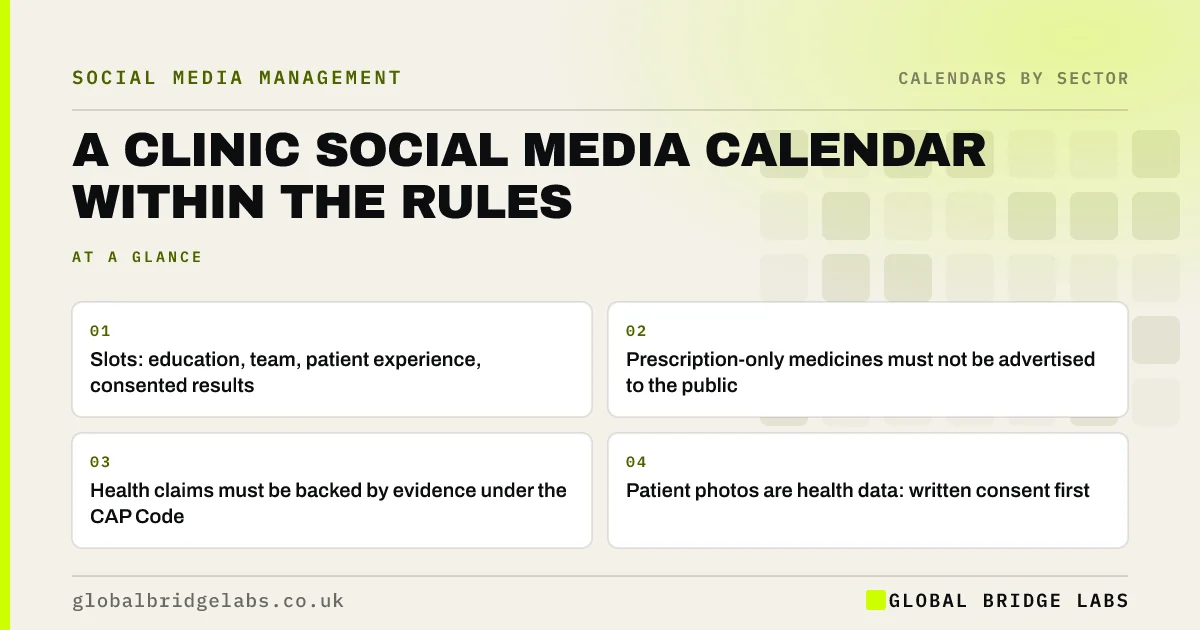
A clinic social media calendar has to build trust within strict rules. Plan slots for education (what a treatment involves and who it suits), the clinical team and their qualifications, the patient experience, and occasional consented results. Check every month's posts for health claims, and never promote prescription-only medicines such as Botox to the public.
- Slots: education, team, patient experience, consented results.
- Prescription-only medicines must not be advertised to the public.
- Health claims must be backed by evidence under the CAP Code.
- Patient photos are health data: written consent first.
Want a clinic calendar that stays within the rules? Message us on WhatsApp.
Chat on WhatsApp →What should a clinic post?
Four slots suit most clinics, dental practices and physios: education that explains treatments, risks and who they are and are not for; the team, with their qualifications; the patient experience, such as what a first appointment is like; and, occasionally, results with explicit consent and honest context. Booking posts sit alongside them.
Which advertising rules apply?
Prescription-only medicines, including botulinum toxin such as Botox, must not be advertised to the public, so promote consultations rather than the medicine. Health and efficacy claims must be backed by evidence under the CAP Code. Before-and-after images must not be edited or filtered in a way that exaggerates results.
How do you handle patient images and stories?
Photos and stories about a patient's health are special category data under UK GDPR, so get explicit written consent that covers social media, keep a record, and remove posts if consent is withdrawn. Never reply to a patient's comment with details of their treatment; move the conversation to a private, secure channel.
Which dates matter for clinics?
Relevant awareness weeks for your specialty, January health goals, pre-summer and pre-wedding season for aesthetics, and back-to-school for family dental practices. Use awareness weeks to educate, not to sell. Plan opening hours around bank holidays and Christmas.
When should a clinic post less?
Post less when nobody has time to check claims and consent properly. In a regulated field, three careful posts a month are better than twelve risky ones. Get an experienced reviewer to check anything about a new treatment.
What does this look like in practice?
A pattern with aesthetics clinics: offers on named prescription medicines and filtered results, which risk complaints and removal. Moving to consultations, education and consented, unfiltered results usually keeps the account safe and still brings bookings.
Clinic calendar checklist
- Plan education, team, experience and results slots.
- Promote consultations, not prescription medicines.
- Check every claim for evidence.
- Get written consent for patient images.
- Move clinical questions to private channels.
Next step
Review last month's posts for any named prescription medicine, unproven claim or filtered result, and fix or remove them before planning next month.
Message us on WhatsApp and we will check your clinic's posts, or book a 30-minute consultation.
Chat on WhatsApp →Sources and further reading
- UK Code of Non-broadcast Advertising and Direct & Promotional Marketing (CAP Code) · ASA / CAP
- Special category data · Information Commissioner's Office
- Regulations for service providers and managers · Care Quality Commission
Frequently asked questions
What can a clinic post on social media?
Education about treatments and who they suit, the clinical team and their qualifications, what the patient experience is like, and results with explicit written consent and honest context. Promote consultations rather than prescription-only medicines.
Can I advertise Botox on social media in the UK?
No. Botox is a prescription-only medicine, and those must not be advertised to the public. Clinics can promote consultations and explain that treatment options will be discussed, without naming or promoting the medicine itself.
Can clinics post patient before and after photos?
Only with explicit written consent that covers social media, because they are health data. Images must not be filtered or edited to exaggerate results, and posts should be removed if a patient withdraws consent.
Written by

Global Bridge Labs (GBL) is a UK–Sri Lanka partner for social media, websites and BPO. Everything here comes from client delivery, not theory.