On this page
- 01Key takeaways
- 02What is an agency test budget?
- 03How should tests be set up?
- 04How do test budgets get value from a premium agency?
- 05When should you increase the test budget?
- 06When should you keep it small?
- 07What does this look like in practice?
- 08Test budget checklist
- 09Next step
- 10Sources and further reading
- 11Frequently asked questions
Key takeaways
A test budget is a set share of your social media spend, often around a tenth, kept for trying new formats, channels or ideas. It lets a premium agency use its creativity without risking your core results. Agree what each test should learn, how it will be measured and what happens to winners.
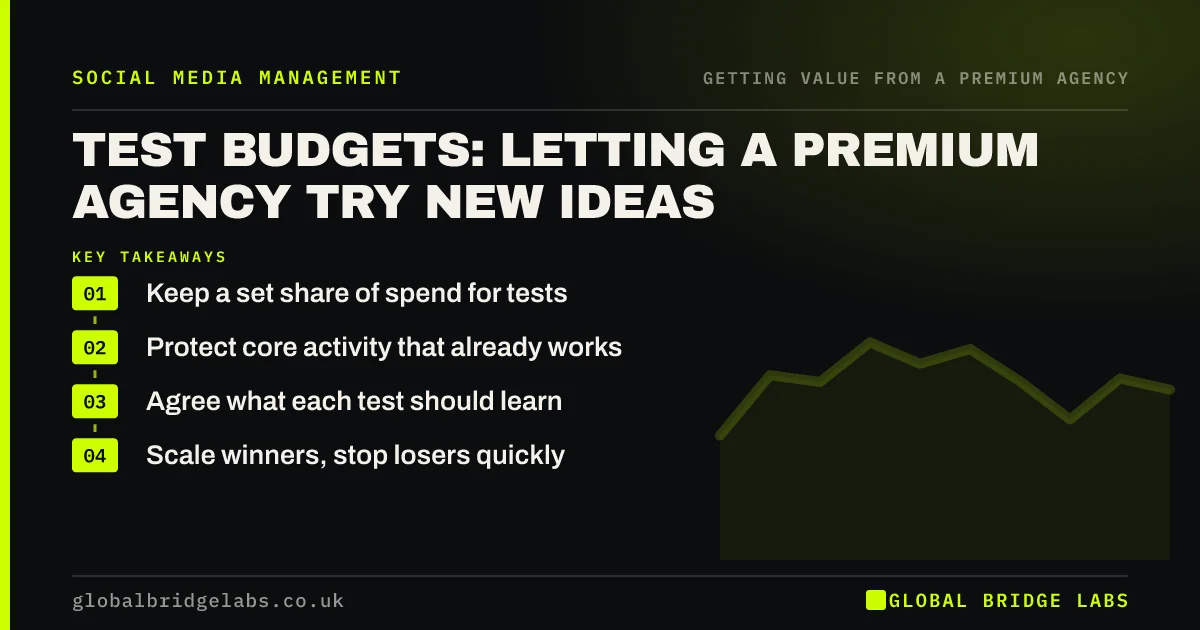
- Keep a set share of spend for tests.
- Protect core activity that already works.
- Agree what each test should learn.
- Scale winners, stop losers quickly.
Want help setting up a test budget with your agency? Message us on WhatsApp.
Chat on WhatsApp →What is an agency test budget?
A test budget is money set aside for experiments: new formats, platforms, audiences, offers or creative ideas. Keeping it separate protects proven activity while giving the agency room to find better approaches. Many businesses keep roughly a tenth of their social media budget for tests.
How should tests be set up?
Each test needs a question, such as whether short video brings more enquiries than images, a simple measure, a set budget and duration and a decision rule for what happens next. Small, clear tests teach more than vague experiments.
- A clear question.
- A simple measure.
- A fixed budget and time.
- A decision rule.
How do test budgets get value from a premium agency?
Premium agencies are often paid for ideas and expertise. A test budget lets them try ideas safely and prove which work before you invest more. It focuses creativity on learning, rather than on one big untested campaign.
Want help planning your first tests? Message us on WhatsApp and we will discuss your requirements.
Chat on WhatsApp →When should you increase the test budget?
Increase it when tests regularly find improvements, when your market changes quickly or when core results have plateaued and new approaches are needed.
When should you keep it small?
Keep it small when budgets are tight, when core activity still needs fixing or when your audience is too small for clear test results. In those cases, a single well-designed test each quarter is better than several rushed ones that never reach a clear answer.
What does this look like in practice?
A pattern we see: a client tests short video on a new platform with a small budget for six weeks. It brings cheaper enquiries, so the budget moves there, while a second test that failed is stopped quickly.
Test budget checklist
- Set aside a fixed share for tests.
- Write the question for each test.
- Agree measures and duration.
- Set decision rules in advance.
- Record what each test taught.
Next step
Agree one test with your agency for next month, with a question, budget and measure.
Message us on WhatsApp for a test plan, or book a 30-minute consultation.
Chat on WhatsApp →Sources and further reading
- Meta Business Help Centre · Meta
- About key events · Google Analytics Help
- Minimise A/B testing impact in Google Search · Google Search Central
Frequently asked questions
How much should I spend on social media tests?
Many businesses set aside around a tenth of their social media budget for tests, adjusting for size and goals. Enough budget is needed to get meaningful results, so very small budgets may need longer tests or fewer, bigger experiments rather than many small ones.
What should I test on social media first?
Start with things most likely to change results: the offer, the opening hook, the content format and the audience. Test one thing at a time where possible. Avoid testing tiny details until bigger questions are answered, because small changes need larger audiences to show clear differences.
How long should a social media test run?
Long enough to gather meaningful results, often two to six weeks depending on budget and audience size. Paid tests can conclude faster than organic ones. Set the duration before starting, and avoid stopping early just because the first few days look good or bad.
Written by

Global Bridge Labs (GBL) is a UK–Sri Lanka partner for social media, websites and BPO. Everything here comes from client delivery, not theory.