On this page
- 01Key takeaways
- 02Should you have one contact at your agency or several?
- 03Who should be your business's contact?
- 04How should communication with an agency be organised?
- 05When is a single contact essential?
- 06When should you open up direct access?
- 07What does this look like in practice?
- 08Communication checklist
- 09Next step
- 10Sources and further reading
- 11Frequently asked questions
Key takeaways
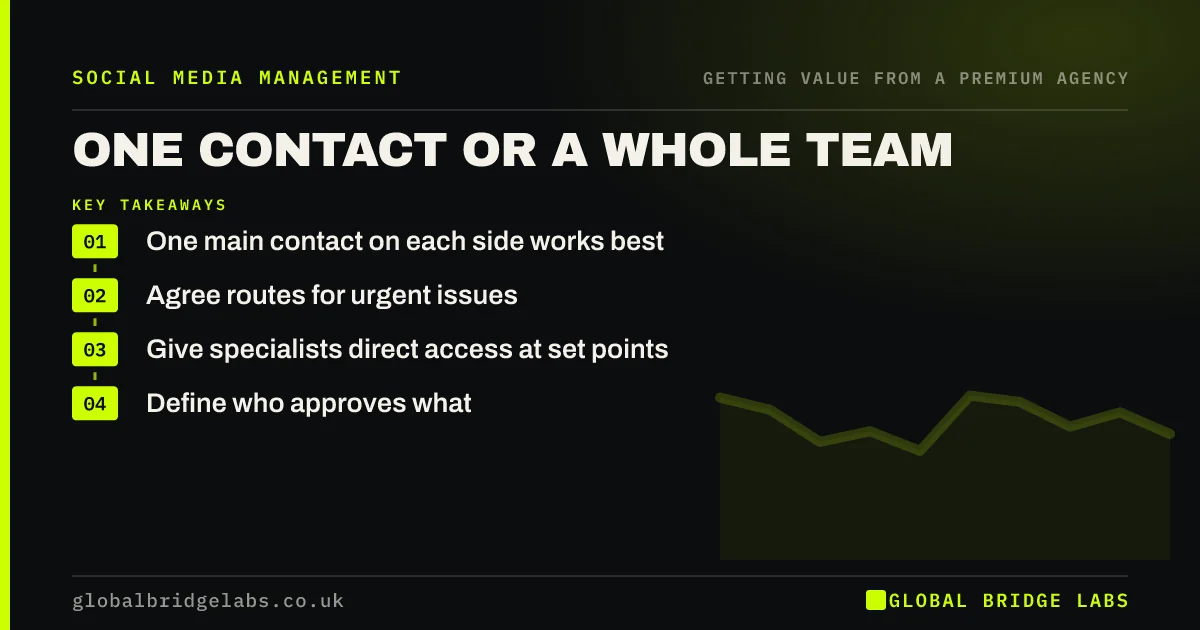
Most businesses work best with a single point of contact on each side, plus agreed routes for urgent issues and specialist questions. One contact keeps decisions consistent and avoids conflicting instructions. Direct access to specialists, such as the strategist, is useful at set points. Agree channels, response times and who approves what.
- One main contact on each side works best.
- Agree routes for urgent issues.
- Give specialists direct access at set points.
- Define who approves what.
Want a simple communication plan for your agency? Message us on WhatsApp.
Chat on WhatsApp →Should you have one contact at your agency or several?
Usually one main contact, typically the account manager, with clear access to specialists when needed. A single contact keeps priorities consistent and ensures someone owns your account. Several contacts can work for large accounts, but only with clear roles and shared notes.
Who should be your business's contact?
Choose one person who understands your goals, can make day-to-day decisions and has time to respond quickly. Give them a deputy for absences. Senior decision-makers should join reviews but not every conversation.
- One owner with authority and time.
- A named deputy.
- Senior people at reviews.
How should communication with an agency be organised?
Agree channels for routine work, approvals and urgent issues, expected response times, a weekly or fortnightly check-in and monthly and quarterly reviews. Keep decisions written in one shared place so both sides can see what was agreed.
Want help setting up a communication rhythm? Message us on WhatsApp and we will discuss your requirements.
Chat on WhatsApp →When is a single contact essential?
A single contact is essential when several people in your business have opinions on social media, which otherwise leads to conflicting feedback and delays. It also gives the agency one person to learn from, so its understanding of your business builds faster.
When should you open up direct access?
Open direct access for specialists such as paid media or video during campaigns, and for senior contacts during escalation, while keeping one owner for overall direction. Copy the main contact into specialist conversations so decisions stay visible and nothing is agreed that the owner does not know about.
What does this look like in practice?
A pattern we see: three managers send separate feedback to an agency, causing delays. Naming one approver with a deputy cuts approval times dramatically.
Communication checklist
- Name one main contact each side.
- Name deputies for absences.
- Agree channels and response times.
- Keep decisions in one place.
- Book regular check-ins and reviews.
Next step
Write down who approves posts in your business. If it is more than one person, choose one owner.
Message us on WhatsApp for a communication plan, or book a 30-minute consultation.
Chat on WhatsApp →Sources and further reading
- Consumer Contracts (Information, Cancellation and Additional Charges) Regulations 2013 · legislation.gov.uk
- What are the Management Standards for work-related stress? · Health and Safety Executive
- Contracts and liabilities between controllers and processors · Information Commissioner's Office
Frequently asked questions
How often should I speak to my social media agency?
Most businesses have a brief weekly or fortnightly check-in for upcoming content and approvals, a monthly results review and a quarterly strategy review. Urgent issues need a faster route. Agree the rhythm at the start so both sides know when decisions happen.
What channel should I use to talk to my agency?
Use one agreed channel for routine work, such as email or a shared project tool, and a faster route, such as a messaging app or phone, for urgent issues. Mixing many channels causes lost messages. Keep decisions recorded somewhere both sides can find them later.
What if several people in my business want input?
Collect their views internally and pass consolidated feedback through one contact. This avoids conflicting instructions and delays. Invite key stakeholders to quarterly reviews, where broader input is genuinely useful, rather than to the day-to-day approval of individual posts and replies.
Written by

Global Bridge Labs (GBL) is a UK–Sri Lanka partner for social media, websites and BPO. Everything here comes from client delivery, not theory.