On this page
- 01Key takeaways
- 02Where does a social media fee go?
- 03Why is the hourly rate higher than a salary?
- 04Why should you want your agency to make a profit?
- 05When is the margin too high?
- 06What does this look like in practice?
- 07Fee breakdown checklist
- 08Next step
- 09Sources and further reading
- 10Frequently asked questions
Key takeaways
Most of a social media agency fee pays for people's time, then tools, overheads and the time no client pays for, such as sales and admin. Profit is what remains, and it varies widely by agency. A healthy margin is in your interest: it keeps good staff and keeps the agency around. Judge value on hours and results, not on margin.
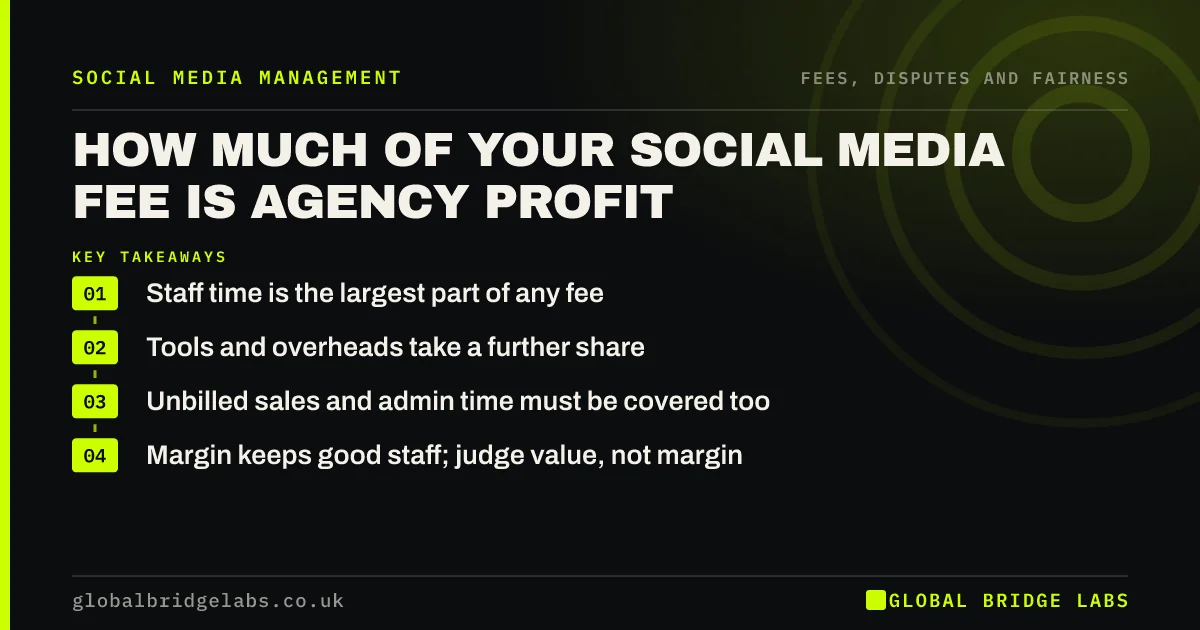
- Staff time is the largest part of any fee.
- Tools and overheads take a further share.
- Unbilled sales and admin time must be covered too.
- Margin keeps good staff; judge value, not margin.
Want to see where a quote's money goes? Message us on WhatsApp.
Chat on WhatsApp →Where does a social media fee go?
A retainer pays for the hours of the people on your account, plus employer costs such as National Insurance and pensions, the software they use, premises, management, sales time spent winning clients, holidays and sickness, and finally profit. Only part of each employee's week can be billed to clients.
Why is the hourly rate higher than a salary?
Illustratively, a £35,000 employee costs about £40,363 a year, or £23.20 per worked hour. Not every worked hour can be billed, and the agency must also pay for tools, managers and premises. That is why a blended agency rate of £75–£100 an hour sits well above the salary.
- Employee cost: about £23.20 an hour on £35,000.
- Billable share: less than every worked hour.
- Tools, managers and premises: on top.
- Blended agency rate: £75–£100 an hour.
Send us your quote on WhatsApp and we will discuss your requirements.
Chat on WhatsApp →Why should you want your agency to make a profit?
An agency that underprices burns out its staff, cuts corners or closes. A sustainable margin pays for experienced people, training and time to think about your account. Very cheap quotes often mean the margin is being taken from the hours spent on you.
When is the margin too high?
You cannot see an agency's margin, but you can see signs: a senior pitch team then a junior who never appears, little time on your account, and a fee that stays fixed while work shrinks. Ask for hours by role and compare outputs over time.
What does this look like in practice?
A pattern we see: a buyer pushes an agency's fee down hard, and the account is quietly handed to the most junior person. Agreeing the hours and seniority in writing usually protects quality better than negotiating the headline fee.
Fee breakdown checklist
- Ask for hours by role each month.
- Check who actually works on your account.
- Compare the hourly rate across quotes.
- Be wary of quotes far below others.
- Judge on results and output, not margin.
Next step
Divide your monthly fee by the hours your agency says it spends. If you cannot, ask for the hours.
Message us on WhatsApp for a fee check, or book a 30-minute consultation.
Chat on WhatsApp →Sources and further reading
- Rates and thresholds for employers 2026 to 2027 · HM Revenue & Customs
- Employee earnings in the UK (Annual Survey of Hours and Earnings) · Office for National Statistics
Frequently asked questions
What profit margin do marketing agencies make?
It varies widely by size, model and efficiency, and few agencies publish it. More useful for a buyer is the hourly rate, the hours spent and who does them, since those decide value.
Why is an agency's hourly rate so much higher than staff pay?
Because the rate must also cover employer costs, unbillable time, tools, premises, management and profit. A £35,000 employee costs about £23.20 per worked hour, but only part of their week is billable.
Is a cheap agency a good deal?
Not always. Very low fees often mean fewer hours, junior staff or templated work. Compare hours, seniority and examples rather than headline price.
Written by

Global Bridge Labs (GBL) is a UK–Sri Lanka partner for social media, websites and BPO. Everything here comes from client delivery, not theory.