On this page
- 01Key takeaways
- 02What is social media training?
- 03How much does training cost?
- 04What should good training cover?
- 05When is training better than an agency?
- 06When is training the wrong answer?
- 07What rules should training include?
- 08How do you make training stick?
- 09What does this look like in practice?
- 10Training buying checklist
- 11Next step
- 12Sources and further reading
- 13Frequently asked questions
Key takeaways
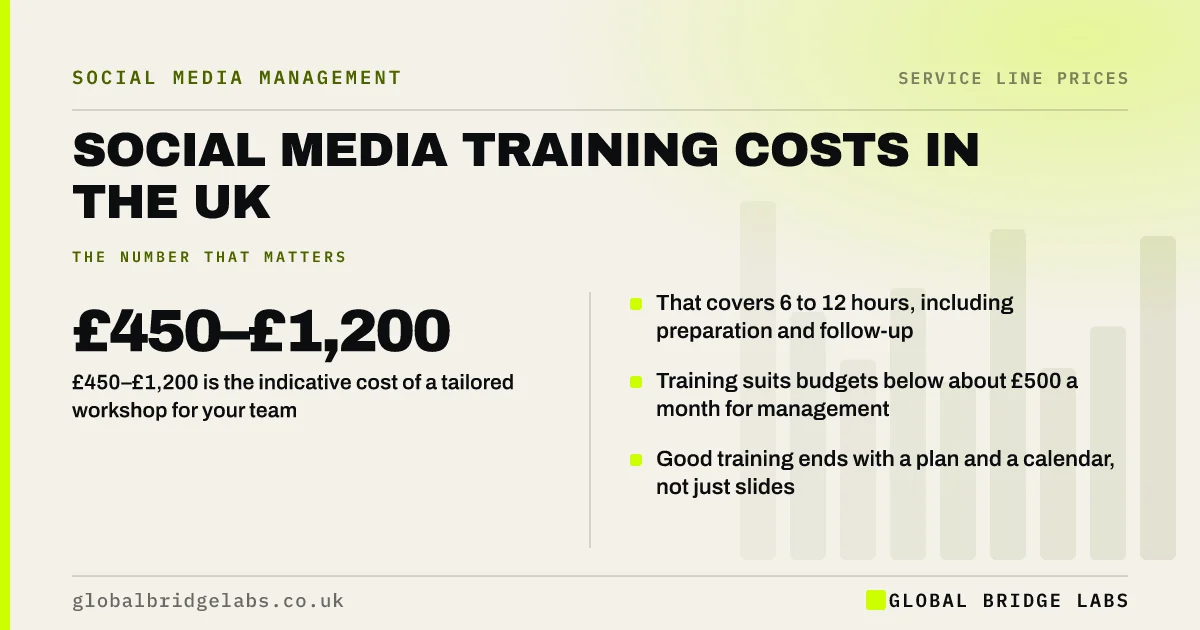
Social media training cost in the UK is indicatively £450–£1,200 for a tailored half-day or full-day workshop, based on 6 to 12 hours including preparation. For a business with under about £500 a month to spend, training plus a clear plan is often better value than an agency.
- £450–£1,200 is the indicative cost of a tailored workshop for your team.
- That covers 6 to 12 hours, including preparation and follow-up.
- Training suits budgets below about £500 a month for management.
- Good training ends with a plan and a calendar, not just slides.
Want your team trained to run social media properly? Message us on WhatsApp.
Chat on WhatsApp →What is social media training?
Social media training is a structured session, usually a half-day or day, that teaches an owner or team how to plan, produce, publish and measure social media for their own business. Tailored training uses your accounts and your customers as the working examples.
How much does training cost?
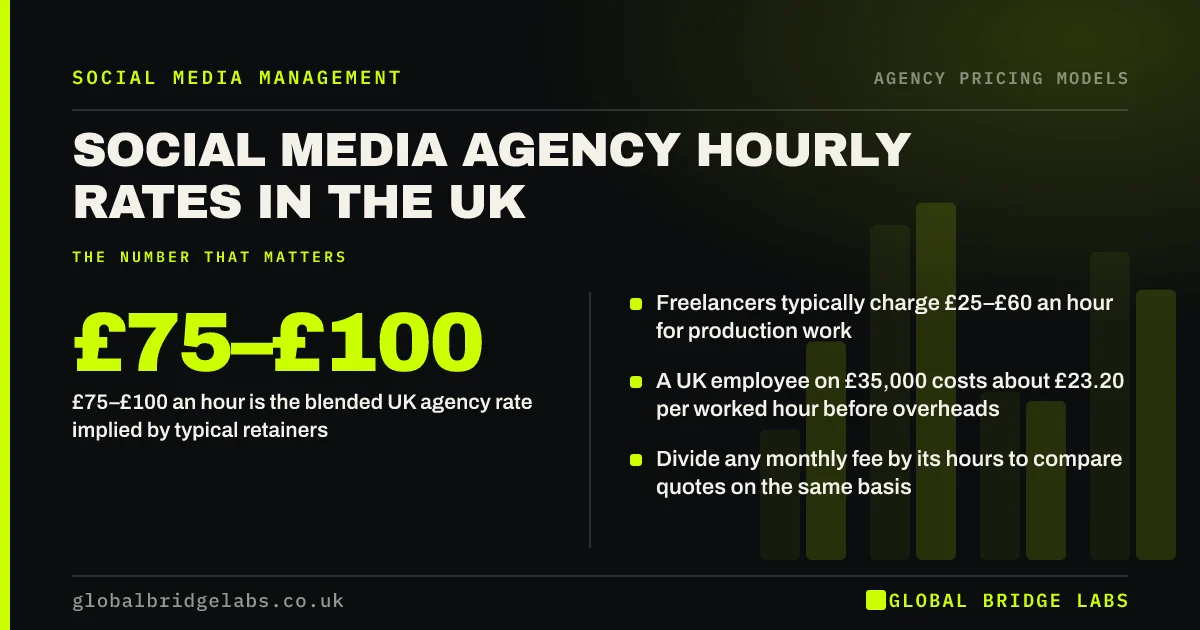
Tailored training is priced on the trainer's time. At the £75–£100 an hour implied by typical UK retainers, a half-day with preparation is about 6 hours, or £450–£600, and a full day with preparation and follow-up about 12 hours, or £900–£1,200. Public courses cost less per person. These are indicative figures.
- Tailored half-day workshop: indicative £450–£600.
- Tailored full day with follow-up: indicative £900–£1,200.
- One-to-one coaching: priced by the hour.
- Public group courses: lower cost, generic content.
Want a session built around your accounts? Send us your team size on WhatsApp and we will discuss your requirements.
Chat on WhatsApp →What should good training cover?
Good training covers decisions, not features. It should leave your team with a goal, two channels, content pillars, a weekly routine, a way to handle replies and a simple monthly review. If it is a tour of buttons, the platform's own help pages do that for free.
- Goal and measures for your business.
- Channel choice and content pillars.
- A weekly routine and batching method.
- Replies, complaints and escalation.
- Advertising rules and data protection basics.
- A 30-minute monthly review.
When is training better than an agency?
Training is better when the budget for management is below about £500 a month, when someone in the business has six or so hours a week, and when the content depends on being on site. At that budget an agency can only schedule, and a trained team member does more.
When is training the wrong answer?
Training is the wrong answer when nobody has the hours afterwards. Knowledge without time produces a good first month and then silence. If the person trained is already at capacity, pay for production instead and keep strategy and approvals in-house.
What rules should training include?
Training should cover the Advertising Standards Authority (ASA) requirement that ads are clearly identifiable, the rules on reviews and endorsements, and the basics of UK GDPR for photos and messages. Staff who post for the business need to know these before they publish.
How do you make training stick?
Training sticks when it ends with a routine and someone checks it. Leave the session with a weekly schedule, a month of planned posts and a review date. A follow-up call four weeks later, to look at what was published and what happened, protects the value of the day.
- A weekly routine in the diary.
- A month of posts planned before the session ends.
- A named owner and a deputy.
- A follow-up review after four weeks.
What does this look like in practice?
A pattern we see with UK owner-managed firms on small budgets: a strategy session and a training day set up the office manager to run one channel well. Some later hand production to a managed service once the workload grows, keeping the strategy they built.
Training buying checklist
Ask the trainer these before booking.
- Is the session built around our accounts?
- What will we have at the end: plan, calendar, templates?
- Is follow-up support included?
- Does it cover advertising rules and data protection?
- Who in our team needs to attend?
Next step
Tell us who would run social media in your business and how many hours a week they have. We will say whether training or a managed service fits better.
Message us on WhatsApp about social media training, or book a 30-minute consultation.
Chat on WhatsApp →Sources and further reading
- Recognising ads: social media and influencer marketing · ASA / CAP
- Direct marketing and privacy and electronic communications · Information Commissioner's Office
- Employee earnings in the UK (Annual Survey of Hours and Earnings) · Office for National Statistics
Frequently asked questions
How much does social media training cost in the UK?
As an indication, £450–£600 for a tailored half-day and £900–£1,200 for a full day with preparation and follow-up. Public group courses cost less per person but use generic examples instead of your own accounts. Ask whether follow-up support is included in the price.
Is social media training worth it for a small business?
Yes, when someone has the time to apply it. For budgets below about £500 a month, training plus a clear plan usually achieves more than a publishing-only package, because the person posting knows the business. It works when the person trained has protected time each week.
How long does social media training take?
A half-day covers one channel and a weekly routine. A full day covers strategy, two channels, replies and measurement. A short follow-up call a month later helps the team keep the routine going. Ask for the slides and templates to keep afterwards.
Should training include advertising rules?
Yes. Anyone posting for a business should know that ads must be clearly identifiable under the ASA's rules, that reviews must be genuine, and how UK GDPR applies to photos of people and customer messages. A short written policy helps the rules stick.
Written by

Global Bridge Labs (GBL) is a UK–Sri Lanka partner for social media, websites and BPO. Everything here comes from client delivery, not theory.