On this page
- 01Key takeaways
- 02What is the difference between a quote and an estimate?
- 03When can the price change?
- 04Which is better for a buyer?
- 05When is a fixed quote unrealistic?
- 06What does this look like in practice?
- 07Quote or estimate checklist
- 08Next step
- 09Sources and further reading
- 10Frequently asked questions
Key takeaways
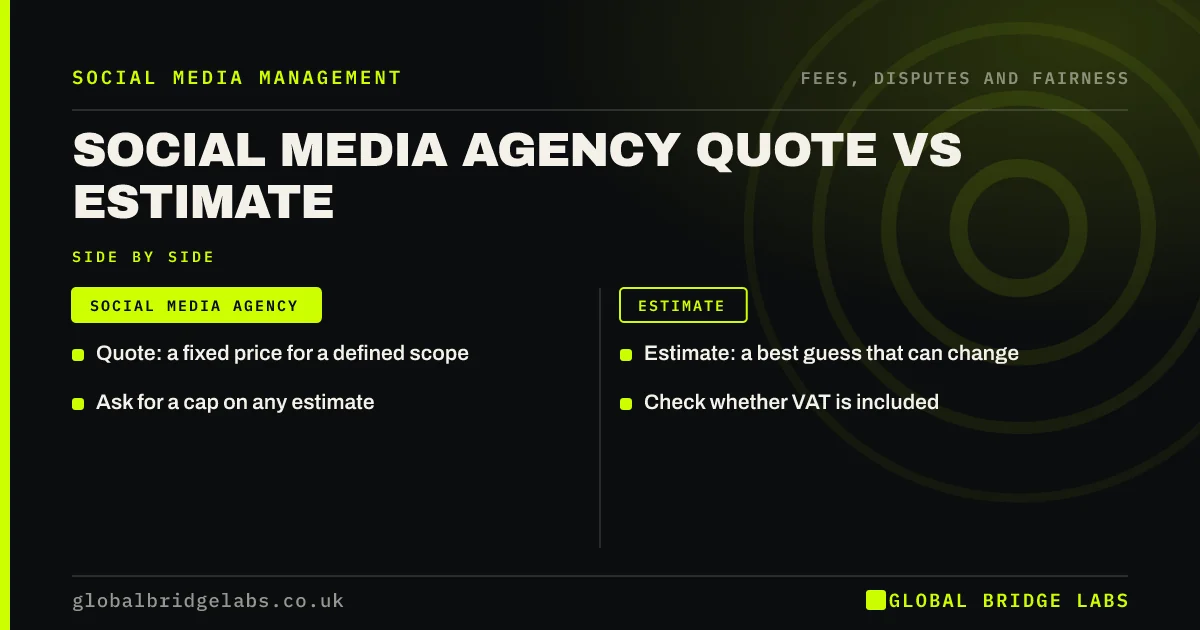
A social media agency quote is usually a fixed price for a defined scope, while an estimate is a best guess that may change. If you accept a quote, the agency should not charge more unless the scope changes. An estimate allows variation, so ask for a cap. Check whether figures include VAT.
- Quote: a fixed price for a defined scope.
- Estimate: a best guess that can change.
- Ask for a cap on any estimate.
- Check whether VAT is included.
Unsure whether your agency gave a quote or an estimate? Message us on WhatsApp.
Chat on WhatsApp →What is the difference between a quote and an estimate?
A quote is a firm offer to do specified work for a specified price; once accepted, it is generally binding for that scope. An estimate is an informed guess, often for work whose size is uncertain, such as fixing a messy ad account. The wording on the document matters.
When can the price change?
Under a quote, when you change the scope: more posts, extra platforms, urgent turnarounds or extra revision rounds. Under an estimate, when the work proves bigger than expected, ideally only after the agency warns you. Agree that any change needs your written approval first.
- Quote: changes only with scope changes.
- Estimate: may move, ideally with a cap.
- Extras: written approval before work.
- Rush work: priced separately.
Send us the document on WhatsApp and we will discuss your requirements.
Chat on WhatsApp →Which is better for a buyer?
A quote gives certainty and suits defined work such as a monthly retainer or a set campaign. An estimate suits uncertain work, but only with a cap and regular updates. If the work is clear, ask for a quote.
When is a fixed quote unrealistic?
For audits of accounts nobody has looked at, recovery work after a hack, or projects that depend on your team's speed. Forcing a fixed price there leads agencies to pad the quote. A capped estimate with a check-in point is fairer.
What does this look like in practice?
A pattern we see: an estimate for a set-up runs well over because tracking is broken. Agreeing a check-in after the first few hours, with a revised figure before carrying on, usually avoids surprise invoices.
Quote or estimate checklist
- Check the document says quote or estimate.
- Confirm scope is listed item by item.
- Ask for a cap on any estimate.
- Check VAT is shown clearly.
- Require written approval for changes.
Next step
Look at your last agency document. If it says estimate and has no cap, ask for one before work starts.
Message us on WhatsApp for a quote check, or book a 30-minute consultation.
Chat on WhatsApp →Sources and further reading
Frequently asked questions
Is a quote from an agency legally binding?
Once you accept it, a quote for defined work at a fixed price generally forms the basis of the contract. The agency can charge more if you change the scope. Keep the accepted quote and any changes in writing.
Can an agency charge more than the estimate?
An estimate can change, but a fair agency warns you before going over and explains why. Agree a cap or check-in point at the start so increases need your approval.
Do agency quotes include VAT?
Not always. Business quotes are often shown excluding VAT. If the agency is VAT-registered, 20% will be added, so check the document states clearly whether VAT is included.
Written by

Global Bridge Labs (GBL) is a UK–Sri Lanka partner for social media, websites and BPO. Everything here comes from client delivery, not theory.