On this page
- 01Key takeaways
- 02What is a key personnel clause?
- 03What should the clause include?
- 04What will agencies reasonably agree?
- 05When is a key personnel clause most important?
- 06When is it less necessary?
- 07What does this look like in practice?
- 08Key personnel checklist
- 09Next step
- 10Sources and further reading
- 11Frequently asked questions
Key takeaways
A key personnel clause names the people who will work on your account and requires the agency to give notice, consult you and provide equivalent replacements if they change. It protects the experience you paid for. Agencies cannot stop people leaving, but they can commit to notice, handover and replacement standards.
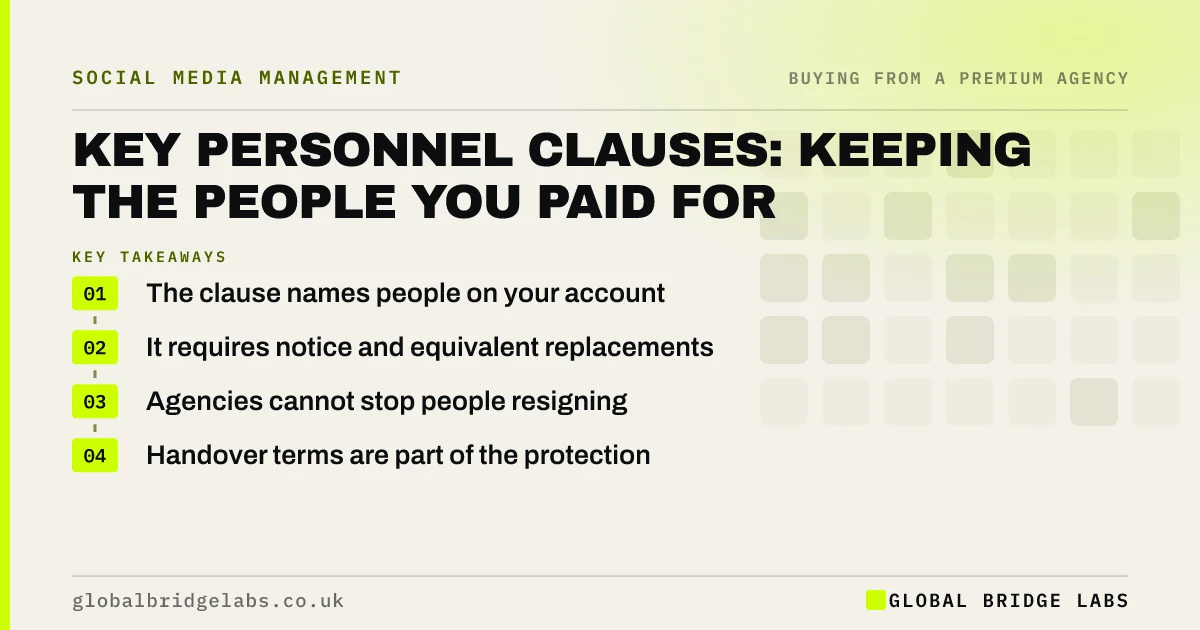
- The clause names people on your account.
- It requires notice and equivalent replacements.
- Agencies cannot stop people resigning.
- Handover terms are part of the protection.
Want a key personnel clause for your agency contract? Message us on WhatsApp.
Chat on WhatsApp →What is a key personnel clause?
A key personnel clause is a contract term naming specific people who will work on your account and setting rules if they change. It typically requires notice, consultation, replacements of similar seniority and a proper handover. It turns promises made in the pitch into contract commitments.
What should the clause include?
It should include the named people and roles, their minimum time on your account, notice of any change, your right to meet replacements, a commitment to similar experience and a handover process. Some clauses allow you to end the contract if key people leave.
- Named people, roles and time.
- Notice and consultation on changes.
- Equivalent replacements.
- A documented handover.
What will agencies reasonably agree?
Most agencies will agree to name a lead, commit time, give notice and replace with similar experience. Fewer will agree to an exit right if someone leaves, but some do for larger contracts. Agencies cannot guarantee staff stay, and clauses should recognise that.
Want help negotiating team commitments? Message us on WhatsApp and we will discuss your requirements.
Chat on WhatsApp →When is a key personnel clause most important?
It is most important when you chose the agency because of specific people, when the contract is long or when the agency's results depend heavily on one strategist or creative lead.
When is it less necessary?
It is less necessary for small agencies where the founders do the work, or short, rolling contracts where you can leave easily if the team changes.
What does this look like in practice?
A pattern we see: an agency's lead strategist leaves; the client's clause means they get two weeks' notice, meet the replacement and receive a written handover. The account barely slows.
Key personnel checklist
- Name key people and roles.
- Set minimum time on your account.
- Require notice of changes.
- Require equivalent replacements.
- Agree a handover process.
Next step
Write down the one or two people who made you choose the agency. Make sure they are named in the contract.
Message us on WhatsApp for a contract review, or book a 30-minute consultation.
Chat on WhatsApp →Sources and further reading
- Consumer Contracts (Information, Cancellation and Additional Charges) Regulations 2013 · legislation.gov.uk
- Contracts and liabilities between controllers and processors · Information Commissioner's Office
- The Sourcing and Consultancy Playbooks · Cabinet Office
Frequently asked questions
Can an agency refuse a key personnel clause?
It can, but most agree to a reasonable version naming a lead, committing time and promising notice and similar replacements. Refusal to commit to any named people may mean the agency expects team changes. Weigh that against the agency's other strengths and the length of the contract.
What happens if my named person leaves the agency?
Under a key personnel clause, the agency should give you notice, propose a replacement of similar experience, let you meet them and provide a handover. Some clauses also let you end the contract early. Without a clause, you rely on goodwill and your notice period.
Is a key personnel clause standard in agency contracts?
It is common in larger agency contracts and less common for small retainers, but you can ask for one at any size. A simple version naming your main contact and requiring notice and handover is reasonable for most social media agreements.
Written by

Global Bridge Labs (GBL) is a UK–Sri Lanka partner for social media, websites and BPO. Everything here comes from client delivery, not theory.