On this page
- 01Key takeaways
- 02How are marketing awards judged?
- 03What do award judges actually see?
- 04What do judges never see that you should check?
- 05When does the judging process make an award trustworthy?
- 06When does the judging process tell you little?
- 07What does this look like in practice?
- 08Judging checklist
- 09Next step
- 10Sources and further reading
- 11Frequently asked questions
Key takeaways
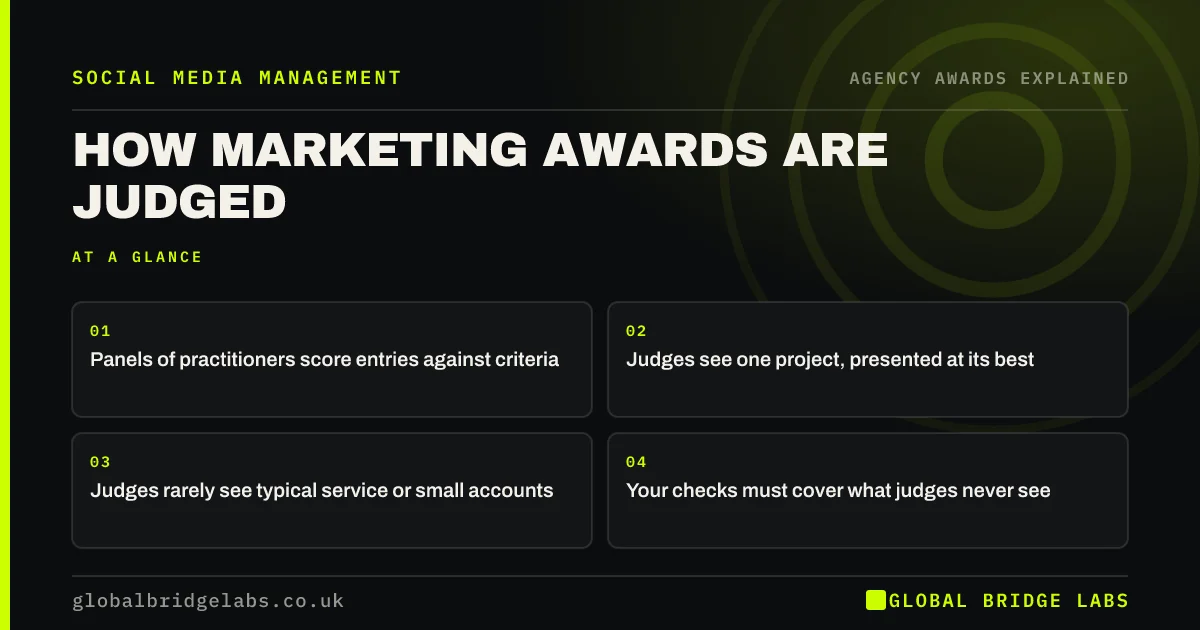
Marketing awards are usually judged by panels of industry practitioners who score written entries, case videos and evidence against published criteria. Judges see the agency's best account of one project. They rarely see the budget in detail, the client's other marketing, or how the agency treats smaller clients. That gap is what your own checks must fill.
- Panels of practitioners score entries against criteria.
- Judges see one project, presented at its best.
- Judges rarely see typical service or small accounts.
- Your checks must cover what judges never see.
Want help checking what an agency's award really covers? Message us on WhatsApp.
Chat on WhatsApp →How are marketing awards judged?
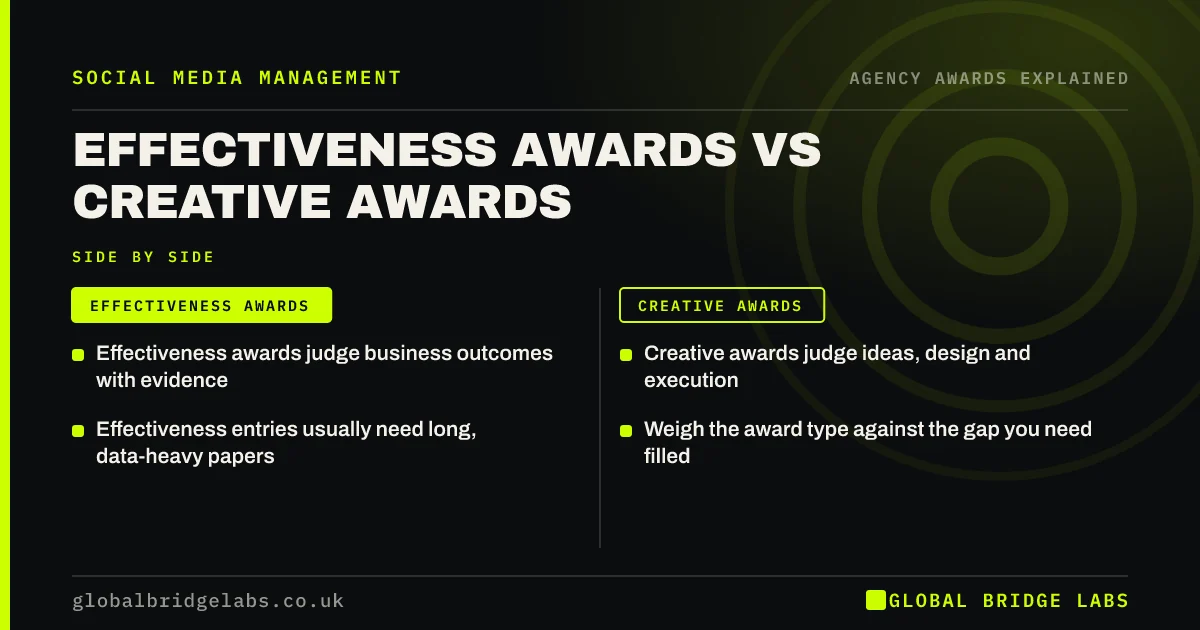
Most marketing awards use panels of senior practitioners who score entries against published criteria, such as strategy, creativity, execution and results, often in two rounds. Effectiveness schemes add detailed scrutiny of evidence. Creative schemes rely more on viewing the work. Criteria and weightings are usually listed on the scheme's website.
What do award judges actually see?
Judges see what the agency submits: a written entry, a case video, images and supporting data. The agency chooses what to include and how to frame it. Good schemes ask for evidence and may query claims, but judges still assess a curated story, not an audit of the whole agency.
- A written entry, often with word limits.
- A short case film or examples of the work.
- Results data selected by the entrant.
What do judges never see that you should check?
Judges never see the agency's average work, its smaller accounts, its response times, staff turnover or how it handles mistakes. These are exactly what decide your experience as a client. Use references, a meeting with the delivery team and a review of recent typical work to check them.
Want a list of checks that covers what judges miss? Message us on WhatsApp and we will discuss your requirements.
Chat on WhatsApp →When does the judging process make an award trustworthy?
An award is more trustworthy when the scheme publishes its criteria, uses independent judges, scores evidence of results and declares conflicts of interest. Schemes that publish winning papers let you read exactly what was claimed.
When does the judging process tell you little?
It tells you little when criteria are vague, when entrants can pay for higher placement, or when categories have so few entries that most entrants win something. Check how many entries a category had if the scheme publishes it.
What does this look like in practice?
A pattern we see: a buyer reads a published winning paper and finds the result came mainly from a price cut by the client. The agency's work still helped, but the paper makes the real contribution clearer than the trophy did.
Judging checklist
- Find the scheme's published judging criteria.
- Check whether results evidence was required.
- Read the winning entry if it is published.
- Ask what the entry left out.
- Check typical work, not only award work.
Next step
Pick the most impressive award an agency claims and find its judging criteria. You will know within minutes what it proves.
Message us on WhatsApp for an agency comparison, or book a 30-minute consultation.
Chat on WhatsApp →Sources and further reading
Frequently asked questions
Who judges marketing awards?
Most marketing awards are judged by panels of experienced marketers, agency leaders and client-side directors, sometimes with academics or researchers for effectiveness schemes. Judges usually declare conflicts of interest and step away from entries they are connected to. The scheme's website normally lists the judging panel for each year.
Can agencies influence award results?
Agencies influence results mainly through how well they write and present entries, which is legitimate. Reputable schemes guard against direct influence with conflict rules and multiple judges. Weaker schemes, especially paid rankings, may let spending affect placement. Read how each award is run before giving it weight.
Are award-winning case studies accurate?
Usually, because entries in reputable schemes can be queried and false claims damage reputations. But they are selective: they show the best framing of one project. Treat an award case study like any marketing claim, and ask the agency how the results were measured and what else affected them.
Written by

Global Bridge Labs (GBL) is a UK–Sri Lanka partner for social media, websites and BPO. Everything here comes from client delivery, not theory.